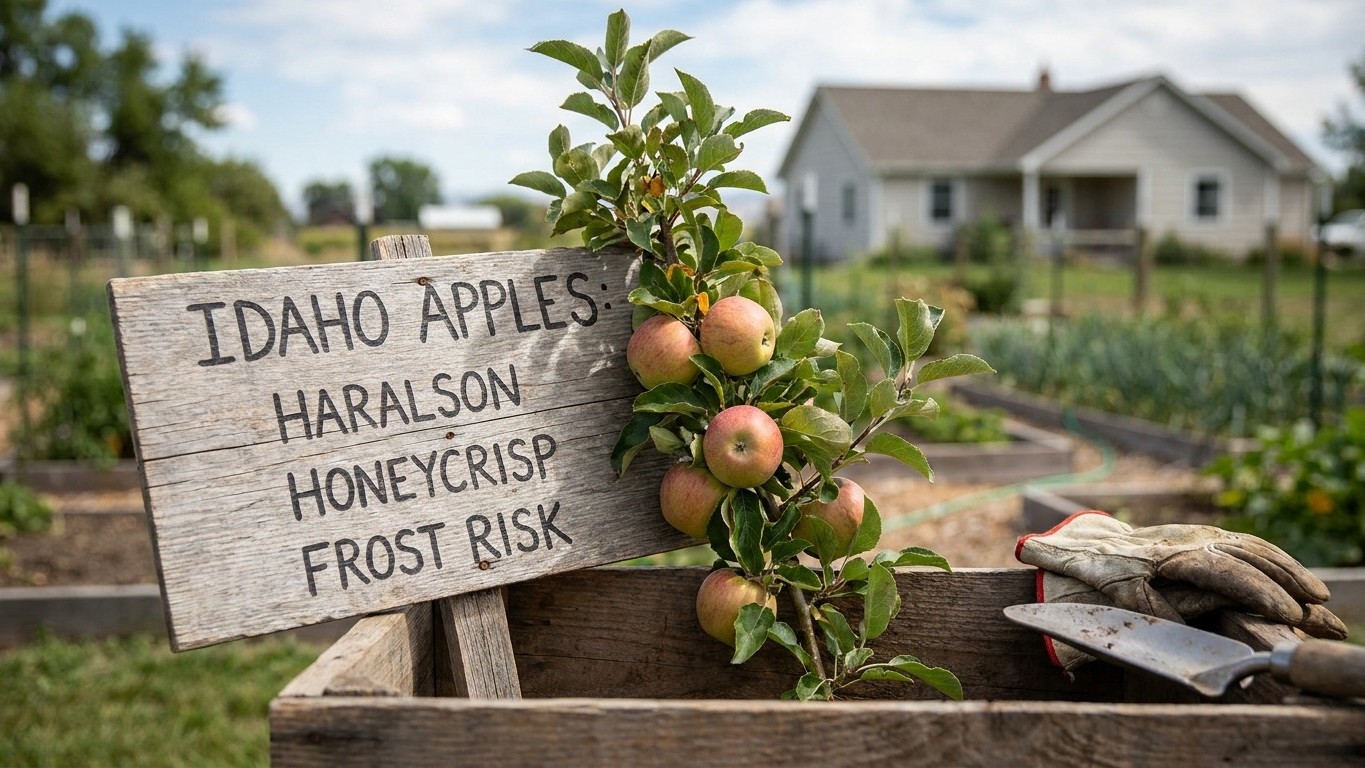

Idaho’s apple answer starts with the map, not the tree: find your spot between zone 3b and 7b before you pick anything else. Boise’s benches and valley floors sit at the mild end and forgive a lot; a mountain valley forty miles off, a thousand feet higher, does not. Go look up your own zone number first — everything else, variety, bloom timing, frost risk, only makes sense once you know which Idaho you’re actually growing in.
Can you grow apples in Idaho
Yes, and the state’s spread of hardiness zones is exactly why the answer needs a location attached. The USDA’s 2023 Plant Hardiness Zone Map puts Idaho at 3b to 7b, a range wide enough that a cultivar comfortable in one county can freeze out in another forty miles away and a thousand feet higher. NOAA NCEI’s 1991-2020 climate normals for the Boise reference station show the coldest month averaging a minimum of 24.0°F, a mild figure by Idaho standards and one that does not apply to the mountain valleys or the higher benches where winter lows run considerably harder.
Where the valleys make growing easier
The lower, irrigated valley floors, the Boise area among them, are where apples are grown most reliably in this state. They warm earlier in spring, hold heat longer into fall, and sit at the milder end of the statewide zone range. Higher ground and the northern mountain valleys sit at the colder end of that same 3b to 7b spread, and a grower there needs to lean on the hardiest cultivars and accept a shorter, later season rather than assume the whole state behaves like Boise.
None of this rules out apples anywhere in Idaho. It changes which cultivars belong on the list and how much frost protection the bloom needs, both covered below — timing that’s easiest to track against an Idaho apple Calendar. A grower at higher elevation who picks a hardy, late-blooming variety and plants it in a sheltered spot can produce a reliable crop even where the season runs short.
Which varieties suit this climate

Hardiness zone tells you whether the tree survives winter. It says nothing about whether it flowers properly, and that second filter, winter chill, is the one most guides skip. Apple trees need a minimum number of hours below about 45°F each winter to break dormancy evenly and bloom on schedule. A cultivar bred for the short, mild winters of the Deep South, given Idaho’s cold, gets more chill than it needs and simply blooms fine. A low-chill tree is never the risk here — for a rundown of cultivars matched to these conditions, see The Best Apple Varieties for Idaho. The risk runs the other way in only a handful of extreme southern states, and Idaho sits firmly at the long-chill end of the national range, so any cultivar sold for cold climates will meet its chill requirement without trouble.
Cultivars with published cold hardiness
The varieties below are commonly listed by nurseries as hardy to USDA zone 4 or colder, which covers most of Idaho’s inhabited valleys and a good part of its higher ground. Catalogue figures for bloom timing and chill hours are general and can shift by a week or two with the season, so treat them as a starting point rather than a promise.
| Variety | Published hardiness | Bloom timing | Chill requirement |
|---|---|---|---|
| Honeycrisp | Zone 3 to 8 | Mid-season | Moderate to high |
| Haralson | Zone 3 to 7 | Mid-season | High |
| Zestar! | Zone 3 to 7 | Early to mid-season | Moderate to high |
| Liberty | Zone 4 to 8 | Mid-season | Moderate |
| Enterprise | Zone 4 to 8 | Mid to late season | Moderate |
| Cortland | Zone 4 to 7 | Mid-season | Moderate |
Idaho’s growing conditions overlap a good deal with Montana’s, and a grower comparing notes with a neighboring cold-climate orchard will find the same short list of hardy cultivars coming up again, covered in more depth on Growing Apples in Montana: Varieties, Timing and Frost Risk. Treat the table above as catalogue-sourced starting points and confirm local performance with the extension office before committing an orchard to any one of them.
Planting a pair that works here
Most apple varieties will not set fruit reliably on their own pollen. You need two trees that bloom at the same time, with at least one of them producing fertile pollen, and ideally both. Among the cultivars named above, none are the sterile triploid types that occasionally show up in older catalogues, so any two from that list, matched for bloom timing, will pollinate each other without a third tree in the mix.
Practically, that means pairing mid-season bloomers with mid-season bloomers. Honeycrisp and Haralson overlap well, as do Liberty and Cortland. Zestar! blooms slightly earlier and pairs better with another early to mid-season variety than with a late bloomer like Enterprise, where the flowering windows may not line up closely enough for good cross-pollination in a short spring.
A grower who already owns an older triploid variety such as ‘Jonagold’ or ‘Winesap’, both known for producing little or no viable pollen, needs a third tree in the yard rather than assuming the triploid and its neighbor will pollinate each other. That third tree, or a crabapple with overlapping bloom, does the pollen work the triploid cannot.
The frost that costs a crop here

Around Boise, NOAA NCEI’s 1991-2020 climate normals put the last spring freeze at 32°F somewhere between April 23 and May 7, based on the 30 to 70 percent probability band at the Boise reference station. Elevation changes that window considerably. Higher valleys and northern Idaho run colder and later, so a grower there should treat the Boise figure as a floor, not a forecast for their own ground.
Why a frost after bloom is worse than one before it
The tree itself is tough. Dormant wood shrugs off far colder temperatures than a spring frost brings. The flowers are not. Once the buds show pink and especially once they open, a freeze in that same range that the tree tolerates without damage kills the blossom tissue outright. The tree leafs out fine, looks healthy all summer, and simply carries no fruit, because the flowers that would have become apples are already dead.
There is not much a home grower can do to stop a hard freeze once bloom is open. Covering small trees with frost cloth on a cold, clear night helps at the margins. Running orchard heaters or overhead irrigation is a commercial-scale response, not a backyard one. The more durable fix is choosing a late-blooming cultivar in a spot where the last frost date runs later or less predictable, since a variety that flowers after the risk window has mostly passed sidesteps the problem rather than fighting it every spring.
Frost risk of this kind is not unique to Idaho. Growers in New Brunswick manage a similar late-bloom, early-freeze squeeze on a shorter growing season, discussed on Growing Apples in New Brunswick: Varieties, Timing and Frost Risk, and the same logic, protect the bloom or choose around it, applies in both places.
The apple year in Idaho
Apple timing follows the tree’s stage, not a date on the calendar, and each stage should be read against this territory’s own frost dates rather than assumed from a national planting chart.
- Dormancy, through winter: prune while the tree is fully dormant and the wood is easiest to see, well before any bud movement.
- Green tip, as days lengthen: buds swell and show the first green. This typically happens well ahead of the Boise-area last frost window of April 23 to May 7, so the tree is not yet at risk from a normal spring freeze.
- Pink, days to a couple weeks before bloom: buds show color but have not opened. Frost sensitivity rises sharply from this point on.
- Bloom, often overlapping the Boise last-frost window: this is the highest-risk stage for frost damage to the crop, described above.
- Petal fall and fruit set, shortly after bloom: young fruit is still tender but less frost-sensitive than open flowers.
- Harvest, well before NOAA’s Boise-area first fall frost of October 7 to October 21 for most varieties, though a hardy late-season apple can hang closer to that window without harm.
A grower at higher elevation should expect every one of these stages to run later and the window between green tip and bloom to feel more compressed, since a shorter frost-free season pushes the whole sequence into a narrower stretch of the year.
Local help
For a variety list matched to your specific county and for current spray timing against regional pests and diseases, contact University of Idaho Extension. Extension offices track local bloom dates and pest pressure that a statewide guide like this one cannot, and their recommendations will be more precise than any published catalogue range for your particular elevation and soil.
Common questions
What USDA zone is Boise Idaho for apples?
Idaho as a whole spans USDA zones 3b to 7b on the 2023 map, and Boise sits toward the milder end of that range given its lower elevation. There is no single statewide zone number to quote, so check your own address on the USDA map rather than assuming Boise’s figure applies to your yard.
Can I plant just one apple tree?
Not reliably. Most apple cultivars need a second tree blooming at the same time to set a full crop, and a lone tree in a yard with no other apples or crabapples nearby will often flower heavily and bear very little. A flowering crabapple with overlapping bloom time can serve as the pollen partner if you only have room for one full-size apple tree.
Is northern Idaho different from southern Idaho for growing apples?
Yes, meaningfully. The frost dates and hardiness figures in this article come from the Boise reference station in the low southern valleys, and northern Idaho’s mountain valleys run colder with a shorter frost-free season. A grower farther north should lean on the hardiest cultivars in the table above and expect every stage of the apple year to run later.
When should I plant a bare-root apple tree in Idaho?
Plant while the tree is still dormant and before green tip appears, which gives the roots time to settle before the top growth demands water. The exact window shifts with elevation, so a grower at higher ground should expect to plant later than one in the Boise valley.
Do I need to spray my apple trees for pests and disease in Idaho?
Most home orchards need at least some disease and pest management, but the right products and timing depend on what is active in your specific area in a given year. That information changes season to season and county to county, so it is worth checking directly with University of Idaho Extension rather than relying on a generic national spray calendar.