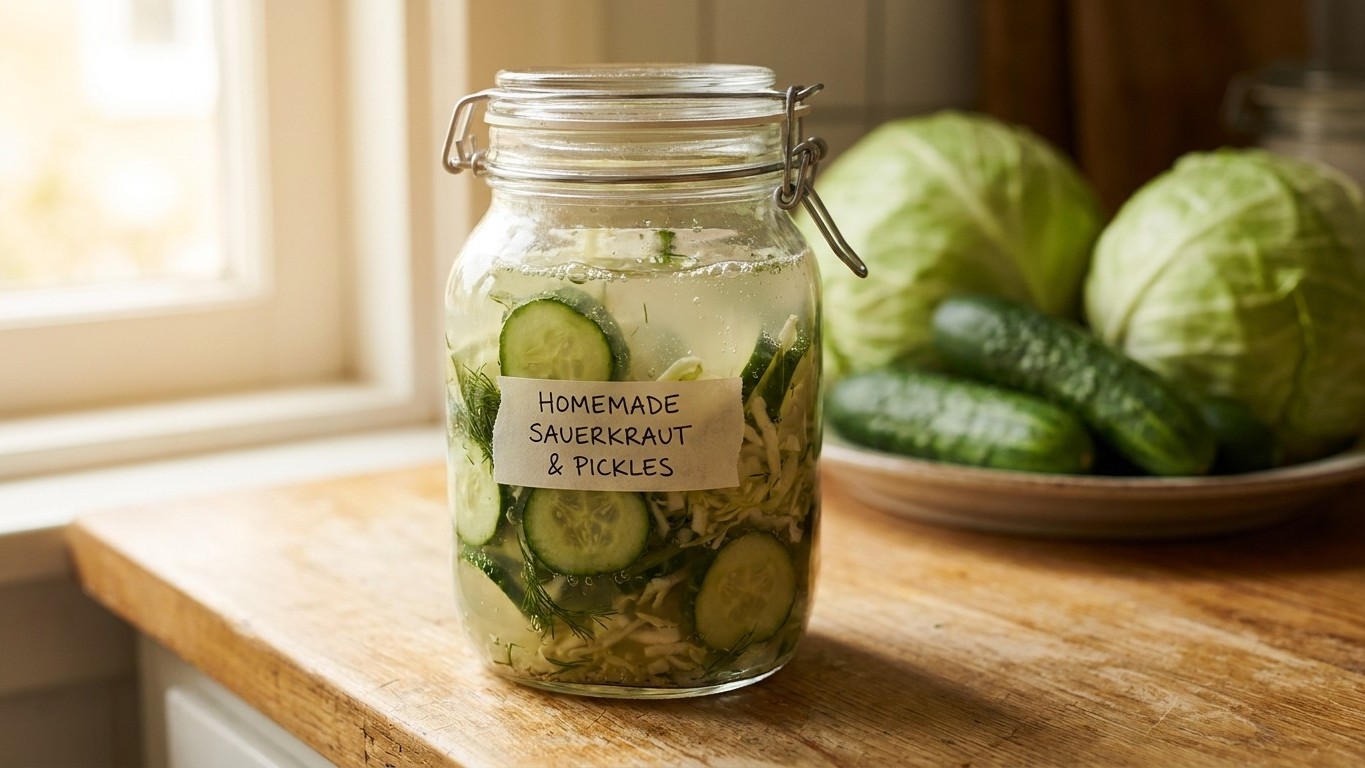

Fermenting is the odd one out in home food preservation: instead of you adding acid, salt, or heat to make a food safe, you set up conditions and let bacteria already present on the food do the work. Salt and time turn cabbage into sauerkraut, cucumbers into pickles, the food producing its own acid as it goes.
Fermenting

Fermenting relies on lactic acid bacteria that already live on fresh vegetables. Add the right amount of salt, keep the vegetable submerged in its own brine using proper Fermenting Containers, Covers and Weights, and those bacteria multiply while less tolerant organisms die off. Over days to weeks, the bacteria convert sugars in the vegetable into lactic acid, and knowing How Long a Ferment Takes, and What Tells You It Is Done is part of judging whether it’s finished. That acid is what shifts a food from one side of the safety line to the other, and it’s why sauerkraut and fermented pickles sit on the acid side of pH 4.6 even though the fresh cabbage and cucumbers they started as do not.
What fermenting does not do is cook the food, sterilize the jar, or replace a canner. A crock of fermenting cabbage isn’t shelf-stable on its own, and it isn’t safe from every hazard just because it smells sour. What the Salt Is Actually For in a Ferment is to select for the right organisms in the first place, favoring lactic acid bacteria over spoilage microbes and pathogens. That’s not a detail to play with, and Why You Cannot Change the Proportions in a Ferment comes down to exactly this issue. A brine that’s too weak lets the wrong organisms compete; a home cook guessing at a lower salt level to “cut the sodium” is changing the one variable that makes the whole process work, and understanding What Goes Wrong in a Ferment, and What Each Sign Means can help you tell a normal ferment from one that’s failed. The correct salt figure depends on the specific food and method, and that number belongs to a tested recipe from a reliable source, not a rule of thumb.
Fermenting versus other acid methods
Quick pickles and most commercial dill pickles get their acid from added vinegar, mixed in before jars ever go into a canner. Fermenting is different: no vinegar goes in at the start. The food generates the acid itself through bacterial activity, which is slower, less predictable in timing, and dependent on temperature, salt level, and how well the vegetable stays submerged. Once fermentation is finished and the food has reached a safe pH, it can then be canned for long-term storage, following a tested processing time for that finished product. The National Center for Home Food Preservation, run out of the University of Georgia, is the reference point for how that transition from ferment to canned jar should be handled, because timing, headspace, and process specifics vary by food and are not interchangeable.
Which foods this method suits
Whether a food needs fermenting, acidification, or a pressure canner comes down to where it lands relative to pH 4.6, the dividing line for the entire subject of home food preservation, as defined by the National Center for Home Food Preservation. Foods above that line are low-acid and require a pressure canner, which reaches 240 to 250 F. Foods at or below 4.6 are acid and can go into a boiling-water canner, which tops out at 212 F at sea level. Fermenting exists because it’s a way to push certain low-acid vegetables, mainly cabbage and cucumbers, over to the acid side before they’re ever canned.
- Acid foods (pH 4.6 or below): fruits, pickles, sauerkraut, jams, jellies, marmalades, and fruit butters. These can be safely processed in a boiling-water canner because their acidity already blocks the organism that matters most.
- Low-acid foods (above pH 4.6): red meats, seafood, poultry, milk, and nearly all fresh vegetables. These need the higher, sustained heat of a pressure canner, because a boiling-water bath never gets hot enough to eliminate the risk they carry.
Cabbage and cucumbers start out on the low-acid side of that line. Fermenting is the process that moves them across it, generating enough lactic acid that the finished sauerkraut or pickle qualifies as an acid food. Two crops complicate this picture without any fermenting involved: some tomatoes are now known to test slightly above pH 4.6, and figs do too, which is why both need added acid before they’re canned, regardless of how ripe or tart they taste. That’s worth remembering because tomatoes get treated casually in a lot of kitchens, as if their acidity is a given. It isn’t anymore, not with every variety.
What goes wrong
- The vegetable floats above the brine. Any part exposed to air can mold or spoil, and that risk grows the longer it sits uncovered. A weight that keeps the vegetable fully submerged, checked daily, prevents this.
- The brine is mixed by guesswork. Salt concentration is what selects for lactic acid bacteria over unwanted organisms; a weak or inconsistent brine invites the wrong microbes. Follow a tested ratio from the National Center for Home Food Preservation rather than eyeballing it.
- The ferment sits too warm or too cold. Temperature swings change the speed and balance of bacterial activity, sometimes favoring spoilage organisms over the ones you want. Keep the crock in a stable spot out of direct sun and away from heat sources.
- Cloudy brine or scum is mistaken for spoilage and the batch is tossed. Some cloudiness and a thin white film are normal in an active ferment. The remedy is knowing what normal fermentation looks like ahead of time, from a reliable reference, rather than guessing after the fact.
- A finished ferment gets canned using a random processing time. Whether it’s ready for the pantry depends on a tested time for that specific food, not a number carried over from a different recipe. Using an untested time is how safe-looking jars turn dangerous.
- Reduced-salt or “healthier” versions get tried without a tested recipe. Cutting salt to lower sodium sounds reasonable, but it undermines the exact mechanism that keeps the ferment safe. Stick to salt levels from a source built for food safety, not a general cooking blog.
Where the exact times come from
A processing time, a pressure, or a headspace figure is not universal. They change by food, jar size, and elevation, and the only place to get the right one is the National Center for Home Food Preservation page built for the specific item you’re fermenting and canning. Elevation matters too: water boils at a lower temperature as elevation rises, and a lower boiling temperature kills less, so the process time or canner pressure has to increase to compensate, according to the USDA Complete Guide to Home Canning (Agriculture Information Bulletin No. 539, NIFA-USDA).
The reason this matters so much comes down to one organism: Clostridium botulinum. It needs three things together to become dangerous: a moist, low-acid food, a temperature between 40 and 120 F, and less than 2 percent oxygen. A sealed jar of unprocessed or under-processed vegetables supplies all three without you knowing it. There’s no way to catch the problem by taste or smell, because the toxin it produces has neither. That’s the whole argument for using a tested time instead of an approximate one: by the time something seems wrong, it’s too late to tell.
Common questions
Can I ferment vegetables without salt?
Salt concentration is what favors the lactic acid bacteria that make fermenting safe, so skipping it or reducing it changes which organisms thrive in the crock. Use a tested salt ratio from the National Center for Home Food Preservation rather than fermenting without it.
How do I know when a ferment is done?
“Done” for fermenting means the food has developed enough acidity, which is a chemical endpoint, not a matter of taste alone. The National Center for Home Food Preservation’s instructions for each specific food describe how to recognize that point before moving to storage or canning.
Do fermented pickles still need to be canned?
If you want shelf-stable jars at room temperature, yes, a fermented pickle typically still goes through a boiling-water canner using a tested time for that product. If you’re keeping the ferment in the refrigerator instead, canning isn’t part of the picture, but refrigerator storage has its own limits on how long the food stays safe.
Is a bit of white film on the brine surface dangerous?
A thin white film is common during active fermentation and isn’t automatically a sign of spoilage. But because botulinum toxin can’t be detected by taste or smell, any doubt about a ferment’s safety should be resolved by comparing it against guidance from the National Center for Home Food Preservation rather than assuming it’s fine.