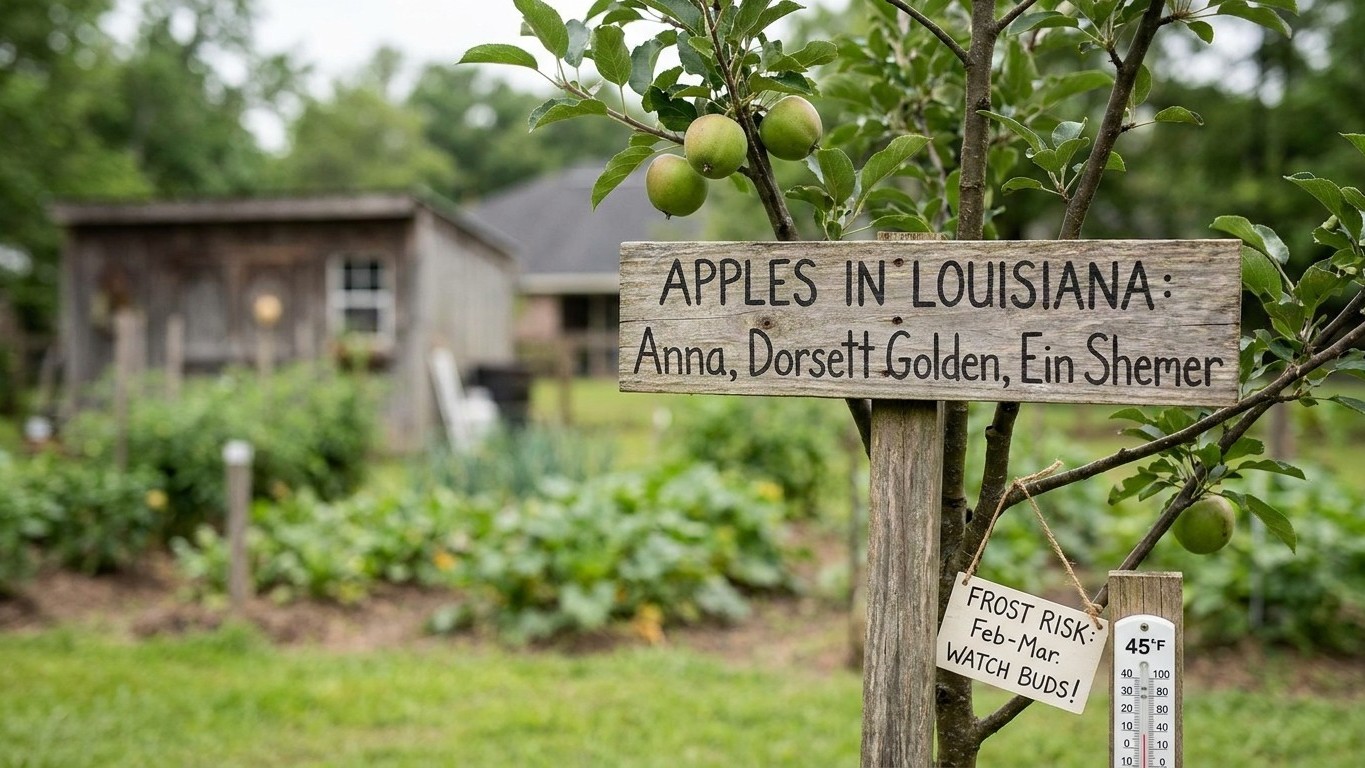

Apples grow in Louisiana, but the state’s warm winters make winter chill the real gatekeeper, not frost. NOAA’s 1991-2020 climate normals put the coldest month’s average daily low at just 44.7°F at the New Orleans reference station, far too mild to threaten a tree but also too mild to let a standard nursery apple leave dormancy and bloom well. Choose a low-chill cultivar bred for the Deep South, such as ‘Anna’ or ‘Dorsett Golden’, before you choose anything else, and see The Best Apple Varieties for Louisiana for the full rundown.
Can you grow apples in Louisiana
A Honeycrisp planted near New Orleans will leaf out fine and then bloom for weeks instead of days, a thin scattering of flowers instead of the tight burst that sets a real crop. That is not frost damage, and spraying or wrapping it won’t fix it. The real shortfall is chill hours, the cold the tree never got while dormant, and it is why so many backyard trees along the coast limp along for years without ever filling out a bushel basket.
What that mild winter does limit is chill accumulation, the hours a tree spends below roughly 45°F while dormant. An apple variety bred for New England or the upper Midwest simply will not get enough cold near New Orleans to break dormancy on schedule, and it responds with a thin, straggling bloom spread over weeks instead of a tight burst. That is a different kind of failure than frost damage, and it is the one that actually rules out most apple varieties in south Louisiana. Seeing how each stage lines up against the local chill and bloom window is easier with The Louisiana Apple Calendar, Stage by Stage.
North versus south Louisiana
The picture changes as you move north. Parishes in the Zone 8a band, away from the coastal influence, accumulate enough winter chill that a wider range of apple varieties can flower normally, though still nothing close to what a Zone 5 or 6 orchard in the upper Midwest gets for free. Growers near New Orleans, by contrast, are working at the extreme low-chill end of what the crop tolerates anywhere in the country, closer in practice to coastal Florida or south Texas than to a classic apple state. The reference figures in this article come from the New Orleans station, and a grower in Shreveport or the hill country of north Louisiana should expect a milder chill deficit and a longer list of workable varieties than the coast.
For contrast, a grower in South Dakota is fighting the opposite problem entirely, a hard, reliable winter that can kill flower buds and even whole trees in an unprotected spot, as covered in Growing Apples in South Dakota: Varieties, Timing and Frost Risk. Louisiana’s apple grower never has to think about that. The tree lives through winter without issue. The real question is whether it blooms tightly enough, and early enough ahead of summer heat, to actually set fruit.
Which varieties suit this climate

Winter chill, not cold hardiness, is the filter that matters most in Louisiana. Apple breeders publish a chill-hour requirement for each cultivar, the number of hours it needs below roughly 45°F to leave dormancy and bloom in a tight window rather than a ragged one. Louisiana sits at the low end of that scale for the entire apple-growing map, so the varieties worth planting here are the same low-chill types used across the coastal Deep South and Gulf Coast, not the standard nursery-catalog apples racked at most spring garden centers.
Skip the high-chill nursery favorites
‘Honeycrisp’ and other cold-country favorites carry chill requirements several times higher than what south Louisiana accumulates in an average winter, and planting one here usually means an erratic, sparse bloom rather than a dead tree. The tree can sit in a yard for years looking healthy and still never fruit reliably, which is a harder problem to diagnose than an outright failure.
Three cultivars come up again and again in low-chill growing guides for the Deep South: ‘Anna’, a Golden Delicious sport bred in Israel with a published chill requirement in the range of roughly 200 to 300 hours; ‘Dorsett Golden’, discovered in the Bahamas and rated even lower, often listed near 100 to 200 hours; and ‘Ein Shemer’, another Israeli selection with a similarly low requirement that also works as a reliable pollen source for the other two. All three ripen in early to mid summer under low-chill conditions, months ahead of the fall harvest familiar from northern apple country.
| Variety | Published chill requirement | Typical ripening | Role in the planting |
|---|---|---|---|
| ‘Anna’ | ~200-300 hours | Early to mid summer | Main fruiting variety, partly self-fertile |
| ‘Dorsett Golden’ | ~100-200 hours | Early to mid summer | Fruiting variety and pollenizer for ‘Anna’ |
| ‘Ein Shemer’ | ~100-200 hours | Early to mid summer | Reliable pollenizer, some fruit of its own |
These chill-hour figures are the published catalog ranges for each cultivar and hold regardless of state. What varies by location is how many of those hours a given site actually accumulates, and that is where the New Orleans figures above matter: a coastal winter delivers chill on the thin end of what even these low-chill cultivars need, while a colder site farther north has more room to spare. No source cited in this article is a Louisiana-specific extension variety trial, so treat these three names as a starting point and confirm current local performance with the LSU AgCenter before ordering trees.
Planting a pair that works here
Almost every apple variety needs a second tree blooming nearby to set a full crop, and the low-chill list for Louisiana is no exception. ‘Anna’ carries some self-fertility, but growers who plant it alone consistently get a lighter, patchier crop than one grown next to a second bloomer. The practical answer here is to plant ‘Anna’ with ‘Dorsett Golden’ or ‘Ein Shemer’, two cultivars that flower on a similar low-chill schedule and supply pollen that ‘Anna’ can actually use.
Watch for sterile-pollen triploids
Avoid leaning on a triploid variety as your only pollen source. A handful of well-known apples, among them ‘Jonagold’ and ‘Winesap’, produce pollen that is largely sterile, so they need two other varieties blooming nearby just to set their own fruit and contribute nothing useful back to the planting. None of the standard low-chill trio above has this problem, which is one more reason they dominate Deep South recommendation lists, but if you bring in an unfamiliar cultivar from a mail-order catalog, check whether it is listed as triploid before counting on it as your pollenizer.
A grower working through the much longer variety list available in a classic apple state, the kind covered in Growing Apples in Maryland: Varieties, Timing and Frost Risk, has dozens of pollen-compatible pairs to choose from across a normal bloom season. Louisiana’s low-chill list is short enough that the pairing decision is simple: plant two of the three named cultivars close enough for bees to move between them, and treat a single lone tree as a bonus crop rather than the plan.
The frost that costs a crop here

Frost in Louisiana is a spring-bloom problem, not a winter-survival problem, and it matters precisely because the state’s low-chill varieties bloom so early. NOAA’s NCEI 1991-2020 climate normals put the last spring freeze window at the New Orleans reference station between January 18 and February 8, based on the band where a 32°F freeze has a 30 to 70 percent chance of occurring. That window sits unusually early in the calendar compared with most of the country, and it overlaps almost exactly with when a low-chill apple like ‘Anna’ is likely to be in bloom during a mild winter.
The same NOAA data set puts the first fall freeze at New Orleans between December 17 and January 8, meaning the freeze season here straddles the New Year rather than sitting neatly inside winter the way it does farther north. A 32°F freeze occurs in only about 86.8 percent of years at this station, so roughly one winter in seven produces no freeze at all along the coast. Inland and northern parishes freeze more often and more reliably than this coastal figure suggests, and a grower there should expect a later, more clearly defined frost window than the one above.
Why a killed bloom looks like a healthy tree
The part of this that catches new growers off guard is what a frost actually kills. Once a flower bud has opened to the pink stage or further, a freeze does not damage the wood or threaten the tree’s survival. It kills the open flowers and the young pistil tissue inside them, and the tree leafs out normally a few weeks later looking completely healthy, just carrying no fruit for the year. There is no visible sign of the loss until midsummer, when the branches that should be carrying young apples are bare.
There is not much a home grower can do to protect an open bloom against a hard freeze beyond covering small trees overnight or running a sprinkler to coat buds in insulating ice, and both are only practical on trees small enough to reach easily. The more reliable protection is choosing a variety that blooms a little later relative to the local frost window in the first place, since a bloom that opens after the freeze risk has passed never needs protecting at all. That is one more reason the pairing decision above matters as much as the variety choice itself.
The apple year in Louisiana
The stages below follow the tree, not the month, and the trigger point in Louisiana is unusually early because of how soon the local low-chill varieties break dormancy. Anchor each stage against the New Orleans frost figures above and adjust for how far your own site sits from the coast.
Dormancy

The tree sits leafless through the coldest stretch of the year. This is the only stage where cold helps rather than threatens the crop, since every hour below roughly 45°F counts toward the chill total a low-chill variety needs to leave dormancy on schedule.
Green tip

Buds swell and show the first flecks of green. In a mild Louisiana winter this can arrive well before NOAA’s late-window date of February 8 for the New Orleans area, so check buds directly rather than assuming the freeze season is over just because the calendar says spring.
Pink

The bud shows pink petal tissue through a split husk, days before it opens fully. This is the stage where a late freeze does the most damage, since the tissue is exposed but not yet protected by full flower.
Bloom

Flowers open fully and pollinators move between the trees in the pair. Overlap between your fruiting variety and its pollenizer matters more than exact timing, and a warm run of days can compress the whole bloom into under a week.
Petal fall

Petals drop and the small green swelling behind each flower is the fertilized ovary, the first visible sign that pollination worked. A freeze at this stage is less catastrophic than one at pink, but a hard one can still abort the young fruit.
Fruit set

Fruit that survives petal fall begins sizing. Thin crowded clusters down to one or two apples each so the tree isn’t carrying more fruit than a Louisiana summer’s heat and humidity can size and ripen well.
Harvest
Low-chill varieties like ‘Anna’ and ‘Dorsett Golden’ typically ripen in early to mid summer under Deep South conditions, months ahead of the fall harvest familiar from northern apple country. Pick by taste and background color change rather than by date, since a warm spring pulls the whole schedule earlier.
Local help
For a current list of low-chill apple varieties that have actually performed in state trials, along with spray timing suited to Louisiana’s humidity and disease pressure, contact the LSU AgCenter, the state’s land-grant extension service. A local county agent can also help estimate how much winter chill your specific parish accumulates in an average year, which is the single number that decides whether a given cultivar is worth planting at all.
Common questions
Will an apple tree from an out-of-state nursery grow here?
It will probably survive since cold isn’t the issue, but it may bloom poorly or not at all if it’s a high-chill variety bred for a northern state. Check the plant tag for a chill-hour rating before buying, and favor ‘Anna’, ‘Dorsett Golden’ or ‘Ein Shemer’ if none is listed.
How much fruit will one low-chill apple tree actually produce here?
Expect a lighter, more variable crop than the same variety grown deeper into its ideal low-chill range, with production tied closely to how mild or unusually cold each individual winter runs. No Louisiana-specific yield figures are available, so treat early harvests as a learning year rather than a benchmark.
Is fire blight a problem for apples in this humidity?
It can be. Fire blight is a bacterial disease that spreads fastest during warm, humid, wet bloom periods, which describes a typical Louisiana spring more often than a typical northern one. Prune out infected wood promptly and ask the LSU AgCenter about current spray recommendations for your area.
Can I grow a low-chill apple in a container on a patio?
Yes, but a dark container in full Gulf Coast sun heats up fast and stresses roots in summer, so use a large pot, light-colored if possible, and water more often than you would for an in-ground tree. A container also accumulates less winter chill than the same spot planted in the ground, which works against you rather than for you here.
Do young apple trees need staking against hurricanes or tropical storms?
A young tree with a small root system benefits from a stake through its first year or two regardless of storm risk, and it’s worth checking ties before named storm season each year. Low-chill apples are often sold on dwarfing rootstock, which keeps the tree shorter and somewhat less exposed to wind than a full-size standard tree.