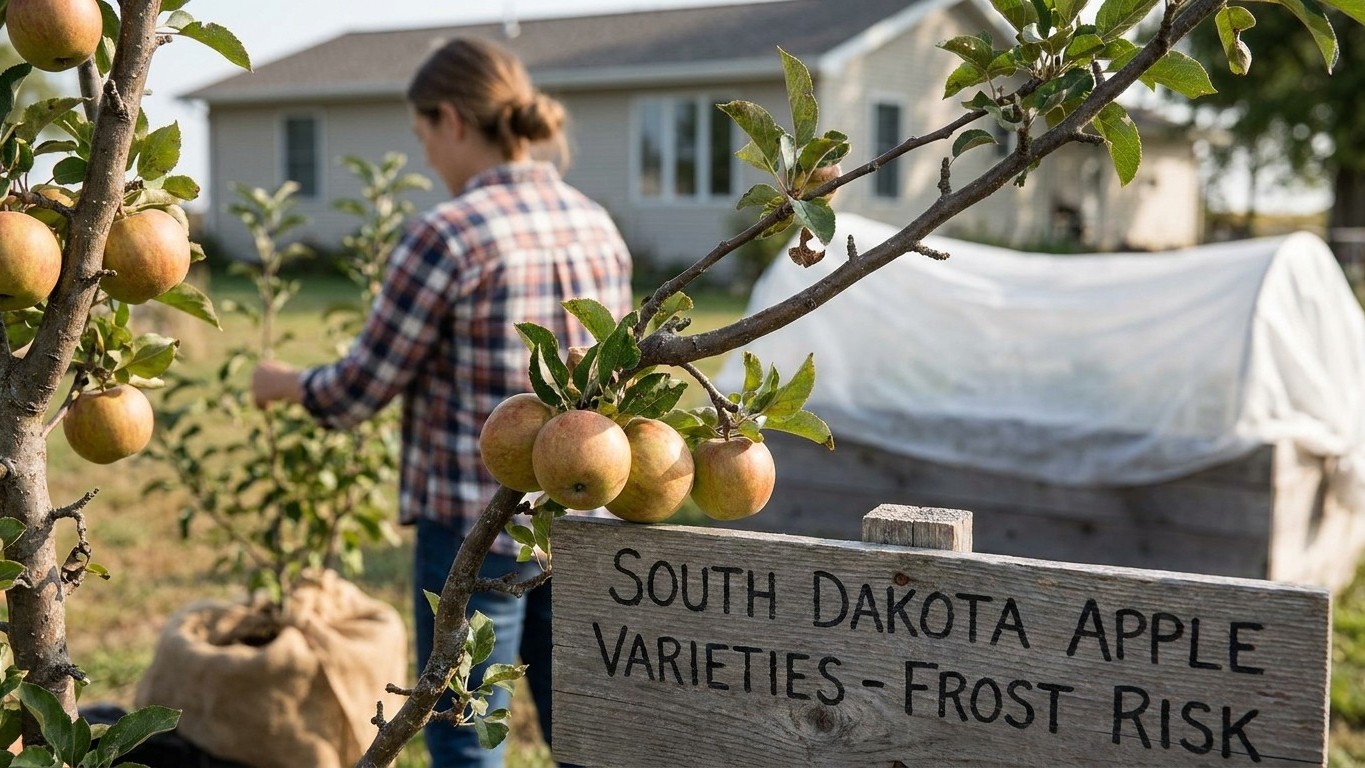

Zone 3b conditions on the high prairie near the North Dakota line explain more about whether your apple tree survives than any planting tip ever will. South Dakota spans USDA zones 3b to 5b, and that spread is the whole story: a variety thriving in a sheltered Sioux Falls yard, where the coldest-month low averages 6.9°F, can die outright two counties north. Apples don’t need a long season here — they need a winter they can survive. That’s the deciding factor, so check your county’s zone before you pick a variety.
Can you grow apples in South Dakota
Yes, and growers do it from the Missouri River valley to the shelterbelts of the northern prairie. The USDA Plant Hardiness Zone Map (2023, based on 1991-2020 normals) places South Dakota across zones 3b to 5b, a range wide enough that a variety doing fine in a sheltered Sioux Falls yard can struggle two counties over. NOAA’s NCEI 1991-2020 climate normals put the mean daily minimum of the coldest month at the Sioux Falls station at 6.9°F, a useful figure because it reflects a typical cold month, not a single record night.
That number comes from one airport station in the state’s southeast corner. Winters get colder and the frost-free window shorter moving north and west, toward the Black Hills foothills and the high prairie near the North Dakota line, where zone 3b conditions are common. The southeastern river valleys, sheltered by bluffs and sitting toward the milder end of the state’s range, are where apple growing is most forgiving. If you garden outside the Sioux Falls area, look up your own county’s zone on the USDA map before choosing a variety, and consult The Best Apple Varieties for South Dakota to match your zone to a tree. It’s a five-minute check that saves years of waiting on a tree that was never going to make it.
What makes apples workable here at all is that the crop doesn’t need a long, hot season the way a tomato does. It needs a tree that survives the winter and a bloom that lines up with a frost-free window, however short. Cold-hardiness in the wood and the flower buds matters more here than season length. A tree that shrugs off a 6.9°F January but blooms into a frost pocket still loses its crop, so survival and timing have to be answered as two separate questions. The next section covers survival, and a South Dakota apple Calendar can help you track the frost timing further down.
Snow cover and shelter change the practical picture more than the map alone does. A tree planted against an exposed slope with no windbreak on the northwest side experiences winter minimums closer to the open-prairie extreme than to the Sioux Falls average, because wind strips away insulating snow and desiccates bark. Growers who plant on the north or east side of a building, or behind a row of conifers, buy themselves real margin without changing variety at all. On the coldest sites, seedling or ‘Antonovka’ rootstock, both published as tolerant well below zero, holds up better than the dwarfing rootstocks bred for milder regions.
Which varieties suit this climate

The hardiness range that rules out a tree matters more here than flavor preference, and the shortlist of apples bred to survive zone 3b to 4 winters is well documented by the breeding programs that produced them, mostly the University of Minnesota and the Canadian prairie programs. ‘Haralson’, ‘Wealthy’, ‘State Fair’, ‘Fireside’, ‘Sweet Sixteen’, ‘Zestar!’ and ‘Norland’ all carry published hardiness to zone 3, and ‘Honeycrisp’, also a University of Minnesota introduction, is rated to zone 3 despite its wide popularity in milder states.
| Variety | Published hardiness | Typical ripening | Notes |
|---|---|---|---|
| ‘State Fair’ | Zone 3 | Late summer | Early ripener, useful for a short season |
| ‘Zestar!’ | Zone 3 | Late summer | University of Minnesota release, crisp and tart-sweet |
| ‘Wealthy’ | Zone 3 | Early fall | Old prairie standard, reliable bearer |
| ‘Honeycrisp’ | Zone 3 | Early fall | Needs good air circulation to limit disease |
| ‘Haralson’ | Zone 3 | Fall | Minnesota-bred, keeps well in storage |
| ‘Sweet Sixteen’ | Zone 3 | Fall | Unusual cherry-like flavor, hardy wood |
| ‘Norland’ | Zone 2b-3 | Late summer | Among the hardiest, suited to the coldest sites |
Winter chill runs the other direction here
Winter chill is the filter most guides skip, and it works opposite to hardiness. A tree needs a certain number of hours below roughly 45°F while dormant before it breaks bud and flowers evenly. Too little chill, and a tree bred for a mild climate planted somewhere colder blooms thin and ragged. That isn’t South Dakota’s problem. Winters here run long and cold enough that every variety on this list accumulates far more chill than it needs well before spring arrives. South Dakota sits at the high-chill end of the spectrum, not the low end, so chill deficiency isn’t something a grower here has to plan around. A grower in a warmer state, Kentucky for instance, has to think about the reverse problem, choosing a variety whose chill requirement actually gets met by a shorter, milder winter. See how that plays out in Growing Apples in Kentucky: Varieties, Timing and Frost Risk.
No SDSU Extension list singles out specific cultivars for South Dakota conditions in what’s published online, so treat the varieties above as a hardiness-and-chill shortlist drawn from the breeding programs’ own published ratings, not a state recommendation. Growers just across the border in Wisconsin work from much the same short list of cold-hardy northern varieties, for the same reasons of hardiness and chill. See Growing Apples in Wisconsin: Varieties, Timing and Frost Risk for how that state’s growers apply it.
Planting a pair that works here
An apple tree does not reliably set fruit on its own pollen, so a single-tree planting mostly gets you blossoms and no apples. You need two varieties in flower at the same time, close enough for bees to move between them, and at least one of them has to produce fertile pollen. A handful of popular apples, including some cold-hardy types, produce little or no usable pollen themselves and need two other varieties nearby, not just one, to fruit at all.
Among the varieties that suit this climate, pairing is straightforward because most bloom in roughly the same window. ‘State Fair’ and ‘Zestar!’ bloom early and match well together. ‘Wealthy’, ‘Haralson’ and ‘Honeycrisp’ bloom in the middle of the local season and cover each other. ‘Sweet Sixteen’ overlaps with ‘Haralson’ closely enough to pair in most years. If you already have an older tree of unknown variety on the property, a flowering crabapple such as ‘Dolgo’, which blooms across a wide window and produces abundant fertile pollen, works as a reliable backup pollenizer for almost any of the varieties above.
Check the pollen fertility of any variety before you build a two-tree planting around it, especially older heirloom names picked up at a farm sale or a plant swap. A tree with sterile pollen planted as half of a two-tree orchard leaves both trees blooming and barren, with the mistake obvious only after the first year that should have carried fruit. Keep the two trees within the same yard rather than at opposite ends of a large property. Bee traffic between them drops off with distance, and a windbreak or a building between the two cuts pollinator visits further still.
The frost that costs a crop here

NOAA’s NCEI 1991-2020 climate normals put the last spring frost at the Sioux Falls airport station in the window of April 29 to May 9, based on the 30 to 70 percent probability band for a 32°F freeze. That’s the reference figure for the state’s southeast corner. Gardens outside town, in low-lying or rural sites away from the airport’s heat-holding pavement, typically see their last frost run one to two weeks later than that window, and growers farther north or at higher elevation should expect it later still. Check your own county’s normals rather than assuming the Sioux Falls dates apply where you garden.
Why a late frost costs the crop, not the tree
A hard freeze in January tests the wood and the dormant buds, and a hardy variety survives it without damage. A frost that arrives after the buds have opened to the pink stage or into bloom is a different event entirely. It kills the open flowers, and with them the entire year’s crop, while leaving the tree itself completely healthy. The tree looks fine every spring; the crop can still fail if bloom happens to land inside that late-April to early-May frost window and a cold night follows.
There’s not much a home grower can do to stop a hard freeze once blossoms are open. Covering a small tree overnight with a bedsheet or frost cloth, weighted at the ground so heat doesn’t escape, can buy a few degrees on a still night, but it does little in wind or in a hard freeze. Running sprinklers through the coldest hours, the trick commercial orchards use, isn’t practical on a backyard scale. The more durable fix is choosing a variety that blooms later in the sequence to begin with, since a bloom pushed even a few days past the frost window is worth more than any overnight scramble to protect open flowers already showing color.
Site selection helps more than most growers expect. Cold air is heavier than warm air and drains downhill overnight, pooling in low spots and depressions where frost settles hardest and lingers longest. Planting on a gentle slope, or on the upper half of a yard rather than the bottom of a swale, can be the difference between a bloom that survives a marginal night and one that doesn’t.
The apple year in South Dakota
Timing an apple tree’s care around the calendar month is less useful than timing it around the tree’s own stage, because a cold spring or a warm one shifts every stage by a week or more in either direction. Anchor your own observations against the Sioux Falls frost dates above and adjust for your county.
- Dormancy (roughly November through March): the tree is fully hardened off. This is the window for pruning, since cuts close over before growth resumes, and for planting bare-root trees once the ground can be worked.
- Green tip (early to mid April at Sioux Falls): buds swell and show the first green. Frost risk to the buds is still fairly low at this stage, and it’s the last point for a dormant-oil spray against overwintering insect eggs.
- Pink (mid to late April): the flower shows color before opening. This stage and bloom are the most frost-sensitive of the year, and they land close to or inside NOAA’s April 29 to May 9 last-frost window at Sioux Falls, which is exactly why a late cold snap does the most damage here.
- Bloom and petal fall (late April into May): open flowers need pollinator visits within a few days, and this is when a late frost costs the crop rather than the tree, as covered above.
- Fruit set (mid to late May): small fruitlets form, followed a week or two later by a natural thinning drop. Thin the remaining clusters to one fruit each if the tree set heavily, to avoid small, weak apples come fall.
- Harvest (August through October, by variety): early types like ‘State Fair’ and ‘Zestar!’ come off in late summer, while ‘Haralson’ and ‘Fireside’ hang later into fall. Get the crop in before NOAA’s first fall frost window of September 24 to October 4 at Sioux Falls, earlier if you’re farther north or at higher ground.
Keep a written note of the date each stage actually arrives on your own trees for a few years. That personal record, checked against the Sioux Falls normals rather than replacing them, becomes a better predictor of your own frost risk than any regional average.
Local help
For a list of varieties trialed under South Dakota conditions, current spray timing, and pest and disease bulletins specific to the state, contact South Dakota State University Extension at extension.sdstate.edu. Extension offices track local outbreaks of fire blight and apple scab and can tell you what’s active in your county before you buy a fungicide you may not need.
Common questions
Can I grow an apple tree in a container in South Dakota?
You can, but a container gives the roots far less insulation than open ground, and a South Dakota winter can freeze a container root ball solid enough to kill the tree even when an in-ground tree of the same variety comes through fine. Sink the container into a trench for winter, or move it into an unheated garage or shed, if you’re growing this way.
Do young apple trees need winter protection the first few years?
Yes, more than mature trees do. Wrap the trunk with a light-colored tree guard to prevent sunscald and rodent gnawing, and mound mulch, not soil, around the base once the ground starts to freeze. Pull the wrap off in spring once nighttime temperatures stay reliably above freezing so the bark can breathe again.
What rootstock should I ask for at the nursery?
For the coldest sites, seedling rootstock or ‘Antonovka’ tolerates root-zone cold better than dwarfing rootstocks such as M9 or M26, which were bred for milder regions and can suffer root damage in an open winter with little snow cover. A full-size or semi-dwarf tree on hardy rootstock is the safer choice on an exposed site, even though it takes longer to bear and grows larger.
My tree bloomed heavily but set almost no fruit. What happened?
The most common cause is a pollination gap: no second variety blooming nearby, or a late frost that knocked out the flowers before bees could work them. Cold, wet weather during bloom also keeps bees from flying even when both the flowers and the pollenizer tree are fine, so a run of bad-weather bloom days can look like a tree problem when it’s really a timing problem.
When’s the right time to plant a new apple tree in spring?
Plant bare-root trees while they’re still dormant, as soon as the ground can be worked, rather than waiting for the last-frost date to pass. The tree doesn’t need frost-free air until it starts pushing green growth, and planting early lets the roots settle into cool soil before summer heat arrives. If you’re planting a potted tree that’s already leafing out, wait until the immediate frost risk in your area has passed.