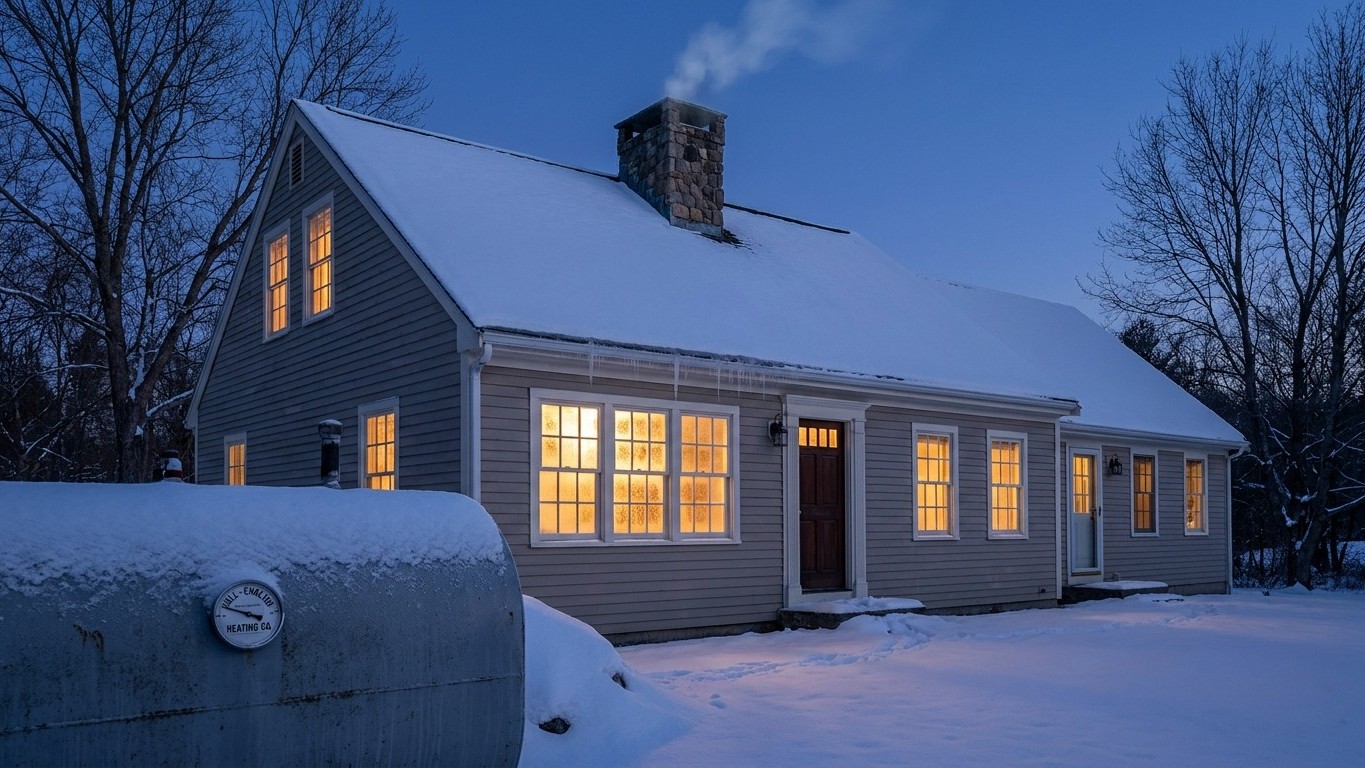

Winter in Massachusetts runs long rather than brutal: the coldest month averages a low of 23.1°F, which puts the state’s furnaces and wood stoves to work for months at a stretch. Here’s what that means in practical terms, and what a cord of wood actually delivers when you’re the one feeding the fire.
How cold it gets, and for how long

The coldest month in Massachusetts, measured at the Boston reference station, has an average daily low of 23.1°F. That’s not a record-cold snap and it’s not the monthly average either. It’s the typical overnight low during the harshest stretch of winter, and it’s the number that tells you what your heating system is actually up against night after night.
That figure sits in a middle zone. It’s cold enough to demand a heating system that runs reliably for months, but it’s not the kind of extreme where pipes freeze solid in a single afternoon or where a furnace failure becomes a life-safety emergency within hours. The bigger issue in Massachusetts isn’t how low the mercury drops, it’s how long it stays down there.
A New England heating season typically stretches from October into April, sometimes longer at higher elevations in the Berkshires or up toward the New Hampshire border. That’s six months, give or take, of a furnace or stove cycling on and off, or a wood fire that needs tending daily. For a closer look at when that season kicks off and how it’s determined, see When Does the Heating Season Start in Massachusetts? and, just as importantly, When Can You Turn the Heat Off in Massachusetts? Compare that to a two-month deep freeze in a place like Minnesota, and you get a different kind of stress on equipment: less about surviving a single brutal week, more about total hours of run time across an entire season.
For homeowners, this changes the math on what matters. A furnace with a slightly lower peak output but excellent efficiency over long, moderate-cold runs often beats one built to blast through short, extreme cold snaps. Same logic applies to wood heat: a stove that holds a steady, moderate burn through a long evening does more good here than one designed for short, intense bursts.
What a cord of wood is worth here
A cord of well-seasoned hardwood delivers about 20 million BTU, according to Michigan State University Extension. That’s the average for good, dry hardwood, and it moves quite a bit depending on species and how dry the wood actually is when it goes into the stove.
The word “cord” itself is where most firewood buyers get burned, so to speak. A cord isn’t a weight and it isn’t a truckload; it’s a specific volume: a stack measuring 4 feet by 4 feet by 8 feet, which works out to 128 cubic feet. Anything smaller, a “face cord” or a “rick,” is a fraction of that and should cost a fraction of the price. Ask for the dimensions of what’s being delivered, not just the word “cord.”
| Measurement | Value |
|---|---|
| Cord dimensions | 4 ft x 4 ft x 8 ft |
| Total volume | 128 cubic feet |
| Heat output (seasoned hardwood) | about 20 million BTU |
MSU Extension frames that 20 million BTU in terms a homeowner can actually use: a single cord of well-seasoned hardwood is roughly equivalent to 145 gallons of #2 fuel oil, or 215 gallons of LP gas. That’s a useful yardstick when you’re trying to figure out how many cords you’ll need to get through a Massachusetts heating season that can run six months long.
Density is the whole game here. A cord of dense hardwood packs more actual wood mass into that 128 cubic feet than a cord of a lighter species, so it burns longer and hotter for the same stack size. That’s why two cords sitting side by side, both measured out the same, can heat a house very differently depending on what’s actually in the pile.
How long wood takes to dry in Massachusetts
Firewood needs to reach roughly 20 percent moisture or less before it burns efficiently. Green wood fresh off the tree can sit above 60 percent moisture, and that water has to boil off before the wood gives up any real heat. Every bit of energy spent evaporating water is energy that isn’t warming your living room.
Split and stacked properly, most hardwood reaches that 20 percent threshold after a full summer of drying, roughly six to twelve months depending on the species and how the wood was handled. The key words there are split and stacked. Rounds left whole, or wood piled in a heap with no airflow, dry far more slowly, sometimes not at all before winter arrives. MSU Extension singles out red oak as a notable exception: its cell structure makes it dry more slowly than most other hardwoods, so it needs extra time on the stack before it’s ready to burn.
Burning wood before it’s properly seasoned is a common mistake, and it costs a household in more than one way. Wet wood produces less usable heat because so much energy goes into boiling off moisture instead of warming the house. It also burns cooler and dirtier, which means more creosote building up inside the flue. That’s not just an efficiency problem, it’s a maintenance one: a chimney that’s regularly fed green wood needs sweeping more often, and creosote buildup is a real fire risk if it’s left unchecked.
The practical fix is simple, if not always convenient: split your wood early, stack it somewhere with good airflow and some sun exposure, and plan at least one full summer of drying time before you count on it for winter heat. If you’re buying wood rather than cutting your own, ask the seller how long it’s been split and stacked, not just when it was cut.
Where to check before you buy
Massachusetts stretches from sea-level coastal towns to the higher, colder terrain of the Berkshires, and the figures above describe conditions at the Boston reference station, not every town in the state. Elevation, exposure, and local microclimates all shift the numbers somewhat, sometimes meaningfully if you’re heating a house up in the hills rather than along the coast.
For guidance specific to your area, the UMass Extension is the right first stop. They can speak to which firewood species are commonly available regionally, how local drying times might differ from the general figures above, and any seasonal burn restrictions that might apply where you live.
Burn rules in particular are worth checking every year rather than assuming last winter’s guidance still holds. These regulations are set at the local level, often by town or county, and they can change from season to season based on air quality concerns or fire risk. What was allowed last winter isn’t guaranteed to be allowed this one, so a quick call or visit to your local extension office before stocking up is time well spent.
What each heat source costs to run in Massachusetts
At Massachusetts’s average residential prices, this is what one million Btu of heat delivered into the house costs with each system. It compares fuels on the same unit: it is not a yearly bill, and it leaves out the price of the equipment.
| System | Cost per million Btu delivered |
|---|---|
| Electric resistance (baseboard, 100% efficient) | $88.34 |
| Heat pump at 8.1 HSPF2 (seasonal COP about 2.4) | $37.21 |
Cheapest to run in Massachusetts: heat pump, $51.13 less per million Btu than the electric resistance.
Prices: U.S. Energy Information Administration (EIA), average residential prices. Efficiencies: ENERGY STAR criteria. A heat pump’s figure is a seasonal average; in the coldest weather its efficiency drops.