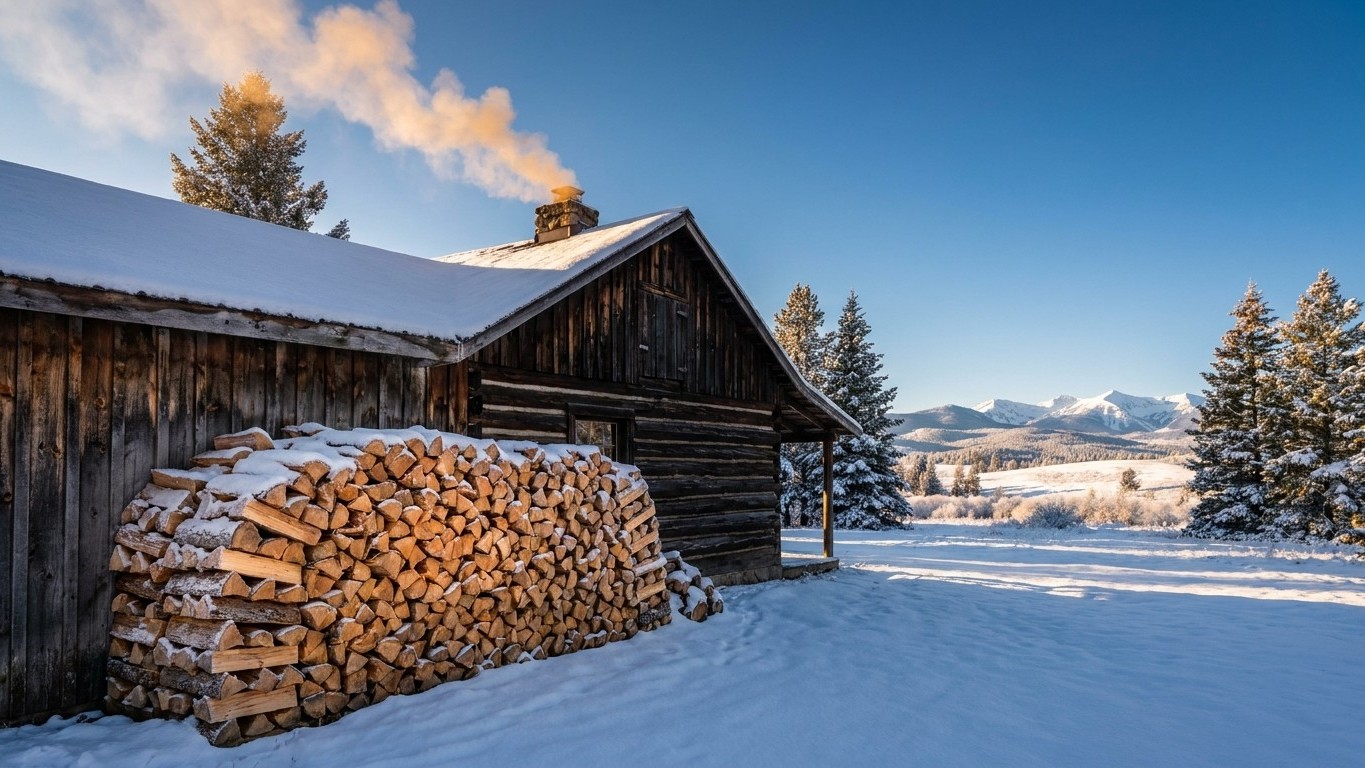

Montana winters ask a lot of a heating system, and the numbers back that up. Billings sits at a coldest-month minimum of 17.9°F, which sounds manageable until you factor in how long that cold sticks around. Here’s what that actually means for wood supply, seasoning time, and the decisions a household needs to make before the first snow.
How cold it gets, and for how long

The mean daily minimum for the coldest month in Billings runs 17.9°F, according to NOAA’s 1991-2020 Climate Normals. That’s not a record low and not a monthly average, it’s the number that decides whether a heating setup is keeping pace or falling behind on a typical night. Seventeen degrees isn’t brutal by mountain-state standards, but the length of the season is where Montana separates itself from milder territories.
A furnace or wood stove here isn’t dealing with a six-week cold snap. It’s dealing with months of sustained demand, starting well before Halloween in higher elevations and often running into April. That changes the math on everything from insulation to fuel storage. A house that would coast through a short, sharp winter elsewhere needs enough reserve, enough dry wood, enough furnace capacity, to run steady for the long haul.
Why duration matters more than the low
Two winters can share the same coldest night and still cost completely different amounts to heat through. A four-month season sitting near freezing puts more cumulative demand on a system than a two-month season with a sharper dip and a faster thaw. Montana’s winter is the former: long, consistent, grinding. That’s the detail that should drive equipment sizing and fuel planning, not the headline low.
For wood burners specifically, this means the supply calculation isn’t “enough for a cold week.” It’s enough for a season that doesn’t let up. That’s where the cord comes in.
What a cord of wood is worth here
A cord is a volume, not a weight, and that distinction is where a lot of firewood buyers get shorted. The standard measure is a stack 4 feet by 4 feet by 8 feet, which comes out to 128 cubic feet. Anything smaller than that, a “face cord” or a loosely thrown truckload, isn’t a cord even if it’s sold as one.
According to Michigan State University Extension, a cord of well-seasoned hardwood delivers about 20 million BTU. That’s an average, not a guarantee, since species and moisture content shift the number considerably. MSU frames it in terms a homeowner can actually use: one cord is roughly equivalent to the heat from 145 gallons of #2 fuel oil, or 215 gallons of LP gas.
| Measurement | Value |
|---|---|
| Dimensions | 4 ft x 4 ft x 8 ft |
| Volume | 128 cubic feet |
| Heat output (seasoned hardwood) | about 20 million BTU |
| Fuel oil equivalent | roughly 145 gallons |
| LP gas equivalent | roughly 215 gallons |
In a heating season as long as Montana’s, that 20 million BTU figure gets stretched across months, not weeks. How far it actually goes depends on the house, the stove, and, more than either of those, whether the wood was dry when it went into the firebox. Green wood spends a huge share of its potential heat just boiling off the water still trapped in the cells, and that’s before a single BTU makes it into the room.
How long wood takes to dry in Montana
Seasoning time isn’t a fixed number stamped on a species chart. It’s climate-dependent, tied to humidity and summer heat, which is exactly why a figure that works in the Southeast doesn’t automatically apply in Montana. MSU Extension’s benchmark is moisture content: firewood should burn at 20 percent moisture or less, while green wood coming straight off the tree can sit above 60 percent.
Getting from that green state down to 20 percent typically takes one full summer, but only if the wood is split and stacked so air can move through it. Rounds left whole, or wood piled without airflow, dry far slower and can still be wet come burning season. Red oak is the named exception in MSU’s guidance: its cell structure makes it dry more slowly than most species, so it needs extra time on the stack, not just extra months on a calendar.
What happens when wood goes in too soon
Burning wood before it’s ready doesn’t just mean a weaker fire. The energy that should be heating the house instead goes into vaporizing residual water, which lowers the flame Temperature and produces more smoke. That smoke condenses in the flue as creosote, and a heavier creosote buildup means a chimney that needs sweeping sooner and, in the worst case, a higher risk of a chimney fire. None of this requires drama to explain, it’s simple thermodynamics: wet fuel burns cooler and dirtier, full stop.
The fix is unglamorous but effective. Split the wood, stack it loosely with airflow on all sides, and give it a full summer before it goes into the woodpile that gets burned. For red oak, plan on more time.
Where to check before you buy
The figures above describe Billings, the NOAA reference station for this territory, but Montana spans a huge range of elevation and exposure. A property at higher elevation or in a more sheltered valley can see meaningfully different cold snaps and different seasoning conditions than the reference city, even within the same general region.
Before buying firewood or locking in a heating plan, check with the Montana State University Extension service. Extension offices track which species are locally available, how local drying conditions compare to the statewide picture, and whether any seasonal burn restrictions are in place. Those restrictions are set at the local level and can change from year to year depending on air quality conditions, so a rule that applied last winter isn’t guaranteed to apply this one. Checking directly, rather than relying on last season’s memory, is the difference between a stove that runs all winter and a fire ban that shows up right when it’s needed most.