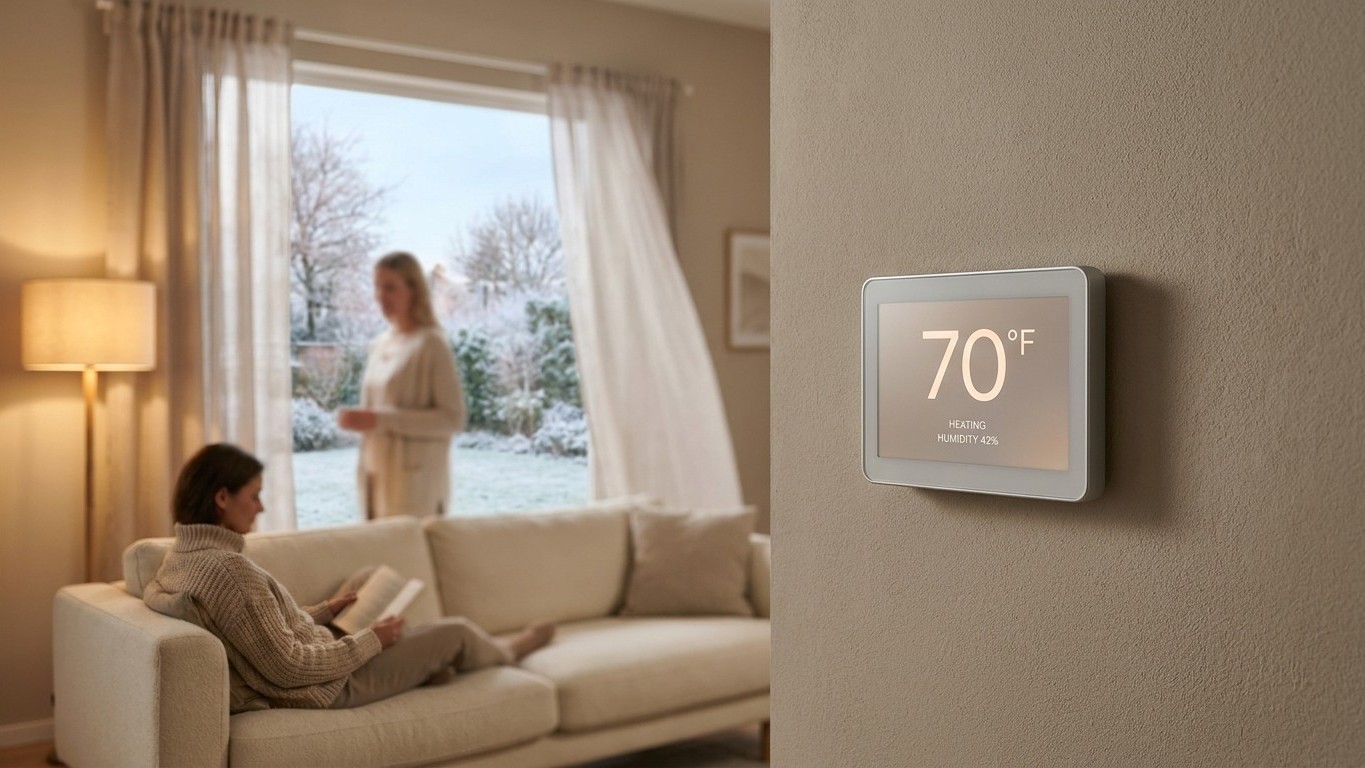

There’s no universal number that works for every house, because comfort depends on humidity, air movement, what you’re wearing, and how well your walls and windows hold heat. What actually gets measured, published, and can save you money isn’t a fixed setpoint at all. It’s the size of the setback you use when nobody needs the house at full temperature.
There is no single right number

Two houses set to the exact same number can feel completely different. A drafty older home at 70°F in January can feel chilly because cold air is sliding off the windows, while a tight, well-insulated house at the same 70°F feels perfectly warm. Humidity changes the math too: dry winter air makes a room feel colder than the thermometer says, and a humid summer afternoon makes a room feel hotter than the number on the display. Add in what people are wearing, how many people are moving through the house, and whether sunlight is pouring through south-facing windows, and you can see why no single figure fits every household.
What does have a documented, measurable effect is the setback itself, the gap between the temperature you keep while the house is occupied and the temperature you allow while it’s empty or everyone’s asleep. The U.S. Department of Energy states it plainly: “You can save as much as 10% a year on heating and cooling by simply turning your thermostat back 7-10 F for 8 hours a day from its normal setting.” That sentence is worth reading slowly, because it’s easy to mangle in casual conversation.
First, it’s 10% a year, not 10% off a single monthly bill and not 10% every time you nudge the dial. Second, the setback itself needs to be 7 to 10 degrees, not one or two degrees of wiggle room. Third, it has to be held for a solid 8 hours a day, which usually means either the work day or the overnight sleep window, not a quick 20-minute dip while someone runs to the store. Fourth, and often missed, the figure covers heating and cooling together, so it applies whether you’re pulling the furnace back in January or letting the house drift a little warmer while you’re at work in July.
A lot of people try setting their occupied temperature somewhere in the upper 60s for winter and upper 70s for summer, simply because those ranges tend to feel workable for most bodies and most homes. That’s a common starting point, not a rule, and it’s worth treating it that way. The right move is to pick a number that feels comfortable for your household, then build the setback around it, because the setback is where the documented savings actually live.
This distinction matters more than it sounds. Someone chasing a “correct” setpoint will fiddle with the thermostat by a degree or two and wonder why nothing changes. Someone who understands that the savings come from the gap between occupied and unoccupied hours will set a comfortable baseline once, then let the schedule do the work automatically, whether that’s a programmable thermostat or a smart one that learns the household’s routine.
Winter: the setting and the setback
Every winter thermostat schedule is really two separate decisions dressed up as one dial. The first decision is the temperature you want while the house is occupied and awake, which is entirely a comfort call based on your household, your insulation, and your tolerance for a sweater indoors. The second decision is how far back that number goes when the house is empty or everyone’s asleep, and that second decision is the one the Department of Energy figure actually describes. It’s easy to blur the two together, but only the setback has a published number attached to it.
A typical winter day breaks into four moments, and each one calls for a different kind of judgment rather than a fixed figure.
| Moment | What the decision depends on |
|---|---|
| Morning | How early people rise, and how much lead time the system needs to recover from an overnight setback before anyone’s out of bed |
| Away (work/school) | How long the house sits empty, and whether pets or plants in the home need a warmer floor than a fully empty house |
| Evening | When the household is actually home and active, not just when people arrive through the door |
| Night | Personal sleep comfort, plus how quickly the system can recover by the next scheduled rise |
Two kinds of systems deserve a caution before you dial in an aggressive winter setback. A heat pump that falls too far behind on temperature can trigger its backup electric resistance heat to catch up faster, and that backup heat is far more expensive to run than the heat pump’s normal cycle, which can quietly erase the savings a setback was supposed to deliver. A hydronic or steam system carries its own problem: the water or steam moving through pipes and radiators has real mass, and that mass takes time to heat back up, so a deep setback can mean a slow, uncomfortable recovery rather than a quick bounce back to temperature. Both of these situations are covered in more detail in their own dedicated guides on this site, and they’re worth reading before you set an aggressive nightly or daytime setback on either type of system.
None of this means winter setbacks aren’t worth using. It means the size of the setback should match the system doing the work, not just the calendar or the thermostat’s default programming.
Summer: why cooling behaves differently
Cooling isn’t heating in reverse, and treating it that way is where a lot of summer thermostat habits go wrong. An air conditioner doesn’t just lower the air temperature, it also pulls moisture out of the air as it runs. A house that’s been left to heat up and get humid all day doesn’t snap back to comfortable the moment the compressor kicks on. It has to be cooled and dried at the same time, and pulling humidity back out of a house takes longer than just dropping the temperature reading on a thermostat display.
This is also where the single most common summer mistake shows up: setting the thermostat far below the actual target, say cranking it down several degrees past where you actually want the house, in the belief that it’ll cool the space faster. It won’t. The equipment runs at one speed, whether the compressor is a single-stage or variable system, and the setpoint only tells it when to stop, not how hard to work in the meantime. Setting the target lower doesn’t add cooling capacity, it just means the system keeps running past the point where the house was already comfortable, using more energy for no extra speed.
The average household spends heavily on this trial and error without realizing it. ENERGY STAR notes: “For the average American household, almost half of the annual energy bill goes to heating and cooling – that’s more than $900 a year.” That’s an average figure across American households, not a prediction of any single bill, but it’s a useful reminder that cooling habits carry real weight in a typical year’s energy spending, right alongside heating.
Ceiling fans cool people, not rooms
A ceiling fan is genuinely useful in summer, but it works by moving air across skin, which speeds up evaporation and makes a person feel cooler even though the room’s actual temperature hasn’t changed at all. That means a fan left running in an empty room does nothing but use electricity. It only helps while someone is actually sitting or standing underneath it, which is why raising the thermostat a couple of degrees and running the fan only in occupied rooms tends to work better than running fans throughout an empty house.
Away, asleep and away for a week
People tend to lump three very different situations into one blanket habit, and each one actually has its own constraint.
- Leaving for the day. The house is empty for hours but someone’s coming back that evening, so the constraint is simply recovery time: how long the system needs to bring the house back to a comfortable temperature by the time the household walks in.
- Sleeping. The house is occupied but inactive, and the constraint is personal comfort under blankets versus how quickly the system can rise again by morning, particularly for systems that recover slowly.
- Away for a week or more. Nobody’s coming home tonight, and the constraint shifts entirely. In winter, it’s protecting the plumbing. In summer, it’s keeping humidity from sitting unchecked in a closed-up, unventilated house.
That last situation is where a bad habit can turn expensive fast. In a cold climate, never turn the heat off entirely while you’re away, even for a short trip. Frozen pipes cost far more to repair than an entire season of running the heat at a modest setback, and a burst pipe can cause damage that takes weeks to dry out and fix. Leave the heat running at a reduced but safe level instead, and if you’re planning to be gone for an extended stretch in winter, this is exactly the kind of trip worth planning around ahead of time rather than improvising the morning you leave.
Common questions
Is there an official recommended thermostat setting?
No figure in this guide claims to be an official rule for what number to set. What is documented and citable is the effect of the setback, the Department of Energy’s figure on turning the thermostat back 7 to 10 degrees for 8 hours a day. The comfortable occupied temperature is a household-by-household call based on insulation, humidity, and personal preference.
Does a bigger setback save more energy?
The published figure applies specifically to a 7 to 10 degree setback held for 8 hours a day, yielding as much as 10% a year in combined heating and cooling savings. Pushing the setback further isn’t covered by that figure, and for some systems, particularly heat pumps, a much deeper setback can trigger costly backup heat during recovery.
Should I set the thermostat lower in summer to cool the house faster?
No. The cooling system runs at a fixed capacity regardless of how low you set the target, so setting it far below your actual goal only means the system runs longer past the point of comfort, not faster. Set it to the temperature you actually want and let the system reach it at its own pace.
Can I turn the heat off completely while traveling in winter?
Not in a cold climate. Turning the heat off entirely risks frozen pipes, which cost significantly more to repair than the heating bill for the entire time you’re away. Leave the system running at a reduced, safe setback instead.