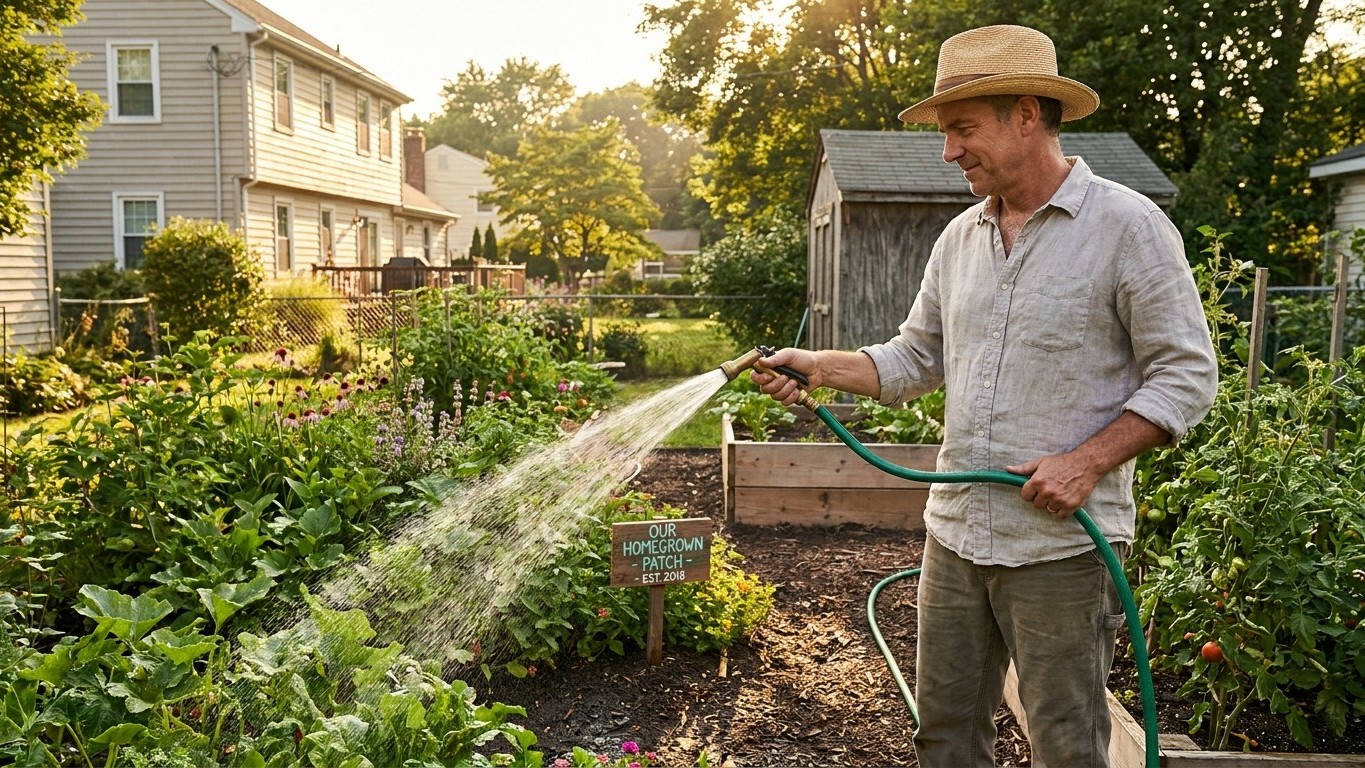

New York doesn’t run one statewide watering law. What governs your hose is a patchwork of local water authorities, county drought declarations, and a climate that swings from Long Island’s sandy coastal plain to the short, sharp summers of the Adirondacks. The rules that actually apply to you sit with your water district. The climate math below explains why those rules exist in the first place.
What the climate asks of you

Two figures set the tone for a New York garden. The first is heat: the state averages 12.2 days a year at 90F or hotter, measured at the reference station in New York City. That’s not a brutal number next to Texas or Arizona, but it’s enough heat spikes to push a garden bed from comfortable to stressed in the space of an afternoon, especially on a lawn or bed that hasn’t been checked in a week.
The second figure is the length of the season you’re actually responsible for watering. In New York City, the last spring frost falls in the window of March 23 to April 3, and the first fall frost arrives between November 14 and November 27. Stretch those two windows against each other and you get a frost-free growing season of roughly 225 to 249 days, depending on the year. That’s the better part of eight months where a newly planted bed, a vegetable patch, or a stretch of lawn can be actively growing and actively thirsty.
Neither figure tells the whole story on its own, and that’s the point. New York’s USDA hardiness zones run 3b to 7b statewide, which is one of the widest ranges of any state in the country. The reference conditions above describe New York City and its immediate surroundings. Head north into the Adirondacks or the Tug Hill Plateau and the frost dates above shift earlier in fall and later in spring by weeks, not days, which shortens the growing season considerably and changes when watering actually needs to start and stop.
Soil adds another layer that varies as much as the frost dates do. Long Island and parts of the Hudson Valley sit on sandy or sandy-loam ground that drains fast and needs more frequent attention. Much of upstate New York, by contrast, carries heavier clay-loam soils that hold moisture far longer but drain poorly when saturated. A gardener in Suffolk County and a gardener outside Syracuse are not managing the same water problem, even under the same statewide hardiness range.
How much, how often
The standard target for most garden beds and lawns is about one inch of water a week, delivered in one or two deep sessions rather than a daily trickle. Shallow, frequent watering trains roots to stay near the surface, where they dry out fast and cook during those 12.2 annual days above 90F. Deep, infrequent watering pushes roots down where the soil stays cooler and moisture lingers longer.
Knowing when to water matters more than following a fixed schedule. Push a finger, or a small trowel, about two inches into the soil near the base of a plant. If it’s dry at that depth, it’s time to water. If it’s still damp, wait. This one check replaces guesswork with something closer to certainty, and it adjusts naturally for New York’s soil differences: sandy ground in Long Island will hit that dry mark faster than clay-loam ground upstate, even after the same rainfall.
A watering routine that fits New York’s soil range
- Check the soil first. Two inches down, dry means water; damp means wait another day or two.
- Water at the base, not overhead. Wet foliage in a humid New York summer invites fungal disease; wet soil doesn’t.
- Water in the early morning. Less evaporation loss before the day’s heat sets in, and dry leaves by nightfall.
- On sandy soil (Long Island, parts of the Hudson Valley), water shorter and more often, since the ground holds little of what falls.
- On heavy clay soil (much of upstate New York), water less often but let it soak in slowly, and never water or work clay ground that’s already wet, since compacting saturated clay damages its structure for a season or more.
- During the hottest stretches, tied to those 12.2 average days above 90F, check soil moisture daily rather than on a fixed weekly schedule, since heat spikes can dry out even clay-heavy beds faster than usual.
Restrictions and rules
Watering restrictions in New York are set locally, not by the state, and they change from one summer to the next depending on reservoir levels and rainfall. A given water authority might limit outdoor watering to certain days of the week, restrict watering hours to early morning or evening, or ban hose-end sprinklers entirely during a declared drought watch or warning. None of this is fixed year over year, and none of it applies uniformly across a state that stretches from New York City’s water supply system to small rural districts drawing on local wells.
That variability is exactly why a general article can’t hand you a rule number and call it accurate. What’s reliable is the process: contact your local water utility or municipal water department before setting an irrigation timer for the season, and check again if a drought advisory is announced mid-summer, since restrictions can tighten with little notice. Cornell Cooperative Extension, New York’s land-grant extension network, is a solid starting point for region-specific guidance on both watering practices and current local conditions; find your county office through Cornell Cooperative Extension.
Given the state’s uneven rainfall pattern and the long, roughly 225-to-249-day growing season identified above, gardeners on drought-prone sections of Long Island or in areas that draw from smaller reservoirs are more likely to see restrictions in a dry year than someone drawing from a large upstate watershed. That’s not a rule you can bank on, but it’s a reason to check early rather than assume the hose is always free to run.
Using less
Cutting water use in a New York garden isn’t about watering less overall so much as losing less of what you already put down. A few practices do most of the work, and they don’t all require the same effort.
- Mulch, two to three inches deep. It slows evaporation from the soil surface and keeps roots cooler during those hottest stretches above 90F, often cutting how often you need to water by a noticeable margin.
- Drip irrigation or soaker hoses. Water goes straight to the root zone instead of evaporating off leaves or running off compacted soil, which matters most on the sandy ground found across Long Island.
- Group plants by water need. Thirsty vegetables and drought-tolerant perennials on the same zone means one or the other is always getting watered wrong; separating them lets you water each bed to its actual need.
- Add organic matter to the soil. Compost worked into sandy soil helps it hold water longer between sessions; worked into heavy clay, it improves drainage so roots aren’t sitting in standing water.
- Rain barrels, where local rules allow them. As a rule of thumb, an inch of rain falling on a thousand square feet of roof yields roughly 600 gallons of runoff. In a New York summer, rainfall doesn’t arrive on a predictable weekly schedule, it tends to come in bursts followed by dry stretches, so a barrel fills fast during a storm and can sit low through a multi-week dry spell. Treat it as a supplement to a rain gauge check, not a guaranteed weekly source.
Common questions
Is there a statewide watering schedule in New York?
No. New York has no single statewide outdoor watering law. Rules on days, hours, and methods are set by local water utilities and municipalities, and they change based on local drought conditions, so check with your own water district rather than assuming a fixed schedule applies.
How do I know if my New York soil is sandy or clay?
Take a handful of moist soil and squeeze it. Sandy soil, common on Long Island and in parts of the Hudson Valley, falls apart immediately. Clay soil, more common across much of upstate New York, holds its shape and feels sticky. This simple test tells you more about your actual watering needs than any statewide average.
When should I stop watering in the fall?
In the New York City area, the first fall frost typically arrives between November 14 and November 27. Upstate and in the Adirondacks, that date comes considerably earlier, so taper watering as growth slows and stop once a hard frost is expected in your specific area.
Does New York really need much watering if it rains often?
Rain alone doesn’t guarantee a garden gets what it needs, since New York’s summer rainfall tends to arrive unevenly, in bursts followed by dry stretches, rather than as a steady weekly amount. Combined with 12.2 average days a year above 90F, that unevenness means most gardens still need supplemental watering through the growing season, particularly on fast-draining sandy soil.