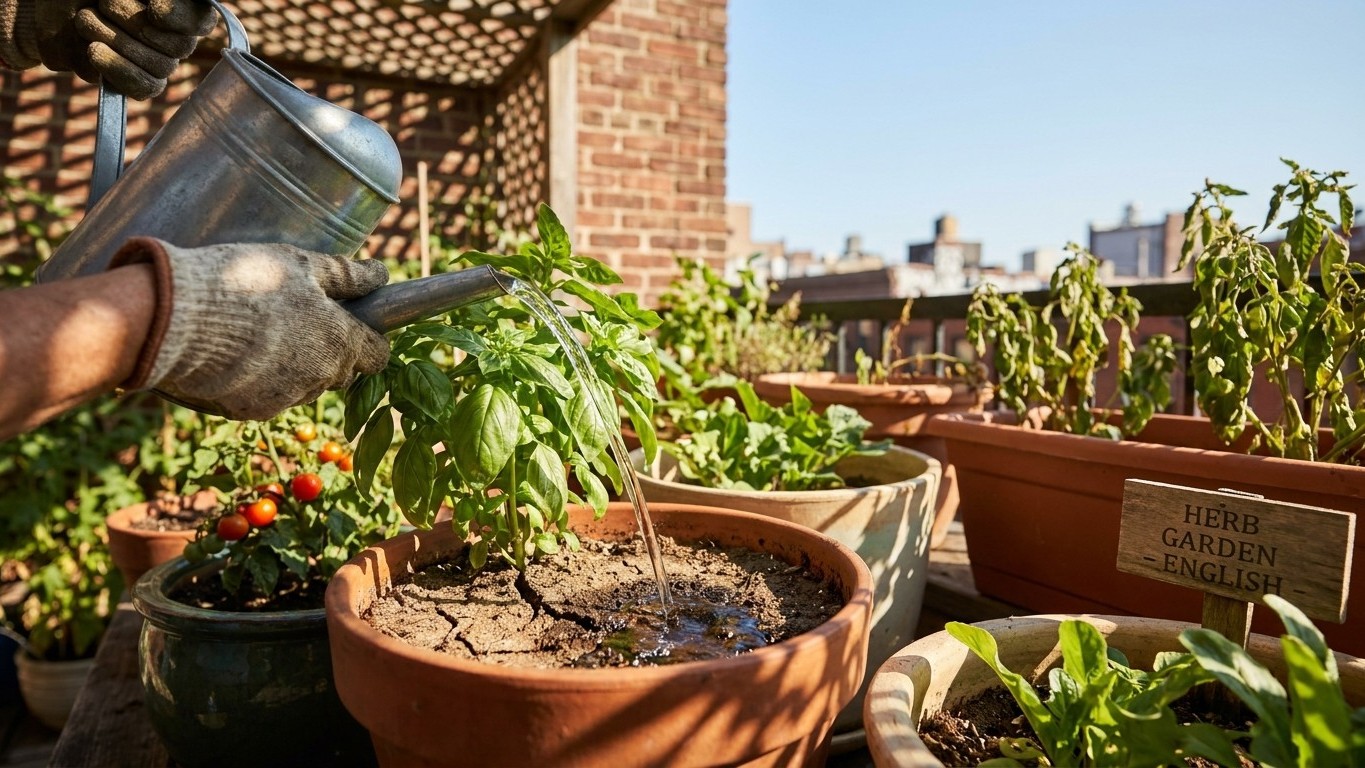

New York gardens need roughly an inch of water a week through the growing season, but the sky only delivers part of that even in a normal summer. The rest depends on the container, the soil underneath it, and how many days push past 90F and pull moisture back out before roots can use it.
What changes here

Start with two numbers from the region’s own weather record: June, the driest summer month, averages 4.54 inches of rain, and the area sees 12.2 days a year at or above 90F. Put those together and you get a simple working rule: the sky in June gets you close to the weekly inch a garden wants, but the heat load from those 90F-plus days means a good share of that water never makes it to the roots before it evaporates.
Do the arithmetic. A vegetable bed or a row of Containers wants about an inch of water a week. June’s 4.54 inches, spread across roughly 4.3 weeks in the month, works out to about 1.06 inches a week arriving from the sky on average. On paper, that looks like enough. In practice it almost never is, because rain in a New York June doesn’t fall in neat weekly installments. It comes as a thunderstorm that dumps half an inch in twenty minutes, followed by ten dry days, then another burst. A lot of that intense rain runs off a container’s soil surface or off a compacted garden bed instead of soaking down to where roots sit.
July and August track close behind June, at 4.6 and 4.56 inches, so the same math holds for most of the season: roughly a week’s worth of water, unevenly delivered, against a heat load that’s actively working to pull it back out. The 12.2 days above 90F matter more than the average summer temperature ever could, because those are the days evaporation spikes hardest, particularly for anything growing in a pot rather than open ground, where the smaller soil volume dries out fastest. A gardener who waters on a fixed schedule based on “it rained this week” is guessing. A gardener who checks the soil directly, and treats the rain total as a rough monthly budget rather than a weekly guarantee, is the one whose plants make it through August.
How to water when it matters
The method that works in this climate is deep, infrequent watering at the base of the plant, done in the morning. Each part of that has a reason behind it, not just a habit passed down from someone else’s garden.
Deep watering pushes moisture down several inches into the soil, which trains roots to grow downward chasing it. Shallow, frequent watering does the opposite: it keeps roots near the surface, where the first hot afternoon bakes them. Watering at the base instead of overhead means the water goes where the plant can actually use it, rather than sitting on leaves. Morning watering gives the plant time to take up moisture before the day’s heat and those 90F-plus afternoons start pulling it back out through evaporation, and it lets any leaf splash dry off before evening rather than sitting damp overnight.
Checking the soil beats checking the calendar every time. A finger pushed two inches down, or a trowel pulled up for a quick look, tells you what’s happening at root depth. Surface soil can look bone dry an hour after a heavy dew and still be moist further down, and the reverse happens just as often after a light shower that only wet the top half-inch.
For containers and raised beds, which dry faster than open garden soil because there’s less volume holding water and heat reaches them from all sides, that inch-a-week starting point often needs splitting into two or three smaller waterings rather than one big soak. Treat that as a starting point to test against your own pots, not a fixed rule, since a glazed ceramic container holds moisture very differently than an unglazed terra cotta one sitting in full sun.
- Check soil moisture two inches down with a finger or trowel before watering, rather than watering on a set schedule.
- Water at the base of the plant, not over the leaves, using a watering can spout or a soaker hose held close to the soil.
- Water in the morning, giving the plant hours to absorb moisture before the heat of the day sets in.
- Apply enough to soak several inches down rather than a light surface splash, aiming for roughly an inch a week as a starting point, split into two or three sessions for containers.
- Skip a scheduled watering if the soil is still moist below the surface, and add an extra one during a stretch of 90F-plus days.
What goes wrong
“I water a little every day, just to be safe.”
This is the single most common mistake, and it works against the plant rather than for it. Daily light watering wets only the top inch or two of soil, which is exactly where roots then decide to stay, since that’s where the moisture is. When a 90F day hits, and the region sees 12.2 of them a year, that shallow root zone dries out fast and the plant shows stress within hours.
“I water in the evening so it doesn’t evaporate.”
The logic sounds reasonable, but it backfires. Water left sitting on leaves overnight, without sun or airflow to dry it, creates exactly the damp conditions fungal diseases need to take hold. Morning watering avoids this because the plant and the soil surface both dry out during the day.
“It rained yesterday, I can skip watering.”
A summer thunderstorm can dump a visible amount of rain and still leave the soil dry an inch down, especially in a container or on compacted ground where water runs off rather than soaking in. The only way to know is the finger test, not the memory of hearing rain on the roof.
“I don’t bother with mulch.”
Bare soil around a plant, or an uncovered container surface, loses moisture straight back to the air, undoing a chunk of whatever was just watered in. A layer of mulch slows that loss and helps stretch the gap between waterings, which matters most on the stretch of days when the temperature is pushing past 90F and the next rain isn’t scheduled to show up on any forecast.
Local help
For soil testing, plant selection and questions specific to a county or growing zone, Cornell Cooperative Extension is the state’s land-grant extension service and a direct line to local horticulture advice. Watering restrictions vary by municipality and water provider and change with drought conditions, so check current rules with the local water utility rather than assuming a statewide policy applies.
Common questions
How often should I water a container garden in New York during summer?
Check the soil two inches down before deciding. As a starting point, expect to water containers every two to three days during average summer weeks, and more often during stretches of 90F-plus heat, since pots dry out faster than garden beds.
Is New York’s summer rainfall enough for a vegetable garden without extra watering?
Not reliably. June, July and August each average around 4.5 to 4.6 inches of rain, close to a garden’s weekly needs when averaged over the month, but that rain arrives in uneven bursts rather than steady weekly amounts, so gaps of a week or more without meaningful rain are common.
What’s the best time of day to water plants in New York?
Morning. It gives the plant time to absorb water before the heat of the day increases evaporation, and it lets any moisture on leaves dry before evening, which lowers the risk of fungal disease overnight.
Do raised beds need more water than in-ground gardens here?
Generally yes, because raised beds have less soil mass and dry out faster than surrounding ground, particularly on the days that reach 90F or above. Checking soil moisture directly, rather than assuming the same schedule as an in-ground bed, is the more reliable approach.