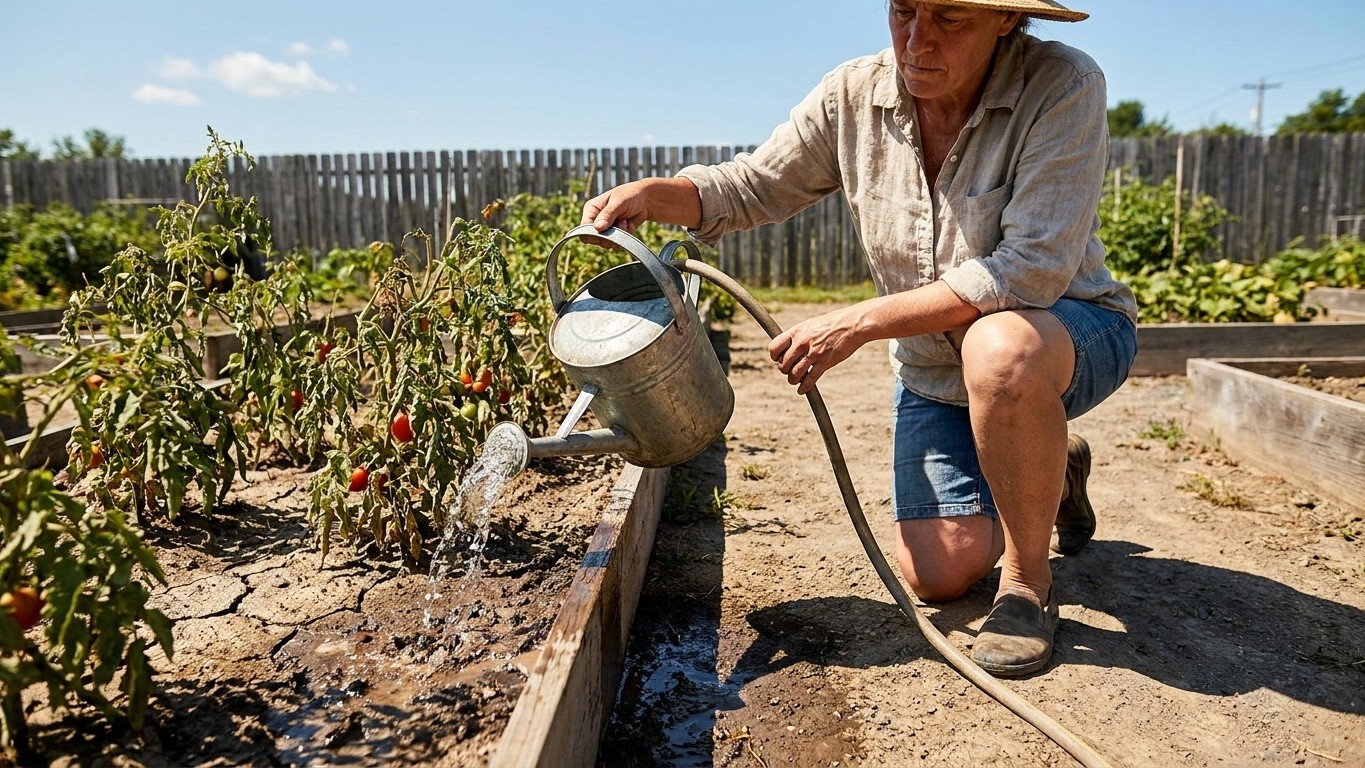

New York gardens get enough summer rain on paper, but the water doesn’t fall on a schedule your tomatoes understand. The driest month averages 4.54 inches, and 12.2 days a year hit 90F or hotter. That combination means most beds need a supplemental soak most weeks, timed around whatever the sky actually delivers rather than what the calendar predicts.
What changes here

Two numbers set the terms for every New York garden. The driest summer month, June, averages 4.54 inches of rain at the reference station. And the region sees 12.2 days a year at 90F or above. Together they say something specific: there’s usually enough water falling from the sky to cover a garden bed, but the heat load is high enough that a chunk of it evaporates before roots ever touch it.
Do the arithmetic and it gets more useful. A vegetable bed or a young perennial border wants roughly an inch of water a week. June’s 4.54 inches, spread over the month’s roughly 4.3 weeks, works out to about 1.06 inches a week on average. That’s just above the target, on paper. In practice, June rain in New York rarely arrives in neat weekly installments. It comes as a heavy thunderstorm that dumps half an inch in twenty minutes, then nothing for eight or nine days. A soil surface that’s already firm sheds most of that water as runoff instead of letting it soak to root depth, so the monthly average overstates what any single week’s roots actually receive.
That’s the gap a gardener has to fill, and it isn’t the same gap for everyone. Sandy soil lets water pass through fast, so even a generous storm drains past the root zone within a day, leaving the bed thirsty again well before the next rain. Heavy clay, common across a lot of New York’s older residential lots, holds water far longer, sometimes for the better part of a week, but that same trait means a bed can still be saturated when the next storm rolls through, and a well-meaning gardener with a hose can push it into waterlogged territory. The 4.54-inch figure is a regional average from 1991-2020 climate normals, not a promise about any specific yard. A rain gauge staked into your own bed is the only way to know what actually landed there this week, versus what fell three miles away at the weather station.
How to water when it matters
The method that works in New York isn’t complicated, but it runs against instinct. Deep, infrequent watering at the base of the plant, done in the morning, beats a daily sprinkle almost every time. Deep watering pushes moisture down past the top few inches, which trains roots to grow downward chasing it. Morning watering gives leaves time to dry before evening, cutting the window fungal disease needs to take hold. Watering at the base instead of overhead means less water is lost to evaporation and wind drift before it ever reaches soil.
Knowing when to water matters as much as how. The surface of a New York garden bed can look bone dry an hour after a storm even though the root zone below is still soaked, and it can look dark and damp on top while the roots two inches down are parched. A finger pushed two inches into the soil, or a trowel pulled up for a quick look, tells the truth the eye can’t.
Soil texture changes the rhythm, not the principle. Here’s a sequence to start from and adjust once you know your own ground:
- Check soil moisture two inches down with a finger or trowel before watering, not after a rain you didn’t measure yourself.
- If the soil is dry at that depth, water deeply enough to wet the top 6 to 8 inches, roughly one inch of water applied in a single session.
- On sandy soil, expect to repeat this every 3 to 4 days during a dry stretch, since the ground drains fast and holds little reserve.
- On heavy clay, space sessions out to once every 6 to 7 days, and always recheck moisture before the next watering rather than watering on a fixed calendar.
- Water in the early morning so foliage dries before nightfall, and direct the hose or drip line at the base of the plant rather than over the leaves.
That one-inch, once-a-week starting point is exactly that, a starting point. A bed under a black locust tree, a raised bed with amended soil, or a slope that sheds water fast will all need adjustment once you’ve watched them through a few dry stretches.
What goes wrong
“I water a little every day, just to be safe.”
Light daily watering wets only the top inch or so of soil. Roots have no reason to grow deeper when water always shows up right at the surface, so they stay shallow, right in the zone that bakes hardest on a 90-degree afternoon. A plant watered this way is more vulnerable during a heat spell, not less, because its root system never developed the reach to find moisture lower down.
“I water in the evening after work.”
Evening watering, especially overhead, leaves foliage wet through the cool overnight hours. Fungal pathogens that cause powdery mildew and blight thrive in exactly that window of prolonged leaf wetness. Morning watering gives the sun several hours to dry leaves before conditions turn favorable for disease.
“We had a good rain, so I skipped watering this week.”
A summer thunderstorm can look like a soaking and still only wet the top half-inch of soil, especially if it fell fast and hard on ground that was already dry and compacted. The fix is the same finger or trowel check described above, done after the rain, not an assumption based on how wet the driveway looked.
“The bed stays wet, so I water it anyway on schedule.”
This is the mistake that costs the most in a region with New York’s rainfall totals. With roughly 13.7 inches falling across a typical summer and clay soil common in many yards, beds can still be holding last week’s water when a gardener waters again out of habit. Roots sitting in saturated clay are cut off from oxygen and start to rot, and a drowned bed can look wilted in a way that’s easy to mistake for thirst, tempting even more water onto a bed that needed exactly the opposite. Leaving mulch off compounds problems in the other direction, letting the sun pull moisture straight back out of bare soil almost as fast as it’s applied.
Local help
Cornell Cooperative Extension is New York’s land-grant extension service and a solid source for soil testing, local planting guidance, and seasonal watering advice tailored to specific counties. Find your local office through the Cornell Cooperative Extension directory. Watering restrictions vary by municipality and water district and change during drought conditions, so check with your own water provider for current rules before setting up an irrigation schedule.
Common questions
How much should I water my New York garden each week?
Start with about one inch of water per week, adjusted for your soil. Sandy soil needs that inch split into shorter, more frequent sessions; heavy clay can often go longer between waterings but needs a moisture check first to avoid drowning roots.
Is June really the driest summer month in New York?
At the reference climate station, June averages 4.54 inches, just slightly below July’s 4.6 inches and August’s 4.56 inches. All three months are close, so summer overall doesn’t have one dramatically dry stretch, but June’s rain often arrives in fewer, heavier events.
Why do 90-degree days matter more than the temperature average?
The count of days at or above 90F, 12.2 per year on average, measures the heat spikes that drive fast evaporation and plant stress, which a seasonal average temperature can hide. Those individual hot days are usually when a garden’s water demand jumps the most.
Can I rely on rainfall alone during a New York summer?
Not reliably. The seasonal totals look generous on paper, but rain often falls in short, heavy bursts that run off rather than soak in, especially on compacted or clay soil. Checking soil moisture yourself, rather than trusting rainfall totals, is the more accurate approach.