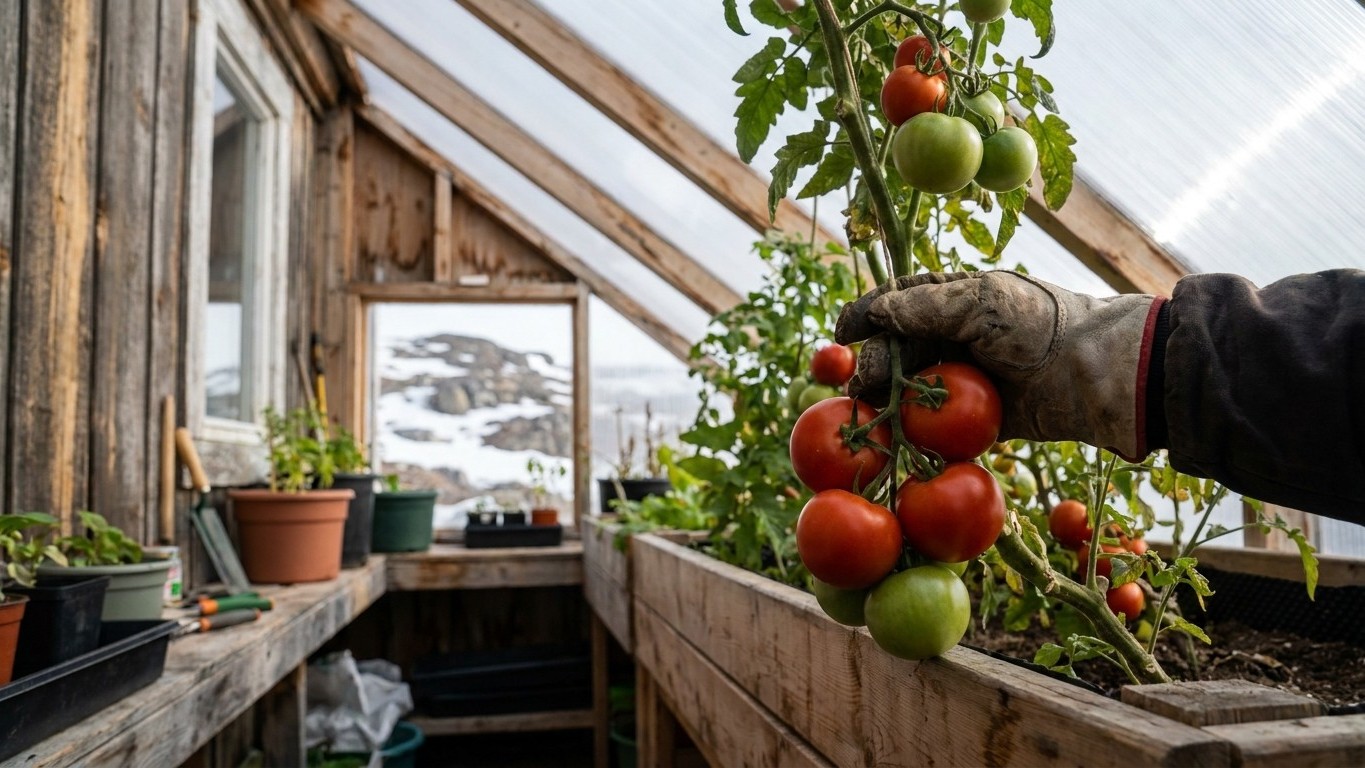

Nunavut’s growing season for tomatoes runs on average from June 19 to September 13, based on the 1981-2010 Canadian Climate Normals at Rankin Inlet from Environment and Climate Change Canada. That works out to a mean of roughly 86 frost-free days, and it is not a guarantee: in one year out of two, frost arrives later than that mean date. Count backward from the September figure using a cultivar’s days-to-maturity, and set transplants out only after the frost risk has clearly passed rather than on the calendar date itself.
What this comes down to in Nunavut

The mean last spring frost at Rankin Inlet, per Environment and Climate Change Canada’s 1981-2010 Climate Normals, falls on June 19, and the mean first fall frost lands on September 13. That puts the average frost-free window at about 86 days, one of the shortest tomato seasons anywhere this site covers. Every planting decision here starts from that number, because a cultivar needing more days to ripen than the season allows will not finish outdoors regardless of how well it is tended.
The catalogue figures used later in this piece for date arithmetic treat early July as the transplant point, not the June 19 mean itself. That gap exists because June 19 is only an average: roughly half of the years on record at Rankin Inlet see frost arrive after that date, so setting tender transplants out right on the mean invites a setback in a below-average year. Waiting two to three extra weeks, into early July, trims that risk without giving up much of an already short season.
Because the frost-free window runs to a mean of about 86 days and the transplant date is pushed to early July, the tomatoes that make sense here are the fast ones. Anything rated much past 60 days from transplant is working against the calendar before it even goes in the ground. A tomato seedling’s usual six-to-eight-week head start indoors also has to be timed backward from that later transplant date rather than from a date copied off a seed packet written for a longer season further south. Start too early on the wrong calendar and the seedling turns leggy and rootbound long before Nunavut’s soil and air are warm enough to take it. The full rundown of which cultivars clear the 60-day bar and which do not is worth reading on Tomato Varieties That Ripen in Time in Nunavut.
Working it out for your own garden
The method is simple arithmetic, and it survives a move to a different hamlet or a colder year better than any single fixed date does. Start from the mean last frost, June 19 at Rankin Inlet, and the mean first fall frost, September 13, both from Environment and Climate Change Canada’s 1981-2010 Normals. Subtract two to three weeks from the June date for a margin of safety, since frost falls after the mean in about half of all years, and work backward from the September date using the cultivar’s days-to-maturity figure printed on the seed packet. That figure is always counted from transplant, not from seed, and it can run a week or two either way depending on how the summer actually turns out.
A cultivar that clears the bar
Take Sun Gold, rated at 57 days from transplant. Set out in early July, as the season here requires, 57 days lands the first ripe fruit in early September, which the catalogue math puts at about 15 days ahead of the September 13 mean frost date. That 15-day cushion is the margin, not a promise: it can disappear fast in a year where frost arrives early or a stretch of cool, cloudy weather slows ripening.
A cultivar that does not
Now take Cherokee Purple, rated at 72 days from transplant. The same early-July transplant date puts first ripe fruit at mid-September, level with the mean frost date itself and leaving zero days of margin. In an average year that cultivar is racing the frost to a draw. In years where frost lands later than the mean it might sneak through; in the other half of years it will not finish outdoors at all without some form of protection.
Lay a handful of cultivars side by side against the same early-July transplant date and the pattern is easy to see:
| Cultivar | Days from transplant | Approx. margin before mean frost |
|---|---|---|
| Sakura | 55 | 17 days |
| Sun Gold | 57 | 15 days |
| Juliet | 60 | 12 days |
| Black Cherry | 64 | 8 days |
| Amalfi | 68 | 4 days |
| Cherokee Purple | 72 | 0 days |
The table is built for one transplant date, early July, and for one weather station’s mean. If your own community sits further north or at higher elevation than Rankin Inlet, shift the whole calculation later: a last frost running even one extra week behind pushes every row in that table closer to zero margin, and the 72-day cultivars drop out of consideration entirely.
The mistakes this state punishes

The single costliest mistake is reading June 19 as a safe planting date instead of a midpoint. Environment and Climate Change Canada’s own normals mean that frost lands after that date in roughly half of all years on record at Rankin Inlet. Treat the mean as the earliest the season could start, never as the date you plant on. A run of warm days in mid-June is not proof the frost risk has passed. It is proof the average is being pulled forward that particular week, and the cold snap behind it can still arrive on schedule.
The second mistake is choosing a cultivar by flavor or fruit size alone and only checking the days-to-maturity figure after it is already growing in the tray. A 72-day tomato transplanted in early July finishes right at the mean frost date with no room to spare, and a slow, cool August pushes that harvest past the frost line entirely. Pick the cultivar before the season picks it for you, working the arithmetic shown above against your own transplant date rather than the days-to-maturity number printed on a seed rack stocked for a warmer province.
The third mistake is starting seed indoors too late and trying to make up the difference by transplanting into soil that has not warmed yet. Tomato roots stall in cold ground regardless of how many weeks of top growth the seedling already carries, so a plant pushed outside ahead of the soil warming loses time rather than gaining it. Start seed indoors with enough lead time that the transplant is a strong, stocky plant by early July, not a leggy one rushed out the door to chase a shrinking calendar.
Checking this against your county
Every figure above comes from one weather station, Rankin Inlet, and Nunavut spans climates from the Kivalliq coast to the High Arctic islands. A community further north or at higher elevation than Rankin Inlet should expect a shorter season than the 86-day mean calculated here, not the same one. Check with your own hamlet’s growing programs or the federal Department of Agriculture and Agri-Food Canada at agriculture.canada.ca before locking in a transplant date, since local microclimate can shift the real frost window by weeks in either direction. If you grow under a hoop house, greenhouse or other season extension, the outdoor frost dates above still set the baseline, even though a covered structure buys extra days on both ends, a subject covered in more depth on the page for growing tomatoes in Nunavut.
Some gardeners also time this by the Moon: when to plant tomatoes by the moon, as almanac tradition rather than fact.
Common questions
Can I direct-sow tomato seeds outdoors in Nunavut?
Direct-sowing does not leave enough season to work with. Even the fastest cultivars need 55 to 60 days from transplant, and transplants themselves are already six to eight weeks old by the time they go in the ground in early July, so seed sown straight into outdoor soil at the mean frost date would not have time to ripen before the September 13 mean fall frost.
What if my last frost hasn’t happened by early July?
Wait for it rather than force the date. The early-July transplant window already assumes a two-to-three week buffer past the June 19 mean from Environment and Climate Change Canada, but that mean is not a hard ceiling. In a late year, hold transplants indoors under grow lights a little longer rather than risk them outdoors, even if it shortens the eventual harvest.
Does starting seeds earlier indoors make up for the short outdoor season?
Only partly. Extra weeks indoors give you a bigger transplant on day one, but a tomato plant still needs a minimum run of warm days after transplant to flower, set fruit and ripen, and that clock does not start until the plant is in its final growing spot with warm roots under it. A stronger transplant gets going faster once conditions are right, but it does not shrink the 55-to-72-day figure printed on the seed packet.
Is it worth transplanting a 72-day cultivar like Cherokee Purple at all?
It is a gamble rather than a plan. The margin comes to zero days against the mean frost date, so a cultivar in that range only ripens outdoors in years where fall frost runs later than average. Growing it under cover, or choosing a cultivar with more built-in margin, is the more reliable route in most years.