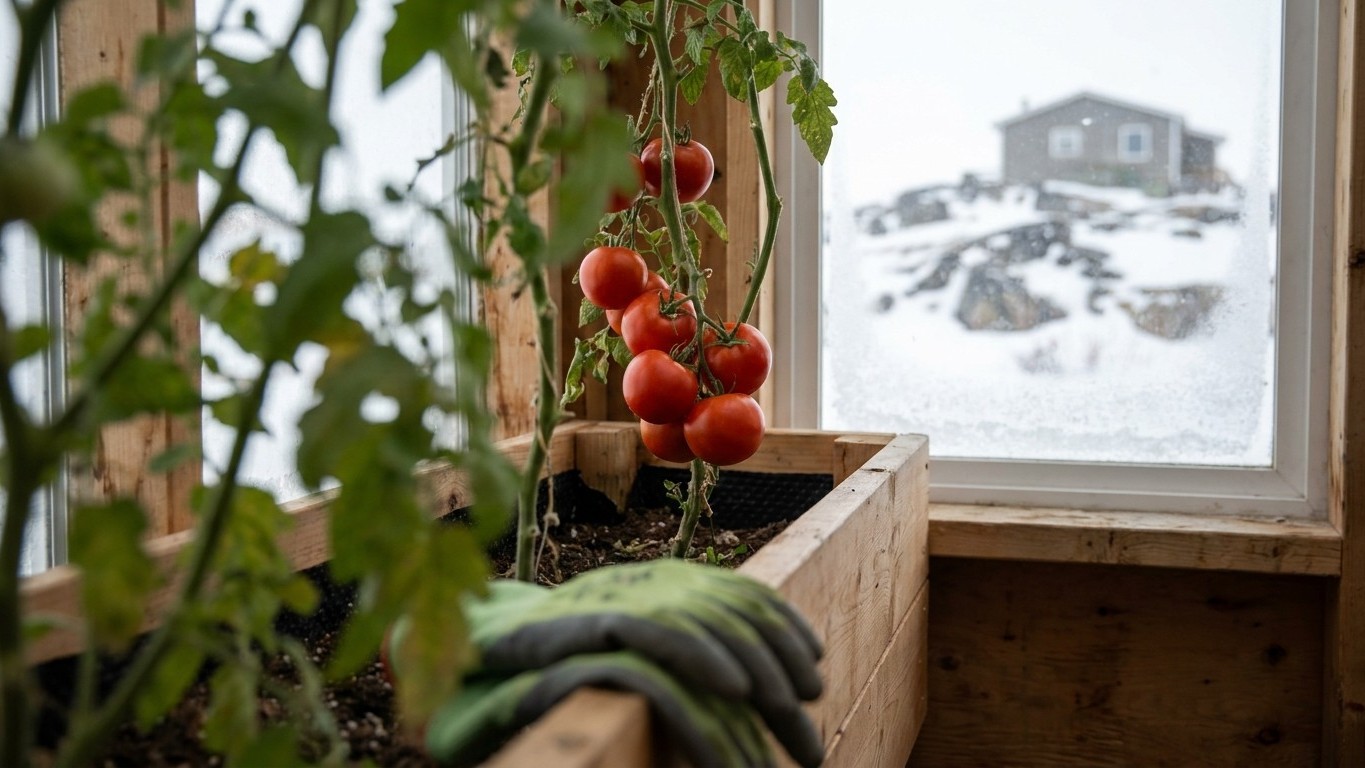

Near Rankin Inlet, Environment and Climate Change Canada’s 1981-2010 Climate Normals put the average frost-free window at about 86 days, running from a last spring frost around June 19 to a first fall frost around September 13. That’s a thin margin for tomatoes, and neither date is a safe one to plant or harvest by, since frost arrives later than average in half of all years and earlier in the other half. Pick a cultivar with 55 to 60 days to maturity from transplant rather than one bred mainly for fruit size.
What this comes down to in Nunavut

Near Rankin Inlet, the average frost-free window runs from June 19 to September 13, a span of roughly 86 days according to Environment and Climate Change Canada’s Climate Normals. That’s a mean, not a promise: in about half of all years the season is shorter than that on one end or the other. In a window this tight, variety choice isn’t a matter of taste. It’s the difference between a tomato that ripens outdoors and one that never gets there.
The days-to-maturity figures below are counted from the date you set transplants outside, not from seed, and they assume a fairly normal season, so treat them as a range rather than a fixed count. Setting plants out in early July, once the average last frost date has passed, gives the shortest-season cultivars real days in hand before the average first fall frost. Beyond about 60 days to maturity, that cushion narrows fast, and past roughly 68 days it disappears in an average year.
Sakura

Sakura reaches maturity in about 55 days from transplant, the shortest season in this group. It’s an indeterminate cherry tomato grown for snacking and salads, with small round fruit produced in long clusters through the rest of the season. Set out in early July, it typically gives its first ripe fruit in late August, leaving about 17 days of margin before the average first fall frost, the safest bet on this list.
Valentine

Valentine also finishes in about 55 days, an indeterminate grape tomato with oblong, deep red fruit meant for eating fresh rather than cooking down. It carries intermediate resistance to early blight, which helps in a damp season. Like Sakura, it clears the average first fall frost with about 17 days to spare.
Glacier

Glacier finishes in about 55 days too, but it’s determinate rather than indeterminate, meaning a compact plant that suits a container or a short row instead of a sprawling vine. The fruit is small, slightly flattened, and works for slicing or cooking. It shares the same 17-day margin as the other 55-day cultivars here.
Sun Gold

Sun Gold needs about 57 days from transplant, an indeterminate vine that produces clusters of small, tangerine-orange fruit prized for eating straight off the plant. Two extra days compared to the fastest cultivars still leaves about 15 days of margin before the average first fall frost, comfortable in most years near Rankin Inlet.
Supersweet 100

Supersweet 100 takes about 60 days, an indeterminate cherry tomato with small, deep red fruit borne in long trusses. It resists verticillium wilt and one race of fusarium wilt, useful in soil that has grown tomatoes before. At 60 days it still clears the average frost window, but with about 12 days of margin, half of what the earliest cultivars carry.
Black Cherry

Black Cherry needs about 64 days, an indeterminate heirloom with round, dusky purple-brown fruit and a richer flavor than most cherry types. Its margin drops to about 8 days before the average first fall frost, workable in a normal year but with little room for a late spring or an early fall.
Amalfi
Amalfi takes about 68 days, a determinate plum tomato with oblong red fruit suited to sauce rather than fresh eating. It carries intermediate resistance to both late blight and early blight, useful given how damp a short arctic season can turn. Its margin narrows to about 4 days before the average first fall frost, meaning a slightly late transplant or a slightly early frost can erase the harvest.
Cherokee Purple
Cherokee Purple needs about 72 days, an indeterminate heirloom beefsteak with dusky pink-purple skin and green-brown shoulders, grown for slicing rather than volume. The arithmetic leaves it with essentially no cushion before the average first fall frost near Rankin Inlet, meaning it ripens on time only in a year that runs warmer or later than average on both ends.
| Variety | Days to maturity (from transplant) | Type | Approx. margin before average first fall frost |
|---|---|---|---|
| Sakura | 55 | Indeterminate | 17 days |
| Edox | 55 | Indeterminate | 17 days |
| Valentine | 55 | Indeterminate | 17 days |
| Glacier | 55 | Determinate | 17 days |
| Sun Gold | 57 | Indeterminate | 15 days |
| Supersweet 100 | 60 | Indeterminate | 12 days |
| Juliet | 60 | Indeterminate | 12 days |
| Jasper | 60 | Indeterminate | 12 days |
| Black Cherry | 64 | Indeterminate | 8 days |
| Amalfi | 68 | Determinate | 4 days |
| Cherokee Purple | 72 | Indeterminate | 0 days |
| Big Beef Plus | 72 | Indeterminate | 0 days |
| Firebird | 72 | Determinate | 0 days |
| STM 2255 | 72 | Determinate | 0 days |
Working it out for your own garden
The method behind every figure above is simple arithmetic, and it works for any cultivar even if it’s not on this list. Start with the average last spring frost near Rankin Inlet, June 19 according to Environment and Climate Change Canada’s Climate Normals, and add roughly a week or two before setting transplants outside, since the soil needs time to warm past the point of a lingering cold snap. That generally puts transplant timing in early July across the districts closest to this reference station, though other communities in the territory run their own schedule. For the fuller breakdown of that calculation, see Tomato Planting Dates in Nunavut: Counting Back From Your Frost Window.
Two cultivars, worked through
Take Sakura first. Its catalogue figure is 55 days from transplant. Set out in early July and count 55 days forward, and the first ripe fruit lands in late August, roughly 17 days ahead of the average first fall frost of September 13. That gap is the margin: it’s what absorbs a cool stretch in August or a transplant that went out a few days later than planned.
Now run the same arithmetic on Cherokee Purple, at 72 days from transplant. Counting 72 days from an early July transplant lands ripening in mid September, the same week as the average first fall frost near Rankin Inlet. There’s no cushion left in that number. A frost that arrives right on the average date, let alone early, catches the fruit still green on the vine.
Catalogue days-to-maturity numbers aren’t exact promises either way. They’re measured in trial plots that often run warmer and sunnier than a Nunavut summer, and the real count can drift a week or two depending on how much heat and light the plants actually get. Treat every calculated ripening date here as a range, not a single day, and treat the margin figures as approximate cushions rather than a guaranteed number of days in hand.
- Find the average last spring frost and first fall frost for the weather station nearest you.
- Subtract the two dates to get the average frost-free window.
- Add the cultivar’s days-to-maturity figure to your planned transplant date.
- Compare that estimate to the average first fall frost, and read the gap as margin, not certainty.
The mistakes this state punishes

The costliest mistake here is choosing a slicing tomato for its size instead of its season. Cherokee Purple, Big Beef Plus, Firebird and STM 2255 all need about 72 days from transplant, and near Rankin Inlet that arithmetic leaves zero days of margin before the average first fall frost. In an average year they ripen right at the frost line. In a year where frost lands early, which happens in about half of all years according to Environment and Climate Change Canada’s own normals, they don’t ripen outdoors at all.
A second mistake is transplanting early because a warm spell arrived before the average last frost. June 19 near Rankin Inlet is a mean date, not a safe one, and a stretch of warm days in early June doesn’t change the underlying odds. Tomato seedlings set out ahead of that window into soil that hasn’t caught up can sit stalled for weeks even if the plants survive the next cold night, losing more season than they gained by going out early.
A third mistake is growing only one variety and betting the whole season on it. Hedging with two or three cultivars at different days-to-maturity, an early cherry type like Sakura alongside something with more disease resistance built in for a wet year, means a poor result from one doesn’t mean a lost season overall. This is also where the groundwork covered in growing tomatoes in Nunavut pays off, since soil warming and hardening off both affect how much of that calculated margin a plant actually gets to use.
Checking this against your county
Before committing a season to any of these cultivars, check the frost record closest to your own community, whether that’s Iqaluit, Cambridge Bay or Rankin Inlet itself, since the dates used here can run weeks off in either direction elsewhere in the territory. Agriculture and Agri-Food Canada’s site is a reasonable starting point for federal growing resources, and it’s worth asking locally too, at a garden group, greenhouse project or hamlet office, since a formal county extension office doesn’t exist here the way it does farther south.
Common questions
Can I just start seeds indoors earlier to beat the frost?
Starting seed earlier doesn’t extend the outdoor season, since transplant timing is set by soil temperature and frost risk, not by how big the seedling has grown. A seedling held too long indoors often gets root-bound and stalls once it finally goes outside, which can cost more time than it saves.
Do I need a greenhouse to grow tomatoes at all here?
Not necessarily. A greenhouse or hoop house buys extra weeks on both ends of the season by holding heat, which matters most for cultivars with a higher days-to-maturity figure like Amalfi or Cherokee Purple. In an average year, the shortest-season cultivars listed here, such as Sakura, Valentine or Glacier, can still ripen in open ground.
Why does the days-to-maturity number on my seed packet seem too optimistic?
Packet figures usually come from trial plots grown in warmer, sunnier conditions than a Nunavut summer typically offers. Treat the printed number as a floor rather than a promise, and expect ripening to run later in a cool or cloudy season.
What if the first fall frost comes earlier than September 13 where I am?
That happens in roughly half of all years, since Environment and Climate Change Canada’s figure is a mean date, not a late-end estimate. It’s exactly why cultivars with more built-in margin, like the 55-day types in this article, are the safer choice even when a 72-day tomato is tempting for its size.