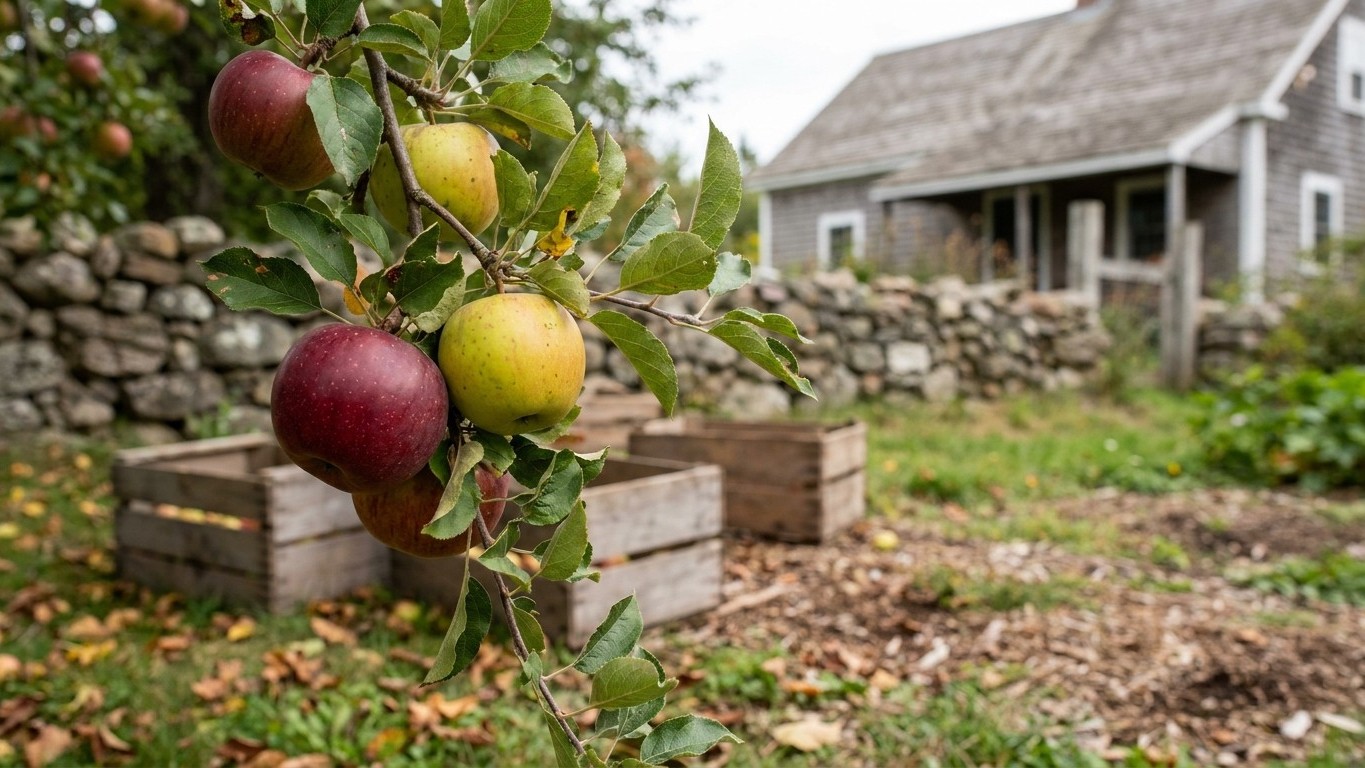

Thirteen degrees Fahrenheit is the average low Halifax sees in the depths of winter, and that single number quietly decides half of what you can grow here. McIntosh trees shrug it off without a thought. Plenty of catalog favorites don’t, or they survive but bloom too thin and too late to bear well. Inland from the coast, in the valleys and up toward Cape Breton, that same number drops further still — enough to end the conversation for some varieties before it starts.
Which varieties suit this climate

Two separate questions decide whether an apple tree does well here. The first is whether it survives winter at all. The second, easy to skip, is whether the winter it gets matches the amount of cold the variety actually needs to flower properly. Get the first wrong and the tree dies. Get the second wrong and the tree lives but blooms thin and ragged, or not on schedule with its pollen partner. Weighing both factors together is what separates The Best Apple Varieties for Nova Scotia from the ones that merely limp along.
Cold hardiness
Halifax’s coldest month averages a daily minimum of -10.4 °C, per Environment and Climate Change Canada’s 1981-2010 normals for the Halifax Stanfield International Airport station. That figure describes an average winter near the coast. Inland valleys and the Cape Breton highlands run colder in a hard winter, so a variety only marginally hardy at Halifax is a poor bet away from the coast. Nursery catalogs rate most apple cultivars by hardiness zone, and the varieties that have done well in the Maritimes for generations sit comfortably on the hardy end of that scale. McIntosh, the variety that built the Annapolis Valley’s orchard industry, is commonly rated to zone 4. Cortland, bred in New York specifically for cold-climate orchards, carries the same rating. Northern Spy and Honeycrisp are both catalog-rated to zone 3 or 4 and tolerate winters considerably colder than anything Halifax’s normals describe. Liberty, a scab-resistant cultivar bred at Cornell, is rated zone 4 and cuts down on the fungicide a maritime, humid climate otherwise demands. Gravenstein, the other historic Nova Scotia variety, is rated only to zone 5, borderline for a hard winter away from the coast, and it carries a second complication covered in the next section.
Winter chill
Chill hours accumulate through the cold months and apple trees need a minimum amount before they’ll break dormancy and flower on a normal schedule. Nova Scotia’s long, cold winters supply chill in abundance, well past what almost any apple cultivar requires — a progression laid out in The Nova Scotia Apple Calendar, Stage by Stage. That puts the province at the opposite end from warm, low-elevation climates, where growers have to hunt for low-chill cultivars bred to flower without much cold at all. Growers in a climate like Nevada’s low-elevation valleys face exactly that problem, covered in Growing Apples in Nevada: Varieties, Timing and Frost Risk. In Nova Scotia the chill filter almost never eliminates a variety on its own. No local extension source publishes a chill-hour figure specific to Nova Scotia, so treat this as reassurance rather than a number to hit.
| Variety | Catalog hardiness | Bloom timing | Note |
|---|---|---|---|
| McIntosh | Zone 4 | Mid-season | Historic Annapolis Valley backbone |
| Cortland | Zone 4 | Mid-season | Good pollen partner for McIntosh |
| Northern Spy | Zone 4 | Late | Needs a late-blooming partner |
| Honeycrisp | Zone 3 | Mid-season | Very cold hardy, fresh-market favorite |
| Liberty | Zone 4 | Mid-season | Scab-resistant, less spray needed |
| Gravenstein | Zone 5 (borderline) | Early | Triploid, sterile pollen, heritage variety |
Planting a pair that works here
An apple tree grown alone in Nova Scotia will mostly disappoint you. Almost every cultivar needs pollen from a different variety, and that variety has to be blooming at the same time or the flowers open and close with no pollen available. Given the varieties covered above, McIntosh and Cortland make a reliable pair. Both bloom mid-season, both are diploid with fertile pollen, and both are rated hardy enough for the same sites. Northern Spy blooms later and needs its own late-blooming partner rather than either of those two.
Gravenstein is the trap. It’s a triploid, which means its own pollen is sterile: it needs a pollen partner to fruit, but it can never serve as the pollen partner for anything else. Plant it alongside only diploid varieties, never alongside another triploid, or you end up with two trees that flower beautifully and set nothing. Other well-known triploids, such as Jonagold, carry the same limitation and are worth checking before you buy. If you’re planting in an isolated yard with no other apples nearby, a flowering crabapple like Dolgo will supply pollen for almost any diploid apple and blooms across a wide enough window to overlap with most of the varieties above.
Timing the two trees to flower together matters more than matching their harvest dates. A grower who plants McIntosh next to a late bloomer like Northern Spy and expects a crop from either is usually disappointed the first few years, before working out that the bloom windows never actually overlapped.
The frost that costs a crop here

At Halifax, the average date of the last spring frost is May 7, according to Environment and Climate Change Canada’s 1981-2010 climate normals for the Halifax Stanfield International Airport station. That’s a mean, not a safe cutoff: in roughly half the years on record, frost at that station fell after May 7, sometimes well after. Inland and upland districts run behind Halifax’s coastal figure, so a grower even a short drive from the airport should expect the real frost window to run later, not earlier.
What frost actually kills
An apple tree survives a hard frost that would wipe out its crop. Once the buds have opened to the pink stage and especially once they’re in bloom, a frost doesn’t damage the tree at all, it kills the flowers themselves. The tree leafs out fine that spring and looks perfectly healthy all summer. There’s just no fruit on it, because the blossoms that would have set apples were frozen before they opened or just after.
There’s not much a home grower can do to actively protect a full-sized tree from a hard frost at bloom, short of running frost cloth or a wind machine overnight, which is rarely practical for a backyard planting. The real protection is choosing a late-blooming variety where the local frost window runs late, since a tree that flowers after the risk has passed simply avoids the problem instead of fighting it. Northern Spy’s later bloom timing gives it a real edge on a site where frost regularly runs past the early-May mean. Site selection helps too: a tree planted on a slope, where cold air drains away rather than pooling, blooms into a warmer microclimate than the same variety at the bottom of a hollow. Further north, in a climate like Nunavut’s where frost risk barely lets up across the growing season, apple growing runs into limits Nova Scotia doesn’t have to deal with at all, discussed in Growing Apples in Nunavut: Varieties, Timing and Frost Risk.
The apple year in Nova Scotia
Apple trees move through the same stages everywhere, but the calendar dates those stages land on shift with the local frost window. Anchor the year on Halifax’s own normals from Environment and Climate Change Canada: a mean last spring frost of May 7 and a mean first fall frost of October 18, both measured at the Halifax Stanfield International Airport station over 1981-2010, and both running later in colder inland districts.
- Dormancy: through winter, no work beyond checking for winter damage or rodent chewing at the trunk base.
- Green tip: buds swell and show green as the weather turns, typically before the mean frost date passes. This is the last easy window for dormant pruning.
- Pink: buds show color but haven’t opened. Frost from this point forward threatens the flowers, and since the mean last frost falls May 7, pink stage often overlaps directly with real frost risk.
- Bloom: flowers open and pollination happens over several days. This is the highest-value stage to protect, and the one where a late-blooming variety pays off on a site with a later true frost window.
- Petal fall and fruit set: petals drop and the pollinated flowers begin swelling into fruit. Thin excess fruit now if the set is heavy.
- Harvest: timing depends on variety, but all of it needs to happen before the mean first fall frost of October 18 threatens fruit still on the tree, and well before that if a hard freeze is forecast early.
Every one of those stage transitions moves earlier or later with the season’s actual weather, not with the calendar. A warm April pushes green tip and pink ahead of the mean date, while a cold, wet spring holds bloom back closer to or past the mean last frost. Watching the buds is a better guide than watching the date on the wall.
Local help
For variety recommendations tailored to specific counties, and for spray guidance suited to Nova Scotia’s humid, disease-prone summers, the Nova Scotia Department of Agriculture is the source to check before planting. They can also point to current scab and fire blight pressure by district, which shifts from year to year in ways a general guide like this one can’t track.
Common questions
Can apples handle Cape Breton winters, or is that too cold?
Cape Breton and other inland or upland districts run colder than Halifax’s normals, so lean toward the hardier end of the varieties listed above, such as Honeycrisp or Northern Spy, and expect the frost window to run later than the Halifax mean dates given here.
How many years before a new apple tree fruits?
Most standard nursery trees take several years to bear a meaningful crop, with dwarf and semi-dwarf rootstocks generally fruiting sooner than a full-size seedling rootstock. Rootstock choice affects this more than variety does, and it’s worth asking the nursery which rootstock a given tree is grafted onto before buying.
Do I need to spray for apple scab in a maritime climate like this?
Humid coastal air favors scab and other fungal disease more than a dry climate does, and most McIntosh-type trees will need some fungicide program to produce clean fruit. Choosing a scab-resistant cultivar like Liberty cuts down on how much spraying is needed but doesn’t eliminate every other maritime disease pressure.
Can I grow an apple tree in a container in Nova Scotia?
A dwarf tree can be container-grown for a few years, but the pot’s roots freeze far harder than roots in the ground, so a container tree needs winter shelter, such as an unheated garage, that a planted tree doesn’t need.
My tree bloomed but set no fruit. What went wrong?
The two most common causes are a missing pollen partner blooming at a different time, or a triploid variety like Gravenstein planted without two other pollen-fertile trees nearby. A late frost at bloom is the third likely cause, and it leaves the tree looking otherwise completely healthy.