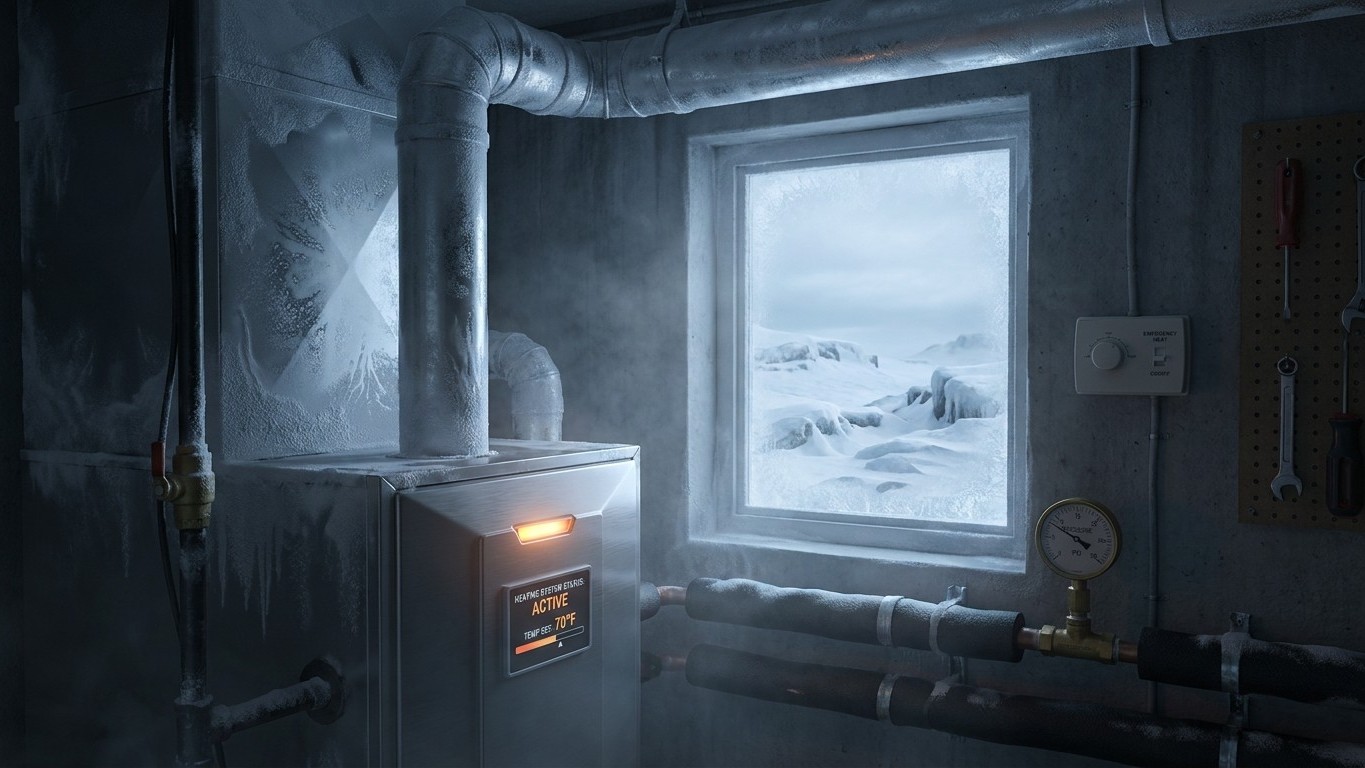

Rankin Inlet’s coldest month averages a daily minimum of -29.8°F, and that single number reshapes everything about keeping a Nunavut home livable. Wood heat plays a role for some households here, but the season length and the fuel math both work differently than they do farther south.
How cold it gets, and for how long

A mean daily minimum of -29.8°F in the coldest month isn’t a rare dip. It’s the average night, for the whole month, at the reference station in Rankin Inlet. That distinction matters because a lot of people picture “cold snaps,” a few brutal days bookended by milder weather. That’s not what this is. This is a baseline low that a heating system has to answer for, night after night, for stretches long enough that any weakness in the building envelope or the fuel supply gets found out.
Compare that to a heating climate where winter sits in the 20s or low teens Fahrenheit for a few months. That kind of winter is a steady draw on a furnace. What Rankin Inlet describes is something closer to a continuous load at temperatures where ordinary building materials, plumbing, and combustion equipment all behave differently than they do at, say, 10°F above zero. Fuel lines can gel. Moisture in wood freezes solid instead of merely making the log heavy. Metal chimney components contract enough to matter.
The practical result is a heating season that isn’t measured in a few cold weeks but in months where the equipment runs near its rated capacity almost continuously. Any furnace, stove, or boiler sized for a “typical” cold-climate winter elsewhere is likely undersized here, and any fuel-buying plan that assumes a short shoulder season is likely wrong here too. A household in this climate is heating against -30°F territory for a real chunk of the year, not against an occasional record low that shows up in a news story.
That’s the number to hold onto before shopping for equipment or fuel: not the record cold snap someone mentions at the hardware store, but the mean minimum for the coldest month. It’s the figure that tells you what the system has to do on an ordinary night, not an exceptional one.
What a cord of wood is worth here
A cord is a volume, not a weight, and that’s the detail that trips up a lot of firewood buyers. It’s a stack measuring 4 feet by 4 feet by 8 feet, which works out to 128 cubic feet total (some of that space is air gaps between the pieces, so the actual solid wood volume is less than the full 128 cubic feet). Because it’s a fixed volume, the amount of heat you get out of it depends entirely on what’s packed into that space. Dense hardwood crams more actual wood mass into the same stack than a softer, lighter species, and more mass means more fuel to burn.
Michigan State University Extension puts a well-seasoned cord of hardwood at about 20 million BTU. That’s an average, and species plus moisture content can move it substantially in either direction, but it gives a useful anchor. MSU also frames that number in a way that actually means something to a household comparing fuels: one cord is roughly equivalent to the heat in 145 gallons of #2 fuel oil, or 215 gallons of LP gas.
| Measurement | Figure |
|---|---|
| Standard cord dimensions | 4 ft x 4 ft x 8 ft |
| Total volume | 128 cubic feet |
| Heat content (well-seasoned hardwood) | about 20 million BTU |
| Equivalent in #2 fuel oil | about 145 gallons |
| Equivalent in LP gas | about 215 gallons |
Where that 20 million BTU figure falls apart is moisture. Wood that hasn’t seasoned properly spends a large share of its combustion energy boiling off water trapped in its cells before it ever throws usable heat into the room. That’s not a small inefficiency, it’s the whole ballgame, which is why the next section on drying time matters as much as the cord math itself. Anyone buying wood by the cord in a climate this demanding needs to ask what’s actually stacked inside those dimensions, not just trust the label.
How long wood takes to dry in Nunavut
Seasoning wood isn’t a fixed calendar exercise. It depends on how much moisture the air pulls out of the wood over a given stretch of time, which means it’s tied directly to local humidity and how much real summer heat a place gets. MSU Extension’s benchmark is straightforward: firewood should burn at 20 percent moisture or less, and green, freshly cut wood can carry more than 60 percent moisture. Getting from one state to the other, for wood that’s split and stacked so air actually moves through the pile, typically takes one full summer season.
That’s the operative detail: split and stacked, not left in rounds. A round log dries from the outside in, agonizingly slowly, while a split piece exposes far more surface area to air. Stack it loosely enough for airflow, in a spot that gets sun and wind, and a summer’s worth of drying does the job for most species. Red oak is the named exception in MSU’s research: its cell structure resists moisture loss, so it needs meaningfully longer than a single season to reach burnable dryness.
Burning wood before it’s ready doesn’t just mean a weaker fire. The unboiled moisture eats combustion energy that should be heating the house, so a load of green wood puts out noticeably less usable heat than the same load properly seasoned. The unburned byproducts of that inefficient combustion condense inside a cooler flue as creosote, and that buildup is what turns an occasional chimney cleaning into a seasonal necessity. In a climate running heating equipment near-continuously for months, a sootier flue and reduced output aren’t minor annoyances. They’re the difference between a stove that keeps up with a -30°F night and one that doesn’t.
None of that is a reason for alarm about wood heat here. It’s a reason to buy or cut a season ahead, so the wood going into the stove this winter was split and stacked the summer before, not the week before.
Where to check before you buy
Nunavut covers an enormous range of terrain, coastline, and exposure, and the figures above describe conditions at the Rankin Inlet reference station specifically. Local microclimates, wind exposure, and elevation can shift what a given household actually experiences, and species availability for firewood varies a great deal across the territory as well.
For guidance specific to a location, Agriculture and Agri-Food Canada is a reliable starting point: https://agriculture.canada.ca/en. It’s worth checking directly rather than relying on general figures, especially for anything involving seasonal burn restrictions. Those rules are set locally, they can change from one year to the next, and burning on a day a restriction is in effect can carry real consequences beyond the inconvenience.
The bottom line for anyone heating with wood in this territory: know the reference numbers, but confirm the local specifics before the wood goes in the stove.