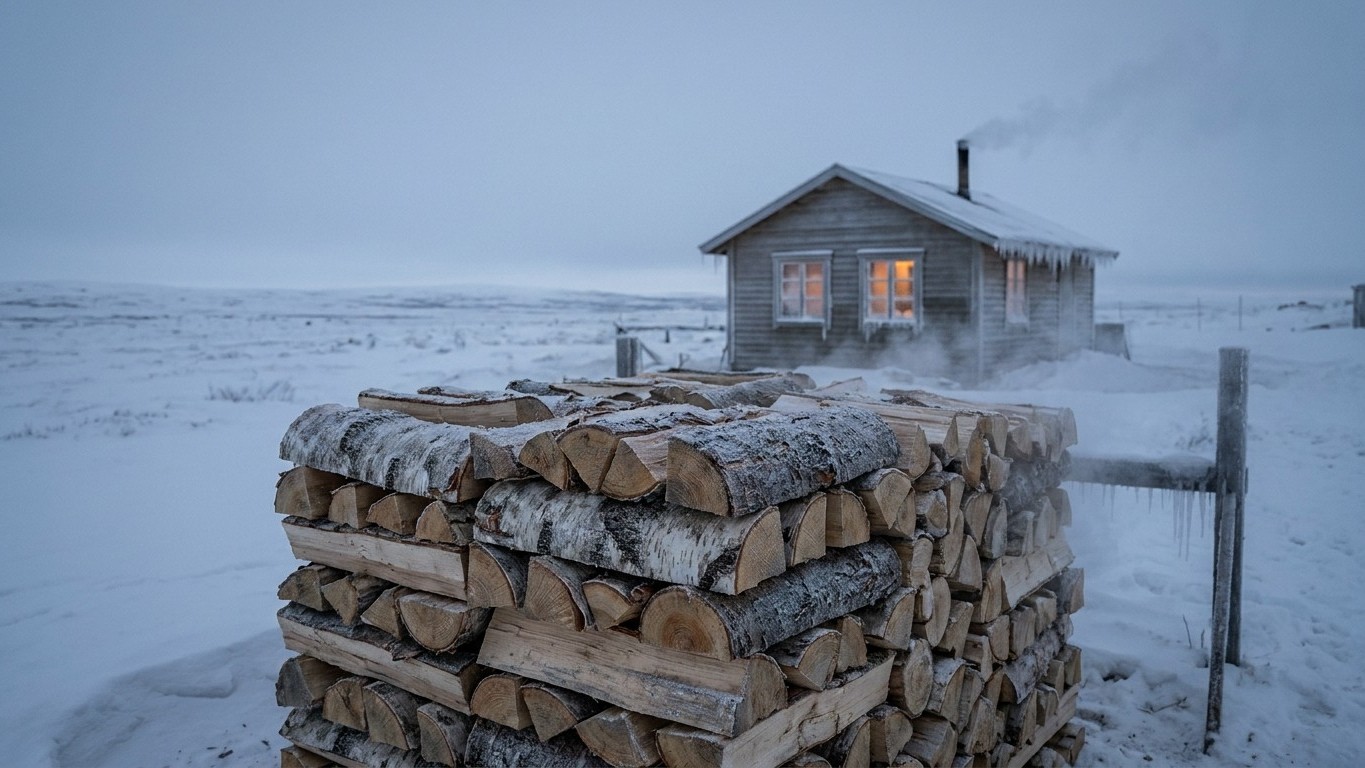

Firewood in Nunavut answers a simple question with a hard number: the coldest month here averages a low of -29.8°F, so any wood you burn has to carry real heat, not just atmosphere. That figure, plus the fact that almost no firewood grows locally, shapes every decision below: which species to chase, how many cords to order, and how long they need to dry before they’re worth burning.
How cold it actually gets here

The reference figure for this region comes from Rankin Inlet: an average daily low of -29.8°F in the coldest month, according to Environment and Climate Change Canada’s 1981-2010 Climate Normals. That’s not a record low, and it’s not some rare cold snap. It’s the average low, meaning half the nights in that month dip colder than that. A stove or fireplace running through a winter like this isn’t decoration. It’s structural.
When the mean low sits nearly 30 degrees below zero, heat loss through walls, windows, and doors accelerates, and whatever is burning has to keep pace for hours at a stretch, often overnight, without anyone tending it. This is the opposite end of the spectrum from a mild-climate homeowner who lights a fire for the mood on a 45°F evening. There, wood is a bonus. Here, wood (where it’s used at all) is part of a heating system that has to hold a house together against sustained, punishing cold.
That context matters because Nunavut sits at or above the treeline across most of its communities. There isn’t a local forest to cut from the way there is in, say, northern Ontario or the Yukon interior. Firewood usually arrives by barge or truck from the south, which means every cord costs more, in money and in logistics, than it does almost anywhere else in the country. That single fact reframes the rest of this guide: the question isn’t just “which wood burns hottest,” it’s “which wood is worth paying to ship and worth the effort to season properly once it arrives.”
In most Nunavut households, wood heat functions as a supplement to fuel-oil furnaces rather than the sole source of warmth, precisely because the deep cold and the supply chain make wood-only heating impractical for most homes. That doesn’t make the wood you do burn less important. If anything, it raises the stakes on getting the choice right, because a shipment that shows up unseasoned or the wrong density is a lot harder to fix mid-winter here than it is somewhere with a woodlot down the road.
Which woods are worth the effort here
With a coldest-month average of -29.8°F, density is the variable that matters most. A cord is a fixed volume, always 4 feet by 4 feet by 8 feet, or 128 cubic feet, no matter what species fills it. A cord of dense hardwood packs far more wood fiber, and therefore far more stored energy, into that same box than a cord of soft, light wood. Michigan State University Extension puts the benchmark at roughly 20 million BTU per cord of well-seasoned hardwood, comparable to the heat in about 145 gallons of #2 fuel oil or 215 gallons of LP gas. That average assumes hardwood and assumes it’s properly dried. Species and moisture content both push that number up or down substantially, so treat it as a reference point, not a guarantee for any specific load.
Because almost nothing burnable grows locally, the practical question in Nunavut isn’t “which of twelve species is theoretically best.” It’s “of what actually shows up on the barge or the truck, what’s worth requesting again.” Dense hardwoods, the kind that anchor that 20-million-BTU average, are what you want reserved for the coldest nights and for the overnight burn, the load you build before bed and expect to still have coals from in the morning. Lighter, softer woods burn fast and hot at the start but drop off quickly. They’re better suited to getting a stove going quickly, to shoulder-season evenings before deep winter sets in, or to mixing with a dense load to bring it up to temperature faster, not to holding heat through a -30°F night on their own.
Smoke and spark behavior track loosely with density and moisture too. Denser, well-seasoned hardwood tends to burn cleaner and produces fewer sparks. Softer wood and anything under-seasoned tends to smoke more and pop more, which matters in a stove or fireplace inside a tightly sealed Arctic home where ventilation is already a balancing act against heat loss.
| Wood category | Heat output per cord | Smoke | Sparks |
|---|---|---|---|
| Dense hardwood, well-seasoned | Highest (near the ~20 million BTU average) | Low | Low |
| Softwood / lighter species | Noticeably lower per cord | Higher | Higher |
| Any species, unseasoned | Reduced regardless of species | High | High |
That last row is the one that matters most here. A dense species you can’t get properly dried before it’s needed is worse than a modest one you can season correctly. In a region where every cord is shipped in, availability and seasoning status often override the species question entirely.
How much wood a winter takes
There’s no honest single number for “cords per winter” in Nunavut, and any source that gives you one flat figure is skipping the variables that actually decide it. Three things move the estimate, and you need to run your own situation through each of them rather than trust a published average.
- The cold itself: with a coldest-month average low of -29.8°F, the heating demand here is already at the extreme end, so whatever baseline usage a milder region reports doesn’t transfer.
- How well the house holds heat: insulation, air sealing, and window quality determine how much of the heat you generate actually stays inside. A poorly insulated house in a hard winter can burn through roughly double what a tightly sealed house uses in that same cold.
- Whether wood is primary or supplemental: a stove backing up an oil furnace on the coldest nights burns far less wood over a season than a stove or fireplace expected to carry the full heating load.
Run those three in order for your own home. Start with the fact that the baseline cold here is severe by any national standard. Then be honest about your house’s insulation, since a leaky older structure and a newly sealed one can differ enormously in wood consumption even sitting on the identical street. Finally, decide what role the wood stove actually plays: evening supplement, overnight backup, or the thing standing between the house and the cold. Only once you’ve answered all three does a cords-per-winter number mean anything for your specific situation, and even then it’s an estimate, not a guarantee.
Drying wood in this climate
Seasoning decides more about how a fire performs than species does, anywhere in the country, and Nunavut’s climate makes the seasoning window tighter than most places. The target is the same everywhere: 20 percent moisture content or less. Green wood can sit above 60 percent moisture, and that extra water has to boil off before the wood releases any usable heat, which means a green log is spending part of its burn just drying itself out instead of warming your house.
What actually dries wood is air movement and time, not direct sun, so split rounds stacked with gaps between them, off the ground, in a spot exposed to wind, will season faster than wood piled tight in a shed. In a place with a short, cool summer and a long, brutally cold winter, that drying window is compressed. Wood split and stacked right at the start of summer has less time to shed moisture before the cold returns than the same wood would have in a region with a longer warm season.
That timeline compression is exactly why the most common mistake in Nunavut is cutting or receiving wood in spring and expecting it to be ready for the winter that follows the same year. In most cases it isn’t. A single short summer, even with good stacking, often isn’t enough to bring green hardwood down to 20 percent moisture, particularly for a species like red oak, which MSU Extension notes dries slowly because of its cell structure and needs extra time regardless of climate. The safer approach here is to plan a full year ahead: wood meant for this winter should ideally have been split and stacked the previous spring or earlier, not the one just past. Given how much every cord costs to ship into the territory, treating seasoning as an afterthought is the fastest way to turn an expensive delivery into a smoky, underperforming fire.