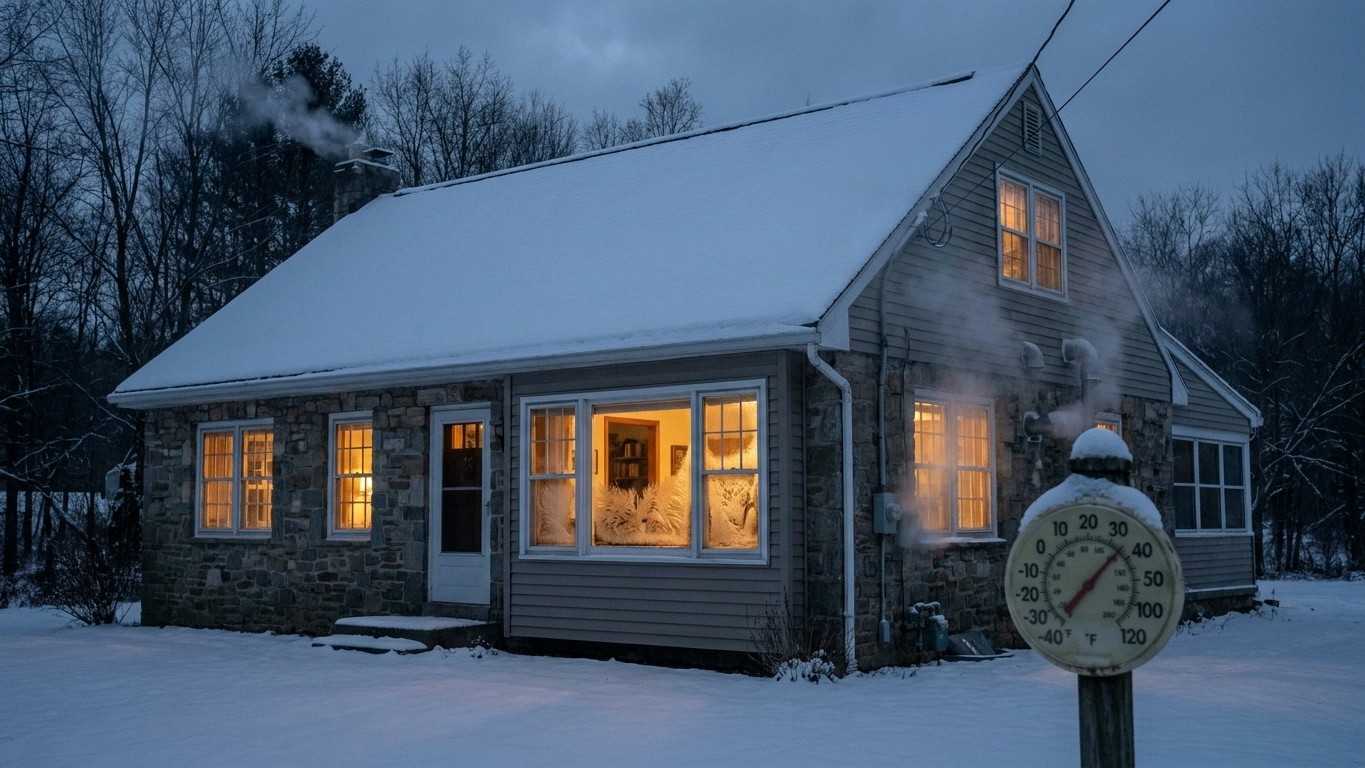

Pennsylvania winters average a coldest-month low of 26°F in Philadelphia, and that single number shapes everything about how a household here burns fuel: how long the season runs, how much wood or oil it takes, and how forgiving the margin is when equipment underperforms. Here’s what that cold actually demands from a home.
How cold it gets, and for how long

Twenty-six degrees is the average daily minimum for the coldest month at the Philadelphia reference station, per NOAA’s 1991-2020 Climate Normals. That’s not a record low and not some rare cold snap. It’s the typical overnight floor, month after month, for the coldest stretch of the year. And that steadiness is the part that matters more than the number itself.
A house doesn’t just need to survive one brutal night. It needs a heating system that can hold a comfortable indoor temperature against a mid-20s outdoor floor for weeks at a stretch, night after night, from roughly December through February and often bleeding into March at higher elevations. (See When Does the Heating Season Start in Pennsylvania? for how that timing breaks down, and When Can You Turn the Heat Off in Pennsylvania? for the other end of that window.) That’s a long, grinding season rather than a short, sharp one. Compare that to a climate where winter drops into single digits but only for a handful of weeks: the equipment sizing, the insulation priorities, and the fuel budget all shift.
What a mid-20s floor means for equipment
A furnace or boiler in this range gets used a lot, not just hard. Runtime adds up over a full season of near-freezing nights, which is why efficiency ratings and proper sizing matter more here than raw output. Oversized systems cycle on and off constantly and never settle into an efficient rhythm; undersized ones run nonstop and still fall short on the coldest nights.
Wood-burning households feel this the same way. A stove that comfortably holds a room at 68°F when it’s 35°F outside has to work considerably harder when the outdoor number sits at 26°F for weeks. That’s the backdrop for the fuel math below.
What a cord of wood is worth here
A cord of well-seasoned hardwood delivers about 20 million BTU, according to Michigan State University Extension. That’s not a small number, but it’s also not automatic. A cord is a volume, not a weight or a heat guarantee, and that distinction is exactly where firewood buyers get shortchanged.
The measurement is fixed: a cord is a stack 4 feet by 4 feet by 8 feet, or 128 cubic feet total. Anything sold as a “cord” that doesn’t fill that stack, loosely thrown, rounded logs, a truck bed called a cord, isn’t one. Density is what actually varies inside that fixed volume: a dense hardwood packs more burnable mass into the same 128 cubic feet than a lighter species, which is why species selection changes how far a cord goes into a Pennsylvania winter even when the stack size never changes.
| Measurement | Value |
|---|---|
| Cord dimensions | 4 ft x 4 ft x 8 ft |
| Total volume | 128 cubic feet |
| Heat energy (well-seasoned hardwood) | about 20 million BTU |
MSU frames that 20 million BTU in terms a homeowner can actually use: one cord of seasoned hardwood is roughly equivalent to 145 gallons of #2 fuel oil, or 215 gallons of LP gas. Against a season with weeks of mid-20s nights, that comparison is the fastest way to gauge how many cords a given heating setup needs to get through to spring, well before any dollar figure enters the picture.
How long wood takes to dry in Pennsylvania
The BTU figure above only holds if the wood is actually dry. MSU sets the target at 20 percent moisture or less for burning; green wood can run over 60 percent. That gap isn’t cosmetic. Every bit of water inside a log has to boil off before the wood releases usable heat, and boiling water consumes energy that would otherwise be warming the house.
Green, split hardwood typically reaches that 20 percent mark after one full summer stacked so air moves freely through the pile. That’s the operative phrase: split and stacked, not left in rounds in a corner of the yard. A round log seals in moisture at its core no matter how long it sits; splitting exposes the wood grain that actually lets water escape. There’s one named exception worth remembering here: red oak dries slowly because of its cell structure, so it needs more than one summer to reach burn-ready moisture, even when it’s properly split and stacked.
Burning too soon has consequences beyond a weaker fire. Wet wood produces less usable heat per log, which means feeding the stove more often to hold the same room temperature. It also builds creosote in the flue faster, since unburned compounds in the smoke condense on cooler chimney walls instead of combusting cleanly. Over a Pennsylvania season with sustained cold and heavy stove use, that translates to a chimney needing a sweep sooner than it would with properly seasoned wood. None of this requires alarm. It just means the wood bought or cut this spring generally isn’t the wood to burn this winter.
Where to check before you buy
Everything above describes the Philadelphia reference station, and Pennsylvania stretches from Lake Erie’s shoreline to Allegheny Plateau elevations well above 2,000 feet. A property in the state’s northern tier or its mountain counties runs colder and often longer than the Philadelphia figures suggest, which shifts both the heating-season length and the number of cords a household should plan on.
For local specifics, which hardwood species are actually available near a given property, how they season locally, and whether any seasonal or county-level burn restrictions apply, Penn State Extension is the resource to check. Burn rules in particular are set locally and revised from year to year, often tied to air quality conditions rather than a fixed statewide calendar, so what applied last winter isn’t a safe assumption for this one. A quick check before stocking a woodpile or lighting the first fire of the season is the difference between planning around this year’s actual rules and last year’s outdated ones.
What each heat source costs to run in Pennsylvania
At Pennsylvania’s average residential prices, this is what one million Btu of heat delivered into the house costs with each system. It compares fuels on the same unit: it is not a yearly bill, and it leaves out the price of the equipment.
| System | Cost per million Btu delivered |
|---|---|
| Electric resistance (baseboard, 100% efficient) | $61.66 |
| Heat pump at 8.1 HSPF2 (seasonal COP about 2.4) | $25.98 |
| Natural gas furnace at 97% AFUE | $14.95 |
Cheapest to run in Pennsylvania: natural gas furnace, $11.03 less per million Btu than the heat pump.
Prices: U.S. Energy Information Administration (EIA), average residential prices. Efficiencies: ENERGY STAR criteria. A heat pump’s figure is a seasonal average; in the coldest weather its efficiency drops.