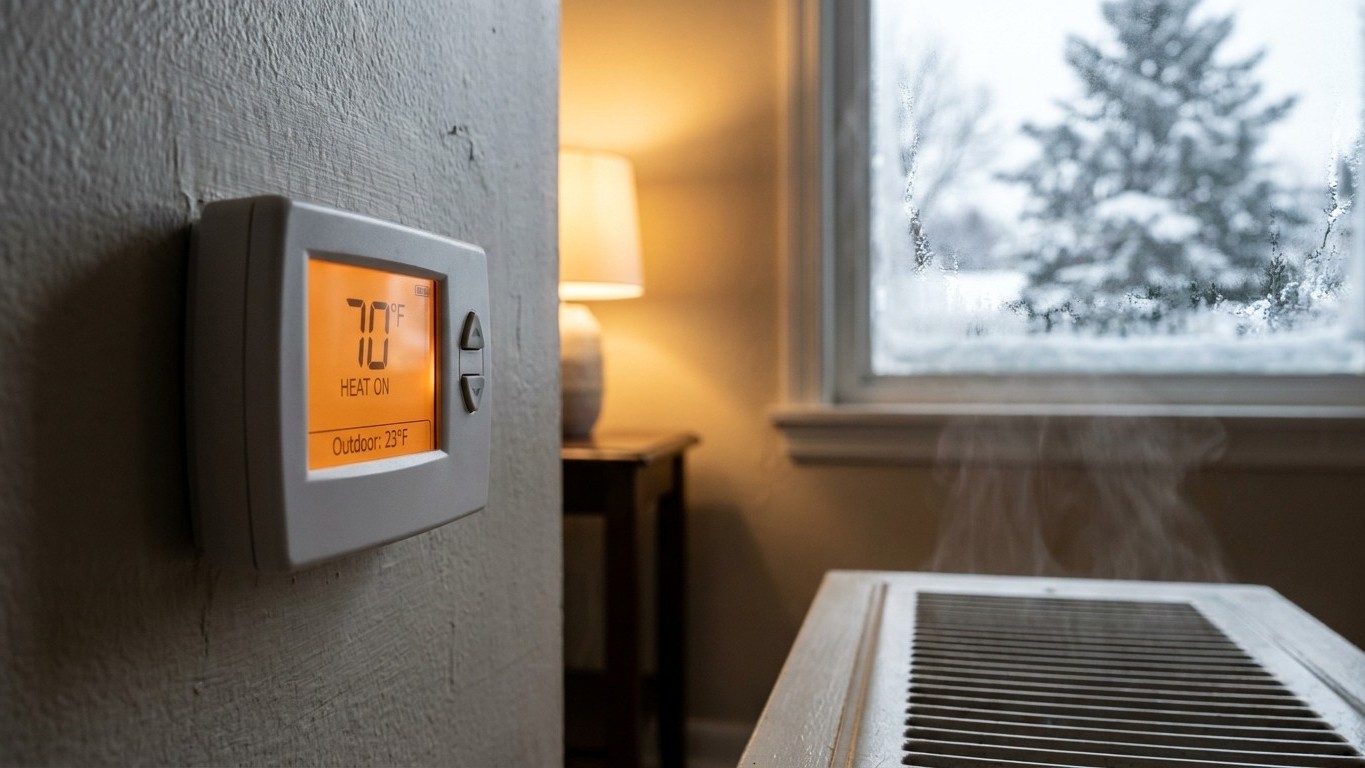

Illinois winters mean months of running a furnace through mornings that barely climb above 20°F, and that steady demand, not the occasional cold snap, is what drives up a heating bill. Here’s what the numbers say about the season, and what they mean if wood is part of your setup.
How cold it gets, and for how long

The coldest month in Illinois averages a daily low of 18.8°F, based on NOAA’s 1991-2020 Climate Normals for the Chicago reference station. That’s not a record low from some freak arctic blast. It’s the typical overnight temperature, night after night, for the coldest stretch of the year. When Does the Heating Season Start in Illinois? That distinction matters more than most homeowners realize.
A single-digit night is an event. A month where the thermostat can’t stop working because it’s consistently in the high teens is a pattern, and patterns are what wear out equipment and inflate bills. A furnace in a climate like this doesn’t get to cycle down and rest for long stretches. It runs, stops briefly, and runs again, day after day, from roughly November through March.
Compare that to a milder mid-Atlantic winter where the coldest month might sit in the high 20s. The difference of ten degrees doesn’t sound dramatic on paper, but it changes how many hours a heating system operates and how much fuel or wood it consumes to hold a house at 68°F. Illinois sits closer to the harder end of that range for the Midwest, not the mildest, which also pushes back the point in spring when it’s safe to stop heating. When Can You Turn the Heat Off in Illinois?
What this means for equipment choices
A house here needs a heating system sized for sustained output, not just peak cold. That applies whether you’re running a gas furnace, a heat pump with backup, or a wood stove supplementing a primary system. Undersized equipment in a climate with an 18.8°F coldest-month low doesn’t just struggle on the worst night. It struggles for weeks at a time, and that’s when energy costs pile up fastest.
What a cord of wood is worth here
If wood heat is part of your plan, understand the unit before you understand the price. A cord is a volume, not a weight: a stack measuring 4 feet by 4 feet by 8 feet, which works out to 128 cubic feet. That’s the legal, standard measurement, and it’s also the single easiest place for a buyer to get shorted. A “face cord,” a “rick,” or a pile that’s simply stacked loose and called a cord may hold a fraction of that volume.
| Measurement | Value |
|---|---|
| Dimensions | 4 ft x 4 ft x 8 ft |
| Total volume | 128 cubic feet |
| Heat output (well-seasoned hardwood) | about 20 million BTU |
According to Michigan State University Extension, a full cord of well-seasoned hardwood delivers roughly 20 million BTU. MSU frames that in terms a homeowner can actually use: one cord is roughly equivalent to the heat energy in 145 gallons of #2 fuel oil, or 215 gallons of LP gas. That comparison is useful in Illinois specifically, since propane and fuel oil still heat plenty of rural homes outside the natural gas grid.
Keep in mind that 20 million BTU is an average, not a guarantee. Species density and moisture content move that number substantially. A cord of a dense hardwood, well dried, will put more usable heat into a house through a cold Illinois month than the same volume of a lighter species or wood that’s still wet inside. That’s the entire logic behind buying by species and by seasoning, not just by the stack size.
How long wood takes to dry in Illinois
Wood needs to reach roughly 20 percent moisture or less to burn efficiently. Green, freshly cut wood can carry more than 60 percent moisture, according to MSU Extension, and that water has to boil off before the wood releases any usable heat. Every bit of energy spent evaporating water is energy that isn’t warming your living room.
Split and stacked wood, with air moving freely through the pile, typically reaches that 20 percent threshold after one full summer of seasoning. That’s the key phrase: split and stacked. Wood left in rounds, or piled tight against a wall with no airflow, dries far slower and sometimes never gets there before burning season starts. Red oak is a notable exception even under good conditions. MSU points out that its cell structure makes it dry more slowly than most other species, so it often needs a second season to reach the same moisture level.
Illinois summers bring enough heat and enough dry stretches to season split hardwood in that one-summer window, provided the stack is set up to catch sun and wind. A tarp over the top to shed rain, sides left open, and some clearance off the ground make the difference between wood that’s ready by October and wood that’s still damp in December.
Burning before wood is ready doesn’t just waste fuel. It changes how the wood burns: more smoke, less flame, and a duller heat that leaves a house colder than it should be for the same amount of wood loaded into the stove. The bigger cost shows up in the chimney. Unseasoned wood burns cooler and produces more creosote, the sticky residue that builds up in the flue and is the leading cause of chimney fires. A stove fed green wood all winter will need its chimney swept sooner, and more thoroughly, than one fed properly dried hardwood.
Where to check before you buy
Illinois runs from the Chicago metro on Lake Michigan down to the southern tip near the Ohio River, and conditions shift across that distance. The figures above describe the Chicago reference station, which is the standard benchmark for the state, but a homeowner in Cairo or Carbondale is working with a noticeably shorter, milder heating season than one in Rockford or the northern suburbs.
Species availability changes with that geography too. Oak, hickory, and maple are common across the state, but what a local firewood seller actually has on hand, and at what stage of seasoning, depends on the region and the year.
Burn restrictions add another layer that a national or regional source simply can’t cover. Some municipalities and counties enact seasonal burn bans tied to air quality alerts, and those rules are set locally and can change year to year. The University of Illinois Extension is the right place to check both of these before committing to a wood-heat plan: local specialists there can speak to species availability in your county and point you toward current burn ordinances, which a general climate figure never will.
What each heat source costs to run in Illinois
At Illinois’s average residential prices, this is what one million Btu of heat delivered into the house costs with each system. It compares fuels on the same unit: it is not a yearly bill, and it leaves out the price of the equipment.
| System | Cost per million Btu delivered |
|---|---|
| Electric resistance (baseboard, 100% efficient) | $56.33 |
| Heat pump at 8.1 HSPF2 (seasonal COP about 2.4) | $23.73 |
| Natural gas furnace at 97% AFUE | $11.18 |
Cheapest to run in Illinois: natural gas furnace, $12.55 less per million Btu than the heat pump.
Prices: U.S. Energy Information Administration (EIA), average residential prices. Efficiencies: ENERGY STAR criteria. A heat pump’s figure is a seasonal average; in the coldest weather its efficiency drops.