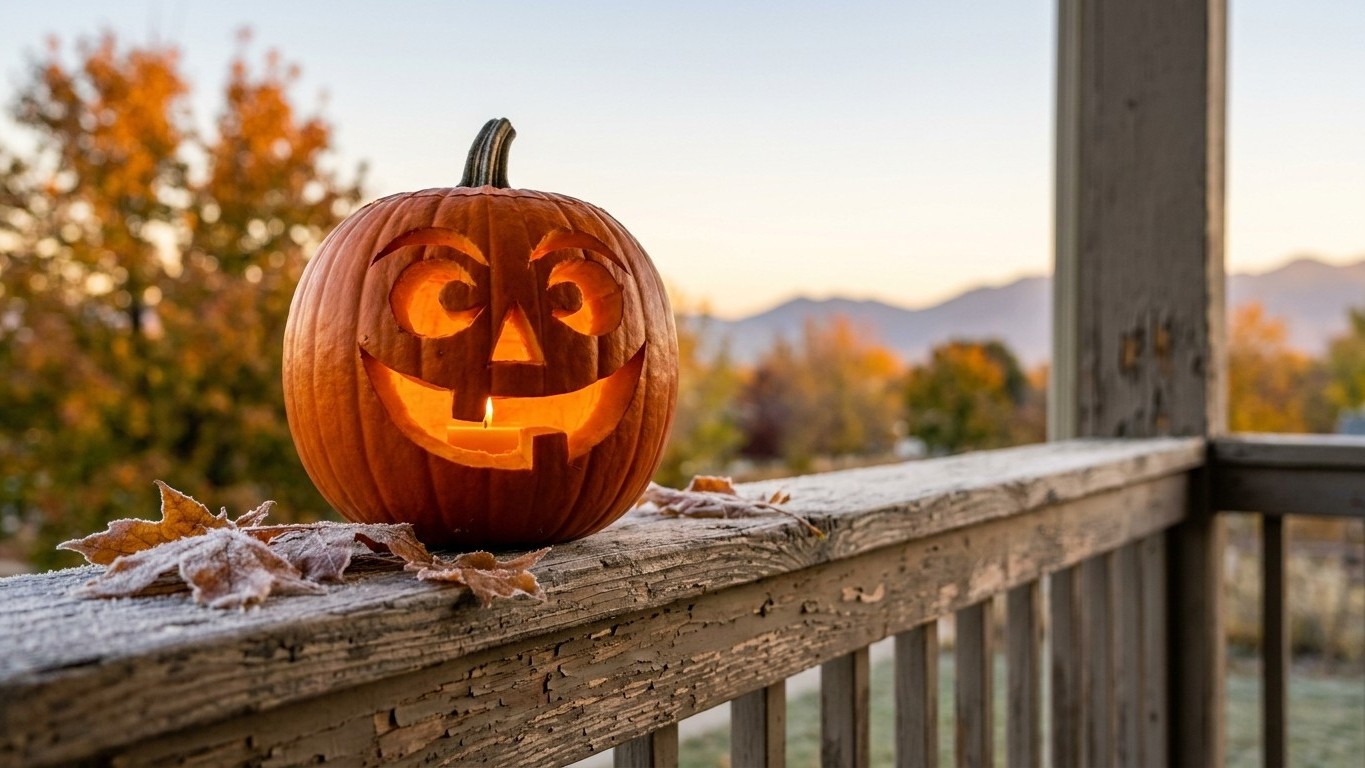

Utah’s mean first fall frost lands somewhere between October 18 and October 29 in the Salt Lake valley, which puts it squarely in the two weeks before Halloween. That timing matters more than most carvers realize: a pumpkin sitting on a porch through a hard freeze softens fast once temperatures climb back up. The safe window here isn’t “anytime in October.” It’s closer to the final few days before October 31, timed to dodge the freeze-thaw cycle rather than to beat some arbitrary calendar mark.
The short answer

Around October 18 to October 29 is when the Salt Lake City area typically sees its first fall frost, according to NOAA’s 1991-2020 Climate Normals. That’s a 30-to-70 percent probability band, not a fixed date, so treat it as a rough marker rather than a countdown clock. What it tells a pumpkin carver is this: frost risk in the valley often arrives before Halloween, sometimes well before it, sometimes just a couple of days ahead.
For anyone outside the immediate Salt Lake basin, the picture shifts fast. Utah’s elevation swings are extreme, and most of the state sits higher and colder than the valley floor where this station sits. Mountain towns and benches above the valley routinely see their first freeze weeks earlier than Salt Lake does. Southern Utah, by contrast, runs warmer, and places like the low desert around St. George often push frost risk later into the season or skip an October freeze altogether.
What that means practically: if you’re carving in the Salt Lake valley, plan on frost arriving somewhere in that ten-day window before Halloween, and don’t assume your pumpkin is safe outdoors just because the calendar says late October. If you’re higher up, in the mountains or on a bench, shift your mental frost date earlier, possibly by two or three weeks. If you’re in the warmer south, the frost risk shrinks and heat becomes the bigger concern instead.
The practical takeaway is to keep the pumpkin whole and stored properly until you’re within a handful of days of Halloween, then carve it close to the day itself. That approach sidesteps the frost question entirely for most of the state, since an uncarved pumpkin stored at the right temperature tolerates the swing far better than one left exposed on a step or a rail. Carving late isn’t just tradition. In Utah’s climate, it’s the simplest way to avoid handing your jack-o’-lantern a freeze it can’t recover from.
Frost or heat: which one gets it here
A whole pumpkin keeps best in a cool, dark spot between 45 and 50 degrees Fahrenheit, per University of Illinois Extension guidance. Utah’s late-October climate rarely sits inside that band on its own, which means the state’s carvers are usually managing one of two problems: too cold, or too warm.
The cold end
Salt Lake City’s coldest month averages a daily minimum of 24.2 degrees Fahrenheit, a full 20 degrees below the bottom of the storage range. That figure is the mean minimum for the coldest month, not a record low and not a daytime average, and it signals just how far outdoor nighttime temperatures can drop once autumn turns toward winter. In much of Utah, especially at higher elevations and away from the valley floor, freezing nights arrive earlier and harder than in Salt Lake itself. A pumpkin left outside overnight in that kind of cold doesn’t just chill, it can suffer cell damage that shows up as soft, sunken spots once it warms back up. For most of the state, cold is the dominant threat to a stored pumpkin, not heat.
The warm end
Southern Utah flips that script. In the lower-elevation desert country near the Arizona border, October afternoons and even overnight lows can sit well above the 45-50 degree storage band for weeks at a stretch. A pumpkin stored in a garage or shed there without any cooling can ripen and soften faster than intended, shortening the useful window before it even gets to the carving stage. For carvers in that part of the state, heat management, not frost, is the bigger variable to watch.
Where to keep it until you carve
- Find the coolest indoor spot that stays dark. An unheated basement, a mudroom against an exterior wall, or a cellar tends to run closest to the 45-50 degree range in most Utah homes during October, especially compared to a heated living space.
- Check an attached garage before trusting it. In the Salt Lake valley and points north, an unheated garage can dip near or below freezing on the coldest October nights, right in line with that 24.2 degree cold-month average. If yours runs that cold overnight, move the pumpkin somewhere less exposed.
- Skip the porch railing and the sunny front step. Direct sun swings surface temperature well outside the storage band during the day, even when the air itself feels mild, and that daily swing stresses the rind.
- Keep it away from ripening fruit and vegetables. Apples, potatoes, and tomatoes give off ethylene gas as they ripen, and that gas speeds up aging in a nearby pumpkin. A kitchen counter fruit bowl is a bad neighbor.
- Leave the stem alone. Look for a pumpkin with 1 to 2 inches of stem intact when you buy it, and never lift or carry it by that stem. Once the stem breaks off, that spot is exposed and spoils faster than the rest of the pumpkin.
Checking this against your own county
Salt Lake City’s frost data is a useful anchor, but Utah’s terrain makes county-level variation the rule rather than the exception. A backyard in Cache Valley behaves nothing like one in Washington County, and neither behaves like the Salt Lake bench. Before locking in a carving date, check with Utah State University Extension (extension.usu.edu), which publishes local growing and frost information tailored to specific counties across the state.
That local data will tell you whether your area tends to freeze earlier or later than the valley average, and whether heat or cold is the bigger factor where you live. Five minutes on the extension site beats guessing based on a statewide average that may not describe your actual backyard.
Common questions
Does a carved pumpkin last longer if I coat it with something?
No university extension publishes a preservation protocol for carved pumpkins, including bleach dips or petroleum jelly coatings. Those tips circulate widely online, but they’re not research-backed. The reliable approach is to choose a firm pumpkin with an intact stem, keep it whole and properly stored, and carve it close to the day you plan to display it.
Is frost worse for a pumpkin than a hard freeze?
They’re not the same event. A frost is a lighter, often surface-level cold event, while a hard freeze drives temperatures well below 32 degrees for a sustained period and does more damage to plant and produce tissue. Utah’s coldest-month minimum of 24.2 degrees points toward freeze-level cold being common in the state once late fall sets in, which is harder on a stored pumpkin than an isolated light frost.
Should I carve earlier if I live in the mountains instead of the valley?
Not necessarily earlier carving, but earlier awareness. Mountain and bench areas above the Salt Lake valley tend to see frost sooner than the valley floor, so the storage question matters more there. Keep the pumpkin whole and in a stable, cool, dark spot longer, and still aim to carve close to Halloween rather than weeks ahead.
What matters more when buying a pumpkin, shape or the stem?
The stem. University of Illinois Extension guidance points to 1 to 2 inches of stem as the marker of a well-sealed pumpkin, along with a heavy weight and no soft spots or blemishes. Shape has no bearing on how well it stores.