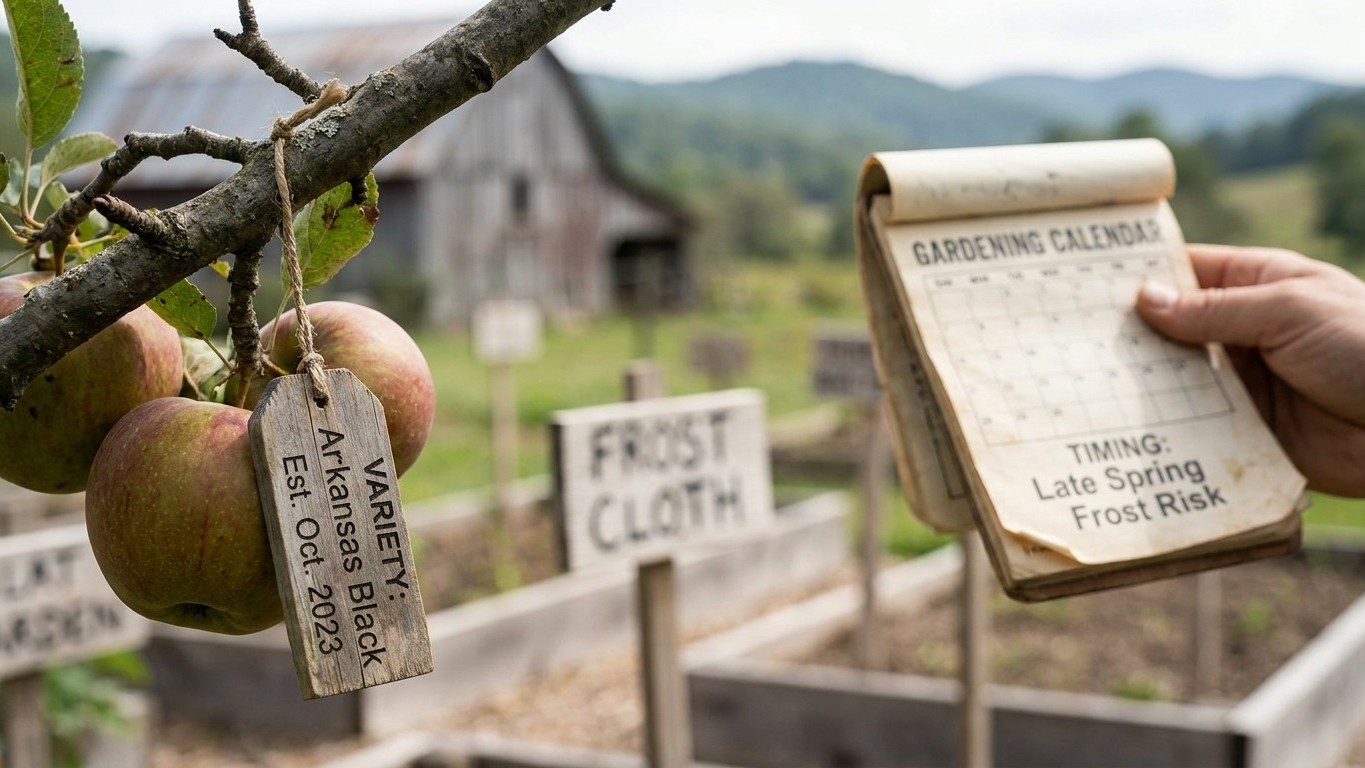

West Virginia’s winters aren’t a barrier to apples, they’re what makes an orchard here work in the first place. Every county from the Eastern Panhandle ridges down to the Ohio border sits squarely in the cold range apples need to flower and fruit reliably, so the tree you plant will most likely still be bearing decades from now. The one thing worth doing before you order it: find your county’s elevation and picture where cold air pools on your own ground, because that decides how your orchard behaves far more than which town you’re closest to.
Can you grow apples in West Virginia
Apples are one of the most reliable tree fruits for this state. The USDA Plant Hardiness Zone Map (2023, based on 1991-2020 normals) places West Virginia across zones 5a to 7a, a spread wide enough to run from the cold ridges of the Allegheny Highlands down to the warmer river valleys around Charleston and the Ohio border. Nearly every apple variety sold through American nurseries is rated for some part of that range, so hardiness alone rules out almost nothing here.
At Charleston, NOAA’s NCEI 1991-2020 Climate Normals put the coldest month’s average daily minimum at 26.3°F. That number matters more than the record low most people worry about. It describes the ordinary cold an orchard sits through every winter, not a rare cold snap, and it sits well within what a dormant apple tree tolerates without injury.
Where the range plays out differently across the state
Charleston sits in a river valley, and the figures above are measured there. Higher ground across the state, the Eastern Panhandle’s ridges, the highlands around Davis and Canaan Valley, the mountain counties along the Virginia border, runs colder and later in spring than the valley figures suggest. If your orchard sits above the river valleys, expect frost to linger longer into spring and arrive sooner in fall than the Charleston dates in this article describe.
None of that rules out an orchard at altitude. It means picking varieties and rootstocks suited to a shorter growing season, and reading local frost timing as a range that shifts earlier or later with elevation, not a fixed date. Growers in the eastern counties and higher hollows have grown apples for generations. The choice of variety and the timing of the calendar just need adjusting for where you actually are, and checking a West Virginia apple Calendar can help you match those adjustments to your own site, while a list of West Virginia apple Best varieties can help you narrow down which trees actually fit that site.
Site selection within your zone
Site matters as much as zone number. A tree planted in a low hollow that pools cold air will bloom into frost more often than a tree planted on a gentle slope with room for cold air to drain away downhill. On a hillside farm, that difference in siting can matter more than the half-zone gap between two nearby towns, and it costs nothing to choose the better spot before you dig the hole.
Which varieties suit this climate

Once hardiness is settled, the next filter is winter chill: the number of cold hours a tree needs before it can break dormancy and flower properly. Get chill wrong and the tree does not die, it just blooms thin and ragged, spread out over weeks instead of concentrated into a real bloom. West Virginia’s winters, with that Charleston coldest-month average of 26.3°F and colder still at elevation, sit at the high end of the chill scale, the same end as the rest of the Appalachian and Northeastern apple belt. Varieties bred for low-chill climates, the kind grown across the Deep South and the low desert Southwest, are the wrong choice here.
Growers in a state like Arizona work from the opposite end of that same chill scale, choosing low-chill selections that would bloom badly in a West Virginia winter. See Growing Apples in Arizona: Varieties, Timing and Frost Risk for how that calculation runs in reverse.
Varieties with published ranges for this state
Several catalogue varieties list hardiness ranges that cover zones 5a to 7a. ‘Liberty’ and ‘Enterprise’, both bred through the same disease-resistance breeding program, carry scab immunity or strong resistance, useful on a hillside orchard where spraying on schedule is inconvenient. ‘Honeycrisp’ and ‘Gala’ are widely planted across the state too, though ‘Honeycrisp’ is a notoriously fussy grower prone to bitter pit and biennial bearing regardless of climate. ‘Golden Delicious’ and ‘Grimes Golden’ both carry hardiness ratings that fit this range. ‘Grimes Golden’ has the added distinction of having originated near Wellsburg, in the state’s northern panhandle, in the early 1800s, and regional nurseries still sell it as a heritage variety suited to the conditions it was found in.
For growers who want the older commercial varieties, ‘York Imperial’, ‘Stayman’ and ‘Winesap’ all list published hardiness ranges covering this state and have a long history in Mid-Atlantic orchards. All three, along with ‘Arkansas Black’ and ‘Jonagold’, are triploids: they produce sterile pollen and cannot pollinate themselves or any other tree, a detail that matters when you plant the second tree.
| Variety | Bloom time | Pollen | Notable trait |
|---|---|---|---|
| ‘Liberty’ | Mid-season | Fertile (diploid) | Scab-immune |
| ‘Enterprise’ | Mid to late | Fertile (diploid) | Disease-resistant, stores well |
| ‘Gala’ | Mid-season | Fertile (diploid) | Widely available regionally |
| ‘Golden Delicious’ | Mid-season | Fertile (diploid) | Good pollenizer for many varieties |
| ‘Winesap’ | Late | Sterile (triploid) | Needs two other pollenizers nearby |
| ‘Stayman’ | Mid to late | Sterile (triploid) | Needs two other pollenizers nearby |
Where no local source names a shortlist of varieties for a specific county or elevation, that is worth saying plainly rather than guessing. Contact your county’s WVU Extension office for a list tuned to your particular ground.
Planting a pair that works here
Apples need cross-pollination from a genetically different variety blooming at the same time, and at least one of the two trees has to carry fertile pollen. That second condition is where a lot of new orchards go wrong. Several of the best-known varieties for this climate, ‘Stayman’, ‘Winesap’, ‘Arkansas Black’ and ‘Jonagold’ among them, are triploids that produce no usable pollen at all. Plant two triploids together, or a triploid with nothing else nearby, and the blossoms have nowhere for the pollen to come from. The tree flowers heavily every spring and still never sets a real crop.
Triploids and safe pairings
The safer route here is to pair a triploid, if you want one, with two diploid varieties blooming in the same window, or simply skip the triploids and plant two diploids together. ‘Liberty’ and ‘Enterprise’ bloom close enough in the same mid-season window to work as a pair. Both are diploid with fertile pollen, and both carry disease resistance that matters on a humid Appalachian hillside where fungicide schedules are hard to keep. ‘Gala’ and ‘Golden Delicious’ is another workable diploid pair sold by most regional nurseries, with overlapping bloom and fertile pollen on both sides.
A neighbor’s crabapple or an old seedling tree at the fence line can also do the pollinating job, since almost any apple or crabapple blooming at the same time will shed usable pollen onto a diploid variety nearby. What matters is bloom overlap, not variety name. Check the bloom period listed on the nursery tag or catalogue page before committing two trees to a pairing, since an early bloomer and a late bloomer planted side by side will miss each other most years.
The frost that costs a crop here

At Charleston, NOAA’s NCEI 1991-2020 Climate Normals put the 30-70% probability window for the last spring freeze at April 9 to April 23. That is not a date to circle on the calendar, it is a range, and the real risk in most years falls somewhere inside it rather than on one single day. Higher elevations across the state push that window later into spring, since Charleston’s river-valley station reads earlier than a ridge or hollow thirty miles away.
Why bloom timing matters more than the calendar
A hard frost that lands on a fully dormant tree does no damage at all. The tree only becomes vulnerable once it starts to move: green tip, then the pink stage when the unopened flower buds show color, then full bloom. A freeze that hits at pink or bloom kills the open flowers, not the tree. The wood, the leaves, and the buds that hadn’t opened yet all survive untouched, and the tree looks perfectly healthy all summer. What’s missing is the crop: no flowers, no pollination, no apples, for that one year only.
There is no reliable way to warm an entire hillside orchard on a frost night, but a grower with one or two trees has real options. Overhead sprinkler irrigation run continuously through a freeze protects blossoms by releasing latent heat as the water freezes on the buds, a technique commercial growers use in orchard country. Smaller plantings sometimes get by with frost cloth or old sheets thrown over the canopy overnight and pulled off by mid-morning. Both buy a few degrees of protection, not immunity from a hard freeze.
The more durable fix is variety choice. A late-blooming variety pushes its bloom window past the point where most spring freezes still occur, so it rides out a cold morning that would strip an early-blooming tree’s flowers clean. ‘Enterprise’, with its later bloom relative to earlier-flowering varieties, is worth checking against your own site’s frost history before you plant it next to an early bloomer. Growers in New York face a similar squeeze between a late-arriving spring and a short growing season further north, though the specific frost dates differ. See Growing Apples in New York: Varieties, Timing and Frost Risk for how that timing compares.
The apple year in West Virginia
Work off the tree’s stage, not the month on the wall, since a warm year and a cold year can put the same tree two or three weeks apart.
Dormancy through green tip
Through winter the tree needs nothing from you but pruning, done any time the wood is dry and the temperature is above freezing. Green tip, the first sign of growth pushing out of the bud, arrives well before the last-frost window and is the signal to finish any dormant-oil spray for overwintering insect eggs before growth hides the target.
Pink and bloom
Pink stage, when the unopened flower buds show color, typically lands close to or just before Charleston’s NOAA-normal last-frost window of April 9 to April 23, though exact timing shifts with the spring and runs later at elevation. This is the stretch to watch a forecast closely, since it’s the point where a freeze does the most damage for the least warning.
Petal fall and fruit set
Once the petals drop, the small green fruitlets that were pollinated begin to swell. This is when growers thin excess fruit by hand, pulling the smallest fruit from each cluster down to one or two. It’s the single step most home orchards skip, and most regret by August when the branches are overloaded with undersized apples.
Harvest
Harvest dates depend on variety, running from mid-summer for the earliest dessert apples to well into fall for late-storage types like ‘York Imperial’ and ‘Stayman’. All of it needs to happen before the first hard freeze, which NOAA’s 1991-2020 Charleston normals put in the October 18 to November 1 window, again later at low elevation and earlier up in the mountains. A late-hanging apple caught by a hard freeze on the tree turns soft and starts breaking down within days, so the safer habit is picking a few days early rather than a few days late.
Local help
For variety lists suited to specific counties and current spray timing for scab, fire blight and codling moth, contact WVU Extension. County agents can also tell you which varieties are actually performing well in your part of the state, since a recommendation that holds for the Eastern Panhandle doesn’t always hold for the southern coalfields or the northern panhandle.
Common questions
Can I grow apples on a hillside farm above the river valleys?
Yes, and many established orchards in the state’s higher counties do exactly that. Expect the last spring frost to run later than Charleston’s window and the first fall frost to arrive earlier, so shift your sense of the calendar accordingly rather than going by the valley dates.
My tree blooms every year but never sets fruit. What’s wrong?
The most common cause is a lone tree, or a pair that can’t pollinate each other. Check whether your variety is a triploid with sterile pollen, and whether a second, compatible, fertile variety is blooming nearby at the same time.
How many years before a new apple tree bears fruit?
It depends on rootstock more than climate. A dwarfing rootstock can produce a light crop within two to three years of planting, while a standard, full-size rootstock often takes five years or more before it fruits meaningfully.
Do I need to spray every year to get a decent crop?
In a humid state like this, disease pressure from scab and fire blight is real most years, and an unsprayed tree can still produce fruit but with more blemished and dropped apples. Scab-resistant varieties like ‘Liberty’ and ‘Enterprise’ cut the spray burden considerably, though they don’t eliminate it entirely.
Is the Charleston frost date the same for my county?
No. The Charleston figures come from a river-valley station, and NOAA’s own caution is that higher ground across the state runs colder and freezes earlier in fall and later in spring. Treat the Charleston dates as a starting reference, not your county’s actual number.