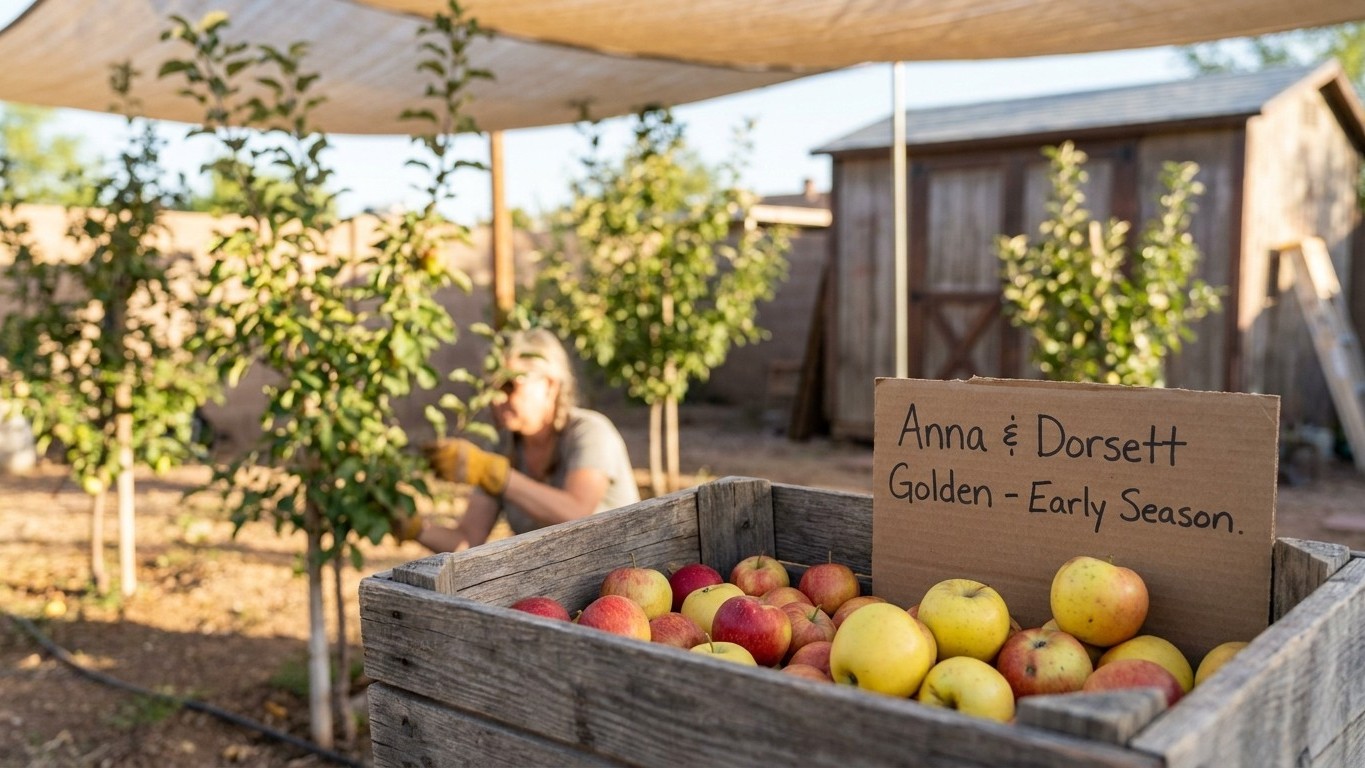

Forty-four point eight degrees — the average low of Phoenix’s coldest month — is the number that settles this before you plant anything. An apple tree needs real cold to break dormancy cleanly, and the low desert floor never delivers enough of it, so bloom comes thin and scattered rather than the tree dying outright. Up in Flagstaff, Prescott, or the grasslands around Willcox, that problem disappears and a different one takes over: hard freezes. Elevation, not frost tolerance, is what decides which apple question you’re actually answering.
Can you grow apples in Arizona
The low desert floor
Phoenix, the reference station NOAA’s National Centers for Environmental Information uses for the Salt River Valley, sits at the mild end of the state’s hardiness range. Its 1991-2020 climate normals put the coldest month’s mean daily minimum at 44.8°F, which barely qualifies as winter at all next to what an apple tree evolved to expect. A tree left in that kind of winter doesn’t get cold enough for long enough to break dormancy cleanly, and the result is a thin, ragged bloom rather than a dead tree. The low desert’s real limit isn’t frost, it’s the lack of one, and summer heat on top of that shuts fruit set down for months at a stretch.
The high country belt
Flagstaff, Prescott, the White Mountains and the high grasslands around Willcox and Sunsites in Cochise County get real winters with hard freezes, and it’s this belt, not the Phoenix or Tucson valleys, that carries most of Arizona’s serious apple growing. USDA’s statewide zone range of 4b to 10b exists because these elevated pockets sit near the cold end of it while the desert floor sits near the hot end. A Phoenix backyard grower and a Prescott hillside grower are answering two different questions when they ask whether apples will do well for them, and the elevation under their feet decides which question applies.
None of this rules apples out anywhere in the state. It means a low-desert grower should treat apples as a challenge crop with modest expectations, while a high-country grower can plant standard varieties and expect them to behave the way they would in any temperate climate. Timing these plantings around the state’s frost windows and chill patterns is easier with the Arizona apple Calendar. New Mexico’s growers split along almost the same line between hot valley floor and cool high country, a divide covered in Growing Apples in New Mexico: Varieties, Timing and Frost Risk.
Which varieties suit this climate

Two separate filters decide whether a variety belongs in Arizona: whether it survives the winter cold at your site, and whether it gets enough winter chill to flower properly, a question covered in depth in our Arizona apple Best varieties guiderly. Hardiness and winter chill are not the same test, and skipping the second one is how a grower ends up with a healthy tree that barely blooms.
Winter chill decides the bloom
Winter chill is roughly the number of hours a tree spends below 45°F over the dormant season, and nurseries publish a chill-hour rating for every named apple variety they sell. Plant a variety that needs more chill than your site delivers and the buds open late, sparse and uneven, a pattern growers call sporadic bloom rather than disease. Arizona’s low desert sits at the low-chill end of the national scale because of the mild winters NOAA records at Phoenix, while the high country belts around Flagstaff, Prescott and Willcox sit at the moderate-to-high end typical of any four-season climate.
For the low desert, catalog listings commonly rate ‘Anna’ and ‘Dorsett Golden’ at roughly 100 to 300 hours of chill, a fraction of what a Northern apple asks for, which is why home growers in the Phoenix and Tucson valleys actually get fruit from them. ‘Ein Shemer’ carries a similarly low published rating and is sold through the same warm-climate nursery lines. None of the three is a large commercial variety in Arizona. They’re simply the ones bred to flower on a winter this short.
For the high country, standard mid-to-high chill varieties fit without any special effort from the grower: ‘Gala’, ‘Fuji’, ‘Liberty’ and ‘Honeycrisp’ all carry published chill ratings well above what the low desert delivers, and a Flagstaff or Prescott winter satisfies them the same way it would in Michigan or Pennsylvania.
| Variety | Published chill hours | Published hardiness zone | Where it fits in Arizona |
|---|---|---|---|
| ‘Anna’ | ~100-300 hours | Zones 5-9 | Low desert (Phoenix, Tucson) |
| ‘Dorsett Golden’ | ~100-200 hours | Zones 5-9 | Low desert, paired with ‘Anna’ |
| ‘Ein Shemer’ | ~100-200 hours | Zones 5-9 | Low desert, widens bloom overlap |
| ‘Gala’ | ~500 hours | Zones 4-8 | High country (Flagstaff, Prescott, Willcox) |
| ‘Fuji’ | ~400-500 hours | Zones 4-9 | High country |
| ‘Liberty’ | ~800 hours or more | Zones 4-8 | High country, scab-resistant |
| ‘Honeycrisp’ | ~800-1,000 hours | Zones 3-8 | High country only |
No published Arizona extension list ranks home-orchard apple varieties by county the way some states publish. Where that documentation doesn’t exist, the safer move is to buy from a nursery that prints the chill-hour rating on the tag and match it to your elevation rather than to the state as a whole.
Planting a pair that works here
Almost no apple variety pollinates itself reliably, so a single tree in an Arizona yard can flower for years and set little or no fruit. You need two trees blooming at the same time, and at least one of them has to carry fertile pollen, because several widely sold varieties are triploid and produce pollen that fertilizes nothing, not even themselves.
In the low desert, ‘Anna’ and ‘Dorsett Golden’ work as a pair for exactly this reason. Both are diploid with fertile pollen, and because they need so little chill they tend to bloom close together even through a mild Phoenix winter. Adding ‘Ein Shemer’ as a third tree widens the bloom window and gives some insurance if a warm spell pushes one variety’s bloom ahead of the other’s.
In the high country, ‘Gala’ and ‘Fuji’ bloom close enough together to pollinate one another, and ‘Liberty’ works as a third tree since it’s also a fertile diploid. What to avoid is leaning on a triploid as your only second tree. ‘Jonagold’ and ‘Winesap’ are two commonly sold varieties with sterile pollen, and a yard planted with one of them alongside a single triploid neighbor can go years without a real crop. Pennsylvania growers run into the same trap with the same varieties, a problem detailed in Growing Apples in Pennsylvania: Varieties, Timing and Frost Risk.
The frost that costs a crop here

Phoenix’s own frost record is close to a non-event. NOAA’s National Centers for Environmental Information, combined with NOAA’s Regional Climate Center daily records for station USW00023183, show the station reaching 32°F in only 6 of the last 30 springs, and when it does happen it lands anywhere from late December to mid-January rather than on a predictable spring date. For a low-desert grower, frost simply isn’t the crop-limiting event. Months of summer heat shutting down fruit set is the real constraint.
Higher up, the picture reverses completely. Flagstaff, Prescott and the Willcox grasslands get a real spring frost, and that’s the event that actually costs an apple crop in Arizona’s productive apple country. The frost that matters lands after the buds show pink, not before. A freeze while the tree is still fully dormant does little harm, but the same temperature once the flower buds have opened even partway kills the blossoms outright. The tree itself usually comes through untouched, leafs out normally and looks perfectly healthy all summer. It simply carries no fruit, because the flowers that would have become apples are already gone.
No station-level frost date exists in the published record for these higher elevations the way it does for Phoenix, so a high-country grower’s best move is to pull the local frost history from NOAA for their own town, or ask the county extension office what late-frost risk looks like at their elevation, before planning around a bloom date.
- Site the orchard on a slope or high ground so cold air drains away instead of pooling around the trees
- Hold off on pruning until the frost risk has clearly passed, since a hard prune pushes bloom earlier
- Keep frost cloth or old sheets ready to cover young trees when a freeze is forecast
- Choose a variety that blooms later in the sequence if your site has a history of late freezes
That last point is the durable fix. ‘Enterprise’, bred in part for a later bloom alongside its disease resistance, and ‘Liberty’ both flower later in the sequence than an early bloomer like ‘Gala’, and a late-blooming variety is frost insurance that works every single year without the grower doing anything on the night itself.
The apple year in Arizona
An apple tree runs through the same stages everywhere: dormancy, green tip, pink, bloom, petal fall, fruit set and harvest. What changes from state to state, and inside Arizona from valley to mountain, is which stage lines up with which frost risk.
Low desert: Phoenix and Tucson
Dormancy here is short and mild, since NOAA’s normals show a freeze reaching the low desert in only a minority of winters. Green tip, pink and bloom can roll through with almost no frost check along the way, which sounds like an advantage until the tree runs out of winter before it has banked enough chill hours, the sporadic-bloom problem covered above. There isn’t a frost-based calendar worth writing for this belt, because frost isn’t what a low-desert grower manages, heat is, and the real work is choosing a low-chill variety and giving it relief from the worst afternoon sun once summer arrives.
High country: Flagstaff, Prescott, Willcox
Here dormancy is a genuine winter with hard freezes, and green tip and pink bud follow the local last-frost pattern the way they would in any temperate orchard. Bloom and petal fall are the exposed stages, since an open flower carries none of the cold tolerance of a dormant bud. Fruit set follows within a couple of weeks of petal fall if pollination went well, and harvest for the varieties suited to this belt runs from late summer into fall depending on the variety’s own maturity window. Check the frost history for your own town through NOAA or your county extension office before committing to a bloom-stage schedule.
Local help
For a variety list matched to your county and current spray guidance for problems like fire blight and codling moth, the University of Arizona Cooperative Extension is the right first call, since its recommendations are tied to Arizona’s own growing conditions rather than a national average. Call the office for your county before you plant, not after something’s gone wrong, since much of the advice is about matching rootstock and variety to your specific elevation.
Common questions
Can apple trees survive Arizona summers once they’re established?
An established tree with a deep, regular watering schedule tolerates desert heat reasonably well, but new growth, thin bark and exposed fruit can sunburn badly in the low desert. Whitewashing the trunk and giving young trees afternoon shade for their first few summers cuts that damage substantially.
Why did my apple tree bloom but never set fruit?
The most common causes are a missing or mismatched pollinizer, a late frost that killed the open flowers, or a low-chill winter that produced weak, uneven bloom with poor pollen viability. Check your pairing first, since a lone tree or a tree paired only with a triploid variety will bloom for years without ever setting a real crop.
What rootstock should I use for apples in Arizona?
There’s no single answer documented for the whole state, and rootstock choice depends heavily on your soil and irrigation setup as much as your climate. Ask your county office of the University of Arizona Cooperative Extension what rootstocks perform well locally before you order trees.
Can I grow apples in Tucson the same way as Phoenix?
Tucson’s low desert climate is close enough to Phoenix’s for the same low-chill varieties and the same summer-heat concerns to apply. Both cities sit at the mild end of Arizona’s hardiness range, and neither delivers the winter chill that standard high-country varieties need.
Do apple trees need full sun in Arizona?
They need plenty of sun to fruit well, but in the low desert a tree that gets some relief from the harshest afternoon hours in July and August often fruits better than one baking in full sun all day. In the high country, full sun is rarely a problem and is generally the better choice.