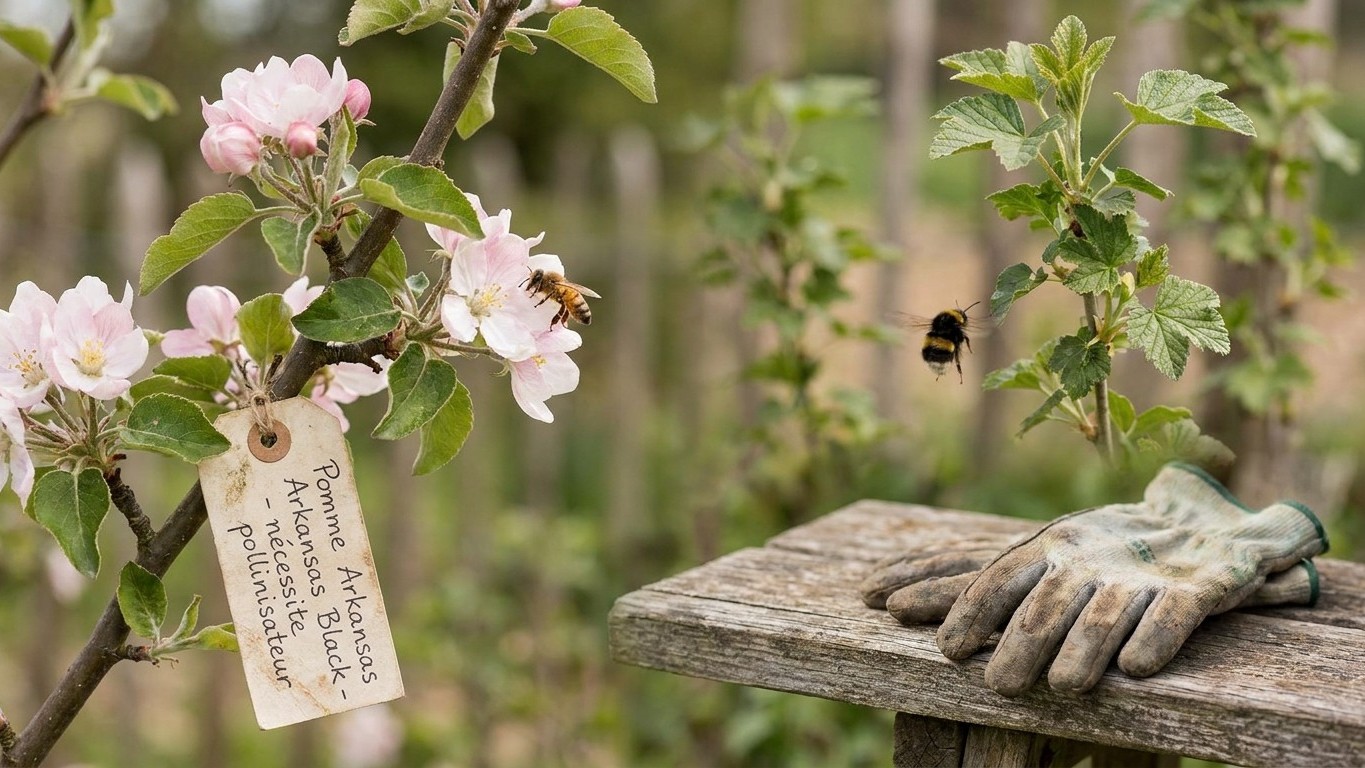

If your Arkansas Black tree keeps blooming but barely fruits, the fix is planting the right neighbor, not waiting another season. It needs one other tree nearby whose pollen actually works with it, and only four apple varieties do that job. Go check what’s already growing in your yard against that short list before you buy anything new.
The short answer
If you already have an Arkansas Black tree and it is setting little or no fruit, the fix is one of four names: Golden Delicious, Ozark Gold, Priscilla, or Rome Beauty. Any one of these, planted where bees can move between it and your Arkansas Black tree, supplies the fertile pollen the flowers need to set fruit. You do not need all four. One is enough.
What you do need is two trees, not one. Arkansas Black is not self-fertile enough to rely on for a full crop, and nearly all apple varieties crop better with a compatible partner nearby. Because Golden Delicious, Ozark Gold, Priscilla, and Rome Beauty all carry fertile pollen, a simple two-tree planting works: your Arkansas Black and one of the four. Neither tree needs a third partner to make the arrangement work, since fertile pollen flows both directions between the two.
That two-tree rule only holds because these four are fertile pollinators. Later in this article you will see two varieties, Jonagold and Stayman, that flower at the same time as Arkansas Black but cannot fertilize it. If your only other apple tree happens to be one of those two, you effectively still have zero pollinators, no matter how well the trees bloom together. The general mechanics of apple pollination, including why some varieties need a partner and others do not, are covered in more depth in our Apple Pollination guide, worth reading before you buy anything.
Why these varieties and not others

What bloom group C actually means
Apples are sorted into bloom groups because timing is the whole game. Two trees can only pollinate each other if their flowers are open on overlapping days, and Clemson Cooperative Extension’s HGIC 1350 chart places Arkansas Black in group C, a mid-season group confirmed separately by Utah State University Extension’s guide to home apple production. That grouping is a relative order, not a calendar date. In a cool spring the whole sequence shifts later; in a warm one it shifts earlier. What does not change is the order itself. A group C variety blooms after the group A and B varieties finish and before the D and E varieties open, wherever you garden.
What the group does not promise
Sharing a bloom group only means the flowers are open at the same time. It says nothing about whether the pollen actually works. Two trees can bloom in perfect unison and still produce no fruit between them, because one or both carry pollen that is genetically sterile or otherwise incompatible. It also says nothing about parentage. A seedling apple cannot be fertilized by the tree it was bred from, no matter how closely their bloom dates line up, because the genetics are too similar. Confirmed compatibility, the kind published in extension pollination charts, has to check both boxes: overlapping bloom and pollen that actually functions on that particular partner. Golden Delicious, Ozark Gold, Priscilla, and Rome Beauty have cleared both.
What cannot pollinate it
Two varieties flower at exactly the right time to be mistaken for pollinators of Arkansas Black: Jonagold and Stayman. Both share the same bloom timing, and both are known to carry sterile pollen. A gardener who plants only an Arkansas Black and a Jonagold, or only an Arkansas Black and a Stayman, will watch both trees bloom together and still get little to no fruit from either. Sterile pollen works one way. The sterile tree can still be pollinated by something else, but its own pollen cannot fertilize a partner, so pairing two sterile varieties together, or pairing a sterile variety with nothing else at all, sets no fruit.
This is the trap that catches more gardens than a mismatched bloom group ever does, because the trees look like they are cooperating. The flowers open together, the bees visit both, and the harvest still disappoints. It is the same trap that shows up with other well-known varieties: gardeners researching what pollinates Autumn Crisp or what pollinates McIntosh run into their own versions of a variety that blooms on cue but contributes nothing as a pollen source.
Beyond Jonagold and Stayman, compatibility for Arkansas Black beyond the confirmed list is not published. That is not the same as saying every other variety fails. It means no extension source has tested and confirmed it, so guessing is a gamble. The table below summarizes what is actually known.
| Variety | Compatible pollinizer? | Why |
|---|---|---|
| Golden Delicious | Yes | Confirmed pollinizer, fertile pollen |
| Ozark Gold | Yes | Confirmed pollinizer, fertile pollen |
| Priscilla | Yes | Confirmed pollinizer, fertile pollen |
| Rome Beauty | Yes | Confirmed pollinizer, fertile pollen |
| Jonagold | No | Flowers at the same time, pollen is sterile |
| Stayman | No | Flowers at the same time, pollen is sterile |
How close the second tree has to be

Pollen for apples travels on bees, not on wind, so distance matters far more than it would for a wind-pollinated crop like corn. The practical rule is simple: closer is always better. A pollinizer in the same garden bed as your Arkansas Black gets visited by the same foraging bees on the same pass. A pollinizer three properties away depends on a bee choosing to cross that distance mid-flight, which happens far less reliably.
The second tree does not have to be another Arkansas Black orchard purchase. A neighbor’s Golden Delicious hanging over a fence line does the job just as well as one you planted yourself, provided the bloom timing lines up and bees can move freely between the two yards. An ornamental crabapple that flowers at the same time works too, since crabapples are apples and their pollen is generally compatible across a wide range of eating varieties. Even a single grafted branch of a compatible variety, added onto an existing tree, is enough pollen source for the whole canopy.
What defeats all of this is weather during the bloom window itself. Cold, wet, or unusually still days keep bees in their hives, and no amount of proximity or partner choice fixes that. If bloom coincides with a stretch of bad weather, the crop suffers regardless of how well the trees are paired, and there is no substitute planting that compensates for a week without pollinators flying.
If there is no room for a second tree
A small yard does not have to mean no fruit, but it does mean trade-offs. A few options exist for gardeners without space for a full second tree, each solving the space problem differently and each leaving something else unsolved.
- A multi-grafted tree carries several varieties on one trunk, so a single planting hole delivers both Arkansas Black and a compatible partner. It takes more pruning skill to keep each graft balanced, and a weak graft can be crowded out by a stronger one over the years.
- A pollinizer branch grafted onto the existing tree is the lowest-cost fix if you already own an Arkansas Black. It needs one successful graft, done at the right time of year, and it does nothing for the tree’s overall size or shape.
- A columnar apple variety takes up almost no lateral space and can serve as the second tree in a narrow side yard. It still needs to be a variety that overlaps in bloom and carries fertile pollen, so the same compatibility rules apply.
- An ornamental flowering crabapple earns its keep as scenery as well as a pollen source, and many are chosen specifically for a long, heavy bloom that overlaps a wide range of apple varieties. It will not give you a second harvest of eating apples, only the pollination benefit.
None of these options changes the underlying rule. Whatever form the second source takes, it still has to bloom at the same time as Arkansas Black and carry pollen that actually fertilizes it, the same two conditions that rule out Jonagold and Stayman in a full-size planting.
Common questions
Can Arkansas Black pollinate itself?
Not reliably. Like most apple varieties, it sets a much better crop with a compatible partner nearby than left alone, even though an isolated tree may produce a light crop in some years.
Will a crabapple really work as a pollinator?
Yes, most flowering crabapples work as pollen sources for eating apples, provided their bloom overlaps the mid-season group Arkansas Black falls into. Check the crabapple’s bloom timing at the nursery before relying on it.
I already have a Jonagold. Do I need to remove it?
No, but you do need a third tree. Jonagold flowers at the same time as Arkansas Black but its pollen is sterile, so it cannot act as the pollinator on its own. Add one of the confirmed varieties, Golden Delicious, Ozark Gold, Priscilla, or Rome Beauty, and keep the Jonagold for its own fruit.
How far away can the pollinator tree be planted?
As close as your layout allows. Bees do the work, and shorter distances mean more reliable visits between the two trees, so a fence-line neighbor’s tree or a branch grafted directly onto the same trunk both outperform a pollinizer planted at the far end of a large property.
Does Arkansas Black’s fire blight resistance affect pollination?
No, the two are unrelated. Utah State University Extension rates Arkansas Black as moderately resistant to fire blight, which affects the tree’s disease risk, not whether its flowers can be fertilized by a neighboring variety.