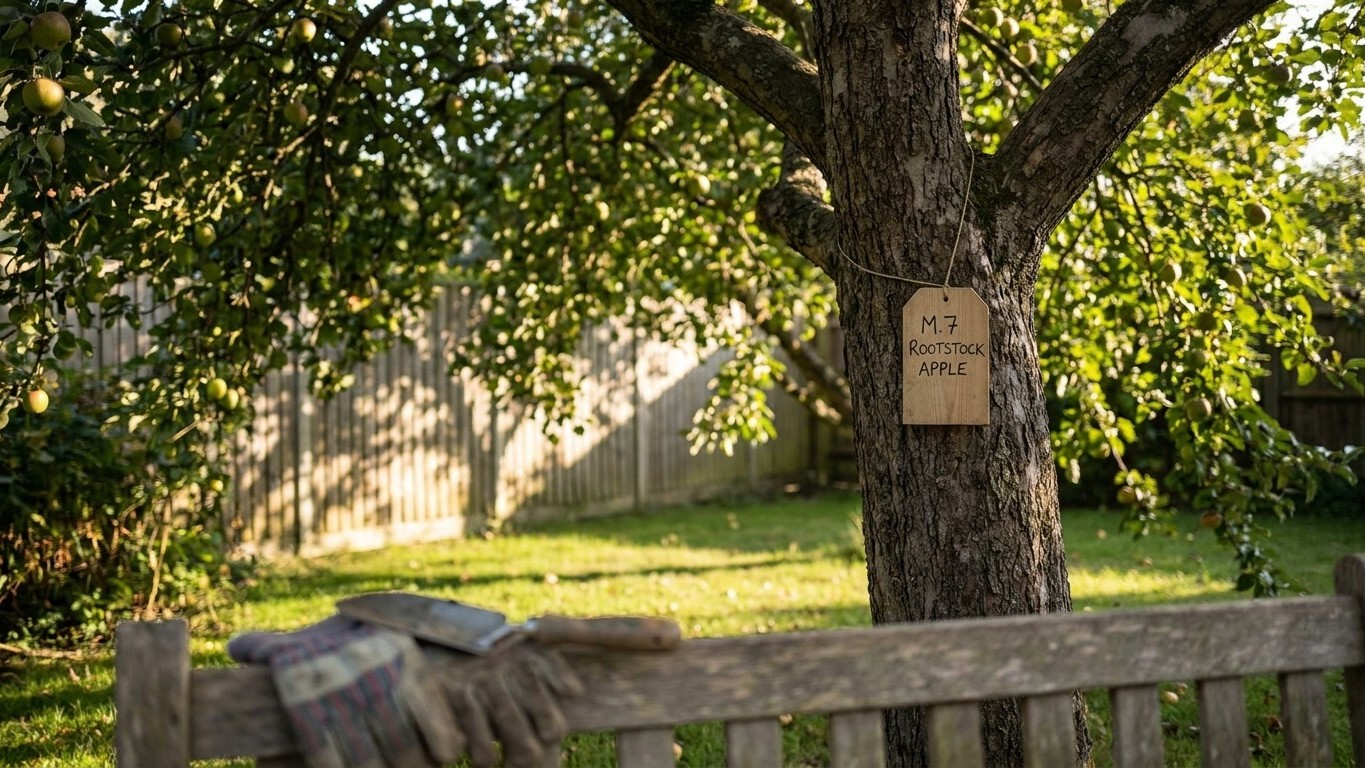

M.7 rootstock produces a mature apple tree of 18 to 20 feet, according to Utah State University Extension. That height sits well above the dwarf stocks and just below the fully vigorous ones, closer to a small shade tree than the tidy patio dwarf many buyers picture when they hear “apple tree.” Measure that mature spread against your fence line and any power lines before you order, because M.7 does not stay small no matter how it’s pruned.
What M.7 does to the tree

How tall will your apple tree actually get on M.7? Eighteen to twenty feet at maturity — a real tree with a real canopy, not the tidy little patio dwarf you may have pictured when you clicked “add to cart.” That’s closer to a small shade tree than a shrub, and it will hold that size for decades once it settles in. Before you order, walk out to where you’re planning to plant and check the clearance overhead and to the sides — power lines, fence lines, the neighbor’s roof — because this rootstock does not stay small no matter how hard you prune it.
| Rootstock | Mature height (USU Extension) | Size class |
|---|---|---|
| M.9 | 8-12 feet | Dwarf |
| M.26 | 12-15 feet | Dwarf |
| G.11 | 12-15 feet | Dwarf |
| G.30 | 18-20 feet | Semi-vigorous |
| M.7 | 18-20 feet | Semi-vigorous |
| M.106 | 25-30 feet | Vigorous |
| MM.111 | 30-35 feet | Vigorous |
| Seedling | 35-40 feet | Standard |
Space it actually needs
Plan on room for a full-size shade tree, not a shrub. A single M.7 apple wants clearance on all sides for a mower, a ladder, and enough light to ripen fruit at the bottom of the canopy as well as the top. Spacing guides written around this size class put M.7 trees far apart, simply because the canopy itself is far larger than a dwarf tree’s.
What the nursery label rarely mentions is that M.7 roots more freely than the fully vigorous seedling and MM.111 stocks, which is why nurseries have propagated it by stooling and layering for decades. The same trait that makes it easy to multiply in the nursery row also makes it prone to throwing root suckers around the base of the trunk in the garden. Left alone, those suckers pull vigor from the graft and can root themselves into a second tree if not cut back at ground level each season.
Staking, and for how long
Anchorage runs in rough proportion to vigor. The fully dwarfing M.9 rootstock roots shallowly and needs a permanent stake or trellis wire for the tree’s entire life, because its root plate never grows large enough to hold a mature canopy upright on its own. M.7 sits well above that. Its root system is more extensive, and most growers stake it only for the first few years, pulling the stake once the trunk has thickened and the roots have spread into the surrounding soil.
An unstaked young M.7 is not a safe bet in its first two or three seasons, though. The graft union sits above ground on any rootstock, and a young tree carrying its first heavy crop through a summer storm can lean at the union, split bark, or go over roots and all if the soil is wet and the wind sustained. A mature, established M.7 stands on its own in ordinary garden conditions, which is one reason growers who don’t want a permanent post or trellis in the yard choose this size class over the fully dwarfing stocks.
Watch a young tree for these signs that it needs staking attention:
- Trunk leaning more than a few degrees off vertical after wind or rain
- Soil cracking or heaving on one side of the root zone
- Bark splitting or separating at the graft union
- Branches touching the ground under a heavy crop load
Any one of those calls for a temporary stake and a loosened tie, not a permanent post driven in for the tree’s life the way it would be for M.9 or M.26.
How soon it fruits, how long it lives
Dwarfing rootstocks push a tree into bearing years earlier than a vigorous one, and they pay for that early crop with a shorter working life. Vigorous stocks such as MM.111 or a true seedling make the grower wait longer for a first real harvest, then keep producing for decades after the dwarf trees planted the same year have been pulled out and replaced.
Where M.7 lands in that spread
M.7 sits in the middle rather than at either end. It comes into bearing sooner than a tree on seedling or MM.111 roots, because a semi-vigorous rootstock puts less of the tree’s early energy into root and trunk growth and more into fruiting wood. It also tends to outlast the fully dwarfing stocks, whose smaller root systems wear out sooner and are more exposed to the freeze-thaw stress and root diseases that shorten a dwarf tree’s working life.
An exact year count for either end of that spread would vary too much by climate, soil, and variety to be trustworthy. What holds across all of them is the order, not the count: dwarf stocks fruit first and fade first, vigorous stocks make you wait and then keep going long after. That middle position is the practical case for M.7 in a home garden, an early enough harvest to feel worth the wait, on a tree built to still be producing when a dwarf planted the same year has been replaced.
The soil and site it suits
Root depth and drought tolerance
Root depth tracks vigor almost as closely as height does. The fully dwarfing stocks root shallow and wide, which is why they need irrigation and mulch to get through a dry spell, and why thin or compacted soil hits them hardest. M.7 roots deeper and more widely than M.9 or M.26, so it tolerates a wider range of soils and rides out a dry stretch better than a fully dwarfing tree, though it still isn’t as forgiving of poor drainage or shallow topsoil as a seedling or MM.111 tree with a full-size root system underneath it.
Good drainage matters more than soil richness for this rootstock. A site that puddles after rain or stays wet through spring costs M.7 more than it costs MM.111 or seedling, because a smaller root system has less spare capacity to compensate for waterlogged roots. Raised beds or planting on a slight mound solve this on flatter ground.
Fire blight, and what the sources actually say
Fire blight resistance is a real reason to choose one rootstock over another where the disease is a known problem. If fire blight is active where you garden, ask your own state extension service which rootstocks they currently recommend for it, rather than assuming M.7 carries any particular resistance on its own.
Who should choose it
M.7 suits a grower with a real yard, not a patio: enough open ground for a mature 18 to 20 foot tree, per USU Extension, full sun, and clearance from the house, garage and power lines on every side. It also suits someone willing to keep a ladder in the shed rather than harvest everything from ground level, since part of the crop will sit above easy reach at full size.
Anyone wanting a smaller commitment should look to the dwarf end of the same lineup instead. The G.11 rootstock and the M.9 rootstock both max out well under half the height of M.7 according to the same USU figures, and either fits a small yard or a row planted close for a fruiting hedge rather than a scattering of shade trees. The trade-off, as covered above, is a permanent stake and a shorter working life for the tree.
Rootstock decides the size. The variety grafted onto it decides everything else, including whether the tree needs a pollinator partner nearby. Clemson HGIC 1350 groups apple varieties by bloom time into groups A, B and C, and a tree generally sets its best crop with a partner blooming in the same or an adjacent group. Four varieties, Jonagold, Mutsu, Stayman and Winesap, carry sterile pollen according to Clemson HGIC 1350, UGA Circular 740 and USU Extension, meaning each can accept pollen from another tree but cannot supply pollen back. A garden planting two of those sterile varieties together, whatever rootstock they’re grafted onto, sets little or no fruit without a third, pollen-fertile variety nearby.
Whatever variety you settle on, remember that the same variety grafted onto a different rootstock is not the same tree to grow. The fruit is identical. The mature size and the years to harvest are not.
Common questions
Can I keep an M.7 apple tree smaller with hard pruning?
You can slow it down for a season or two, but hard annual pruning does not change the mature size the rootstock is built to reach. If you want a tree that stays under 15 feet without constant cutting, choose a dwarfing rootstock like M.9 or G.11 instead of trying to prune M.7 down to that size.
Is M.7 the same as M.7a?
M.7a is a virus-free clonal selection of the original M.7, propagated to be free of certain latent viruses that can reduce vigor over time. Nurseries selling “M.7” today are almost always selling this improved clone, and the mature size USU Extension gives applies to it as it does to the original.
Does M.7 need a pollinator variety planted nearby?
The rootstock itself has no bearing on pollination. Nearly all apple varieties crop better with a compatible partner blooming at roughly the same time, per Clemson HGIC 1350, and that holds true whether the variety is grafted onto M.7, M.9, or seedling roots.
How far apart should I plant two M.7 trees?
Space them wide enough that the mature canopies, each reaching toward the 18 to 20 foot height USU Extension gives for this rootstock, don’t crowd each other for light within a decade. Exact planting distances vary by region and training system, so check the spacing your own state extension service publishes for semi-vigorous rootstocks before you mark out the rows.