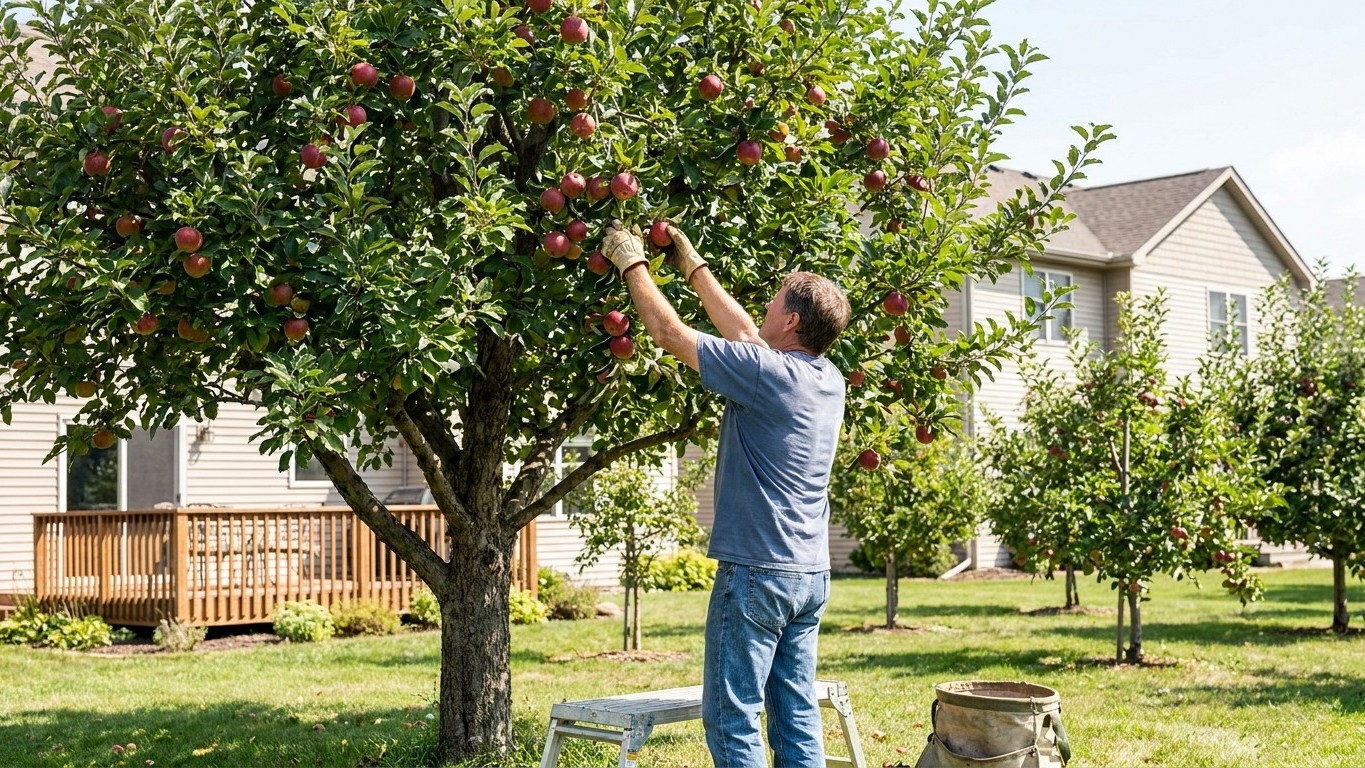

A tree grafted onto G.11 rootstock reaches 12 to 15 feet at maturity, according to Utah State University Extension’s rootstock chart for home garden apples. That puts it in the same size class as M.26, one notch taller than the true dwarf M.9, and a fraction of the size a seedling rootstock would produce. What that height actually means for a backyard, and what it trades away to get there, is what follows.
What G.11 does to the tree

The 12-15 foot figure from USU Extension is the single most important number on the plant tag, because rootstock, not variety, sets the ceiling on a tree’s size. A Gala on G.11 and a Gala on MM.111 carry the same fruit but grow into two entirely different plants. G.11 belongs to the Geneva breeding series, developed with an eye toward the anchorage and disease problems that plagued older dwarfing stocks, and it’s marketed as a workable alternative where a full-size tree simply won’t fit.
That size class rewrites four things about how the tree gets managed:
- The ladder: pruning and picking stay within reach from the ground or a short step stool, not a full orchard ladder
- Spacing: trees can sit closer together than a seedling or MM.111 tree ever could
- Yield per tree: a smaller canopy carries a smaller crop, so a home orchard needs more trees to match the output of a few big ones
- The year cropping starts: dwarfing rootstocks push the tree toward fruiting sooner rather than spending years on wood
The ladder question matters more than it sounds. A tree capped at 15 feet keeps its top growth accessible for thinning, spraying, and harvest without scaffolding or an extension ladder braced against limbs, which is where a lot of home-orchard injuries happen. The spacing benefit shows up at planting time: rows can run tighter, and a suburban lot that couldn’t hold two MM.111 trees can often hold three or four on G.11. The yield trade-off is the part growers underestimate. A mature G.11 tree simply has less wood and fewer fruiting spurs than a 30-foot MM.111 tree, so anyone comparing “pounds of apples” between the two needs to compare per-tree numbers, not per-orchard impressions from a single specimen.
Staking, and for how long
Smaller rootstocks generally mean weaker root systems, and that’s the piece the plant tag rarely spells out. A tree that tops out at 12-15 feet still has to hold up a full crop of apples through summer storms, and a shallow, compact root system doesn’t anchor the same way a seedling’s spreading roots do. For a rootstock in this size class, the practical answer is a permanent stake, not a temporary training stake pulled after year two or three.
Skip the stake, or pull it too early, and the risk isn’t subtle: a loaded dwarf tree leaning in wind can snap at the graft union or simply tip over, roots and all, especially in the wet, heavy soil that follows a spring storm. That failure mode is different from a large seedling tree, which might lose a limb but rarely goes over at the base. Because the graft union on a rootstock like this sits close to the ground, any lean also puts stress directly on the weakest point of the whole tree.
A single sturdy post driven at planting time, with the trunk tied loosely enough to allow some flex, solves most of this. The cost is minor compared to losing a tree that’s three or four years into cropping. Growers who treat staking as optional on a semi-dwarfing rootstock are usually the ones replacing a toppled tree the following spring.
How soon it fruits, how long it lives
Dwarfing and semi-dwarfing rootstocks push trees to fruit earlier, and they generally don’t live as long as vigorous stocks like seedling or MM.111. The two figures move in opposite directions because a smaller root system reaches physiological maturity faster, and less energy spent building trunk and root mass leaves more available for setting fruit buds, but that same limited root system also has less capacity to sustain the tree over decades.
Years to first crop
A rootstock in the G.11 size class is bred and selected for precocity, meaning it’s expected to start bearing well before a full-size seedling tree would. Growers choosing a rootstock in this class are generally trading patience for speed, though neither USU Extension’s chart nor the other reference sheets used here attach a specific year count to G.11 that can be stated as fact.
Lifespan
The flip side of that early cropping is a shorter working life in the orchard. A seedling tree reaching 35-40 feet, per USU Extension, is built to stand for generations; a semi-dwarf sized for a home yard isn’t making that same promise. Neither of the reference sheets used here gives an exact years-in-production figure for G.11, so the honest summary is directional: earlier fruit, shorter tenure, and a grower should plan on eventually replacing the tree rather than expecting it to outlive them.
The soil and site it suits
Shallow-rooted, dwarfing rootstocks are the first to show stress when the site isn’t right, and G.11’s smaller root system fits that pattern. It doesn’t forage as widely or as deep as a seedling or MM.111 root system, which makes site prep matter more, not less, than it would for a full-size tree.
- Consistent moisture: if the site dries out in summer, a shallow root system can’t reach deeper water reserves the way a vigorous rootstock would, and the tree stalls or drops fruit early
- Reasonable soil depth: in thin or compacted soil, a small root system has even less volume to work with, and anchorage problems compound the staking issue above
- Decent drainage: waterlogged roots hit a shallow system’s limited buffer fast, and a stressed root system on a dwarfing stock shows decline sooner than a large tree would
None of the reference material used for this page, not USU Extension’s rootstock chart, Clemson’s HGIC 1350, nor UGA’s Circular 740, credits G.11 specifically with fire blight resistance in a figure that can be stated here as fact. The Geneva breeding program that produced G.11 was built around solving anchorage and disease problems in older dwarfing stocks, but a grower choosing this rootstock for disease tolerance should confirm current recommendations with their own state extension service before relying on it as a fire blight strategy, since local disease pressure varies by region.
Who should choose it
Everything above points to one decision: a G.11 tree fits a grower who wants a manageable tree without waiting on it. It’s a fit for a suburban lot, a backyard where a step stool is the only ladder anyone wants to own, and a grower who’s comfortable planting a permanent stake and leaving it there. Remember that the variety grafted onto this rootstock still needs a compatible partner, since nearly all varieties crop better with a partner nearby, and that varieties with sterile pollen, such as Jonagold, Mutsu, Stayman, and Winesap, can be pollinated but can’t pollinate another tree in return. A garden built entirely around G.11 trees still needs to check bloom groups the same way any orchard does.
- Choose it if the site has consistent moisture and decent soil depth, and reach without a ladder matters more than raw yield per tree
- Choose it if starting to harvest sooner rather than later is a priority
- Choose it if the plan includes a permanent stake and there’s no interest in managing a leaning tree later
- Avoid it on a dry or thin-soil site where irrigation isn’t reliable
- Avoid it if the goal is a long-lived, low-maintenance tree that can go decades without replacement, where a rootstock like MM.111 or seedling fits better
- Avoid it if maximum yield per tree matters more than compact size, since a semi-dwarf carries less wood and fewer fruiting spurs than M.26 or larger stocks
Common questions
Does G.11 need the same staking as M.9?
Both are on the smaller end of the rootstock range and both benefit from permanent support, but M.9, at 8-12 feet mature height per USU Extension, carries an even shallower root system than G.11’s 12-15 foot class, so it typically needs staking maintained longer or indefinitely.
Can I plant just one apple tree on G.11 and expect fruit?
Nearly all apple varieties crop better with a compatible pollen partner nearby, regardless of rootstock, so rootstock choice doesn’t solve the pollination question. Check the variety’s bloom group and confirm it isn’t a sterile-pollen type before planting a single tree.
Is G.11 the same size as G.30?
No. G.11 tops out at 12-15 feet while G.30 reaches 18-20 feet, per USU Extension’s chart, so the two Geneva rootstocks occupy different size classes despite sharing a breeding program.
Will a G.11 tree eventually need replacing sooner than a full-size tree?
Generally yes. Dwarfing and semi-dwarfing rootstocks trade a shorter working life for earlier cropping, while vigorous rootstocks like seedling, reaching 35-40 feet, are built for a much longer run in the same spot.