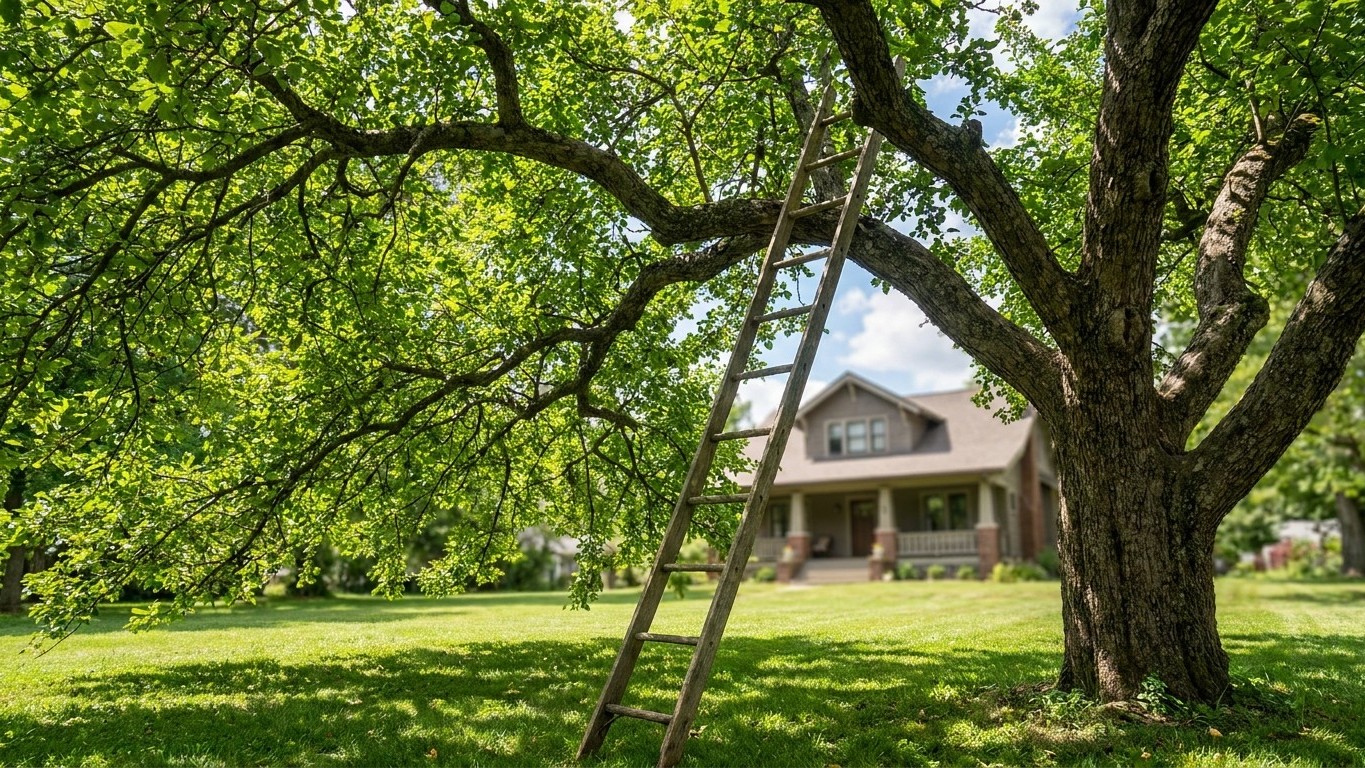

MM.111 is a semi-vigorous apple rootstock that grows a full-size home orchard tree, reaching 30-35 feet at maturity according to Utah State University Extension. It suits growers with real space, a tolerance for ladder work, and patience for a tree that fruits later but keeps producing for decades.
What MM.111 does to the tree

Thirty to thirty-five feet. That’s the mature height Utah State University Extension assigns to a tree grafted onto MM.111 rootstock, and it’s the single number that decides almost everything else about how the tree fits into a yard. For comparison, that’s taller than most two-story houses, and it puts the top branches well beyond the reach of a standard 6-foot orchard ladder. A tree this size needs real room to spread, not a corner spot against a fence.
That height figure changes four practical things for the grower:
- The ladder: harvesting the upper canopy requires a tall orchard ladder or a pole picker, not a step stool.
- The spacing: a mature MM.111 tree needs 20 to 25 feet of clearance from its neighbors, buildings, and power lines.
- The yield per tree: a full-size tree eventually produces far more fruit per tree than a dwarf, which matters if storage or preserving capacity is limited.
- The year it starts cropping: size and vigor come at the cost of a longer wait before the first real harvest.
What the nursery tag rarely spells out is the character behind that number. MM.111 was bred for vigor and toughness rather than compactness. It builds a deep, wide-ranging root system that anchors the tree firmly and lets it forage for water and nutrients across a larger volume of soil than a dwarfing rootstock ever could. That’s the trade nurseries make with this stock: a tree that takes longer to bear and takes up more square footage, in exchange for one that shrugs off dry spells and marginal soil better than nearly any dwarfing option on the market. It’s the rootstock of choice for growers thinking in terms of a permanent, one-time planting rather than a compact, easily replaced tree.
Staking, and for how long
The smaller the rootstock, the weaker the anchorage, and MM.111 sits on the opposite end of that scale from the dwarfing stocks that dominate backyard orchard marketing. Its extensive root system holds the tree upright on its own once established, so a permanent stake isn’t part of the deal here. Most growers use a temporary stake or guy line for the first one to two years after planting, just long enough for the young roots to grip the soil and the trunk to build enough girth to stand on its own in wind.
Once that establishment period passes, the stake comes out and stays out. This is a meaningful difference from a dwarf tree on something like M.9 rootstock, which needs a stake or trellis wire for its entire life because its shallow, limited root mass can’t hold a mature canopy loaded with fruit against a stiff wind. An unstaked dwarf carrying a full crop in a summer storm can lean, snap at the graft union, or topple outright. MM.111 doesn’t carry that risk past its first couple of seasons in the ground. That self-sufficiency is part of why it shows up so often in windy, exposed sites where a trellised dwarf tree would be a constant maintenance headache.
How soon it fruits, how long it lives
Dwarfing rootstocks and vigorous ones pull a grower’s expectations in opposite directions, and MM.111 sits firmly on the patient side of that trade-off.
Years to first crop
A tree on a dwarfing rootstock like M.9 or M.26 often sets its first meaningful fruit within two to three years of planting, because the rootstock deliberately restricts vegetative growth and pushes the young tree toward reproduction sooner. MM.111 doesn’t work that way. Its vigor channels the tree’s early energy into building roots, trunk, and scaffold branches first, which means a longer wait before the first real harvest compared to a dwarf planted the same season.
Years the tree lives
That patience pays off later. Vigorous, full-size rootstocks like MM.111 are associated with long-lived trees that can outlast the gardener who planted them, while heavily dwarfing stocks tend to produce shorter-lived trees. The two figures move in opposite directions for a simple reason: a rootstock that restricts growth to speed up fruiting is also restricting the root and vascular capacity that keeps a tree healthy and productive over the long haul, while a rootstock built for vigor spends its early years on infrastructure that supports decades of bearing wood afterward.
The soil and site it suits
Shallow-rooted dwarfing stocks are the first to suffer in drought or thin, rocky soil, simply because their root systems don’t reach far enough to find reserves of water and nutrients when conditions turn tough. MM.111 is built the opposite way. Its deep, wide root system is one of the more drought-tolerant options among common apple rootstocks, and it handles a broader range of soil types, including heavier or less fertile ground, better than the dwarfing stocks that need consistently good soil to perform.
Site conditions still matter, though, and each one carries a real consequence if it’s ignored:
- Full sun exposure: without at least six hours of direct sun, even a vigorous MM.111 tree will produce sparse fruit and weak, disease-prone growth.
- Room to spread roots and canopy: planted too close to structures or other trees, a tree this size will compete for water and light, stunting its neighbors or itself.
- Reasonable soil drainage: MM.111 tolerates poorer soil better than dwarfing stocks, but waterlogged, poorly drained ground still invites root rot regardless of rootstock vigor.
- Air circulation around the canopy: a dense, unpruned crown on a vigorous tree traps humidity and raises the risk of fungal disease and, in susceptible varieties, fire blight.
On that last point, growers dealing with a history of fire blight pressure should still lean on variety selection and orchard sanitation as their main defense, and check with their local extension service for site-specific guidance, since rootstock alone doesn’t eliminate that risk.
Who should choose it
The decision comes down to space, ladder tolerance, and patience. A grower with a sprawling backyard or a small orchard block, willing to climb a tall ladder at harvest and wait past the early years for the first real crop, gets a tree that will likely outlive the fence line around it. A grower working with a suburban lot, a patio, or a desire for fruit within a couple of seasons should look toward a dwarfing rootstock instead.
- Choose it if: the site has 20-25 feet of clearance to spare.
- Choose it if: drought tolerance and poor soil resilience matter more than speed.
- Choose it if: a single long-lived, low-maintenance tree fits the goal better than several small ones.
- Avoid it if: the space is a small yard, patio, or container.
- Avoid it if: a quick first harvest matters more than long-term size.
- Avoid it if: climbing a tall ladder for harvest and pruning isn’t practical.
Remember that the rootstock only sets the frame. The variety grafted onto it decides flavor, bloom timing, and pollination needs, so the same variety on MM.111 versus a dwarfing stock is effectively a different tree in every way except the fruit it eventually produces. Checking variety-specific pages for bloom group and pollination compatibility, alongside the rootstock choice, rounds out the planting decision before anything goes in the ground.
Common questions
Does MM.111 need a permanent stake?
No. A temporary stake for the first one to two years is usually enough while the root system establishes; after that, the tree’s own vigorous roots hold it upright without support.
How does MM.111 compare to M.106 in size?
M.106 produces a tree of 25-30 feet at maturity, while MM.111 grows larger, reaching 30-35 feet, according to Utah State University Extension. Both are more vigorous than the common dwarfing stocks like M.9, M.26, or G.11.
Is MM.111 a good choice for poor or dry soil?
Yes. Its deep, extensive root system makes it more drought-tolerant and better suited to marginal soil than shallow-rooted dwarfing rootstocks, which struggle when water and nutrients aren’t consistently available near the surface.
Will a tree on MM.111 pollinate any nearby apple variety?
The rootstock has no bearing on pollination; that depends entirely on the grafted variety. Growers should still check bloom group timing and whether a chosen variety, such as Jonagold, Mutsu, Stayman, or Winesap, has sterile pollen, since those varieties can be pollinated but cannot pollinate another tree in return.