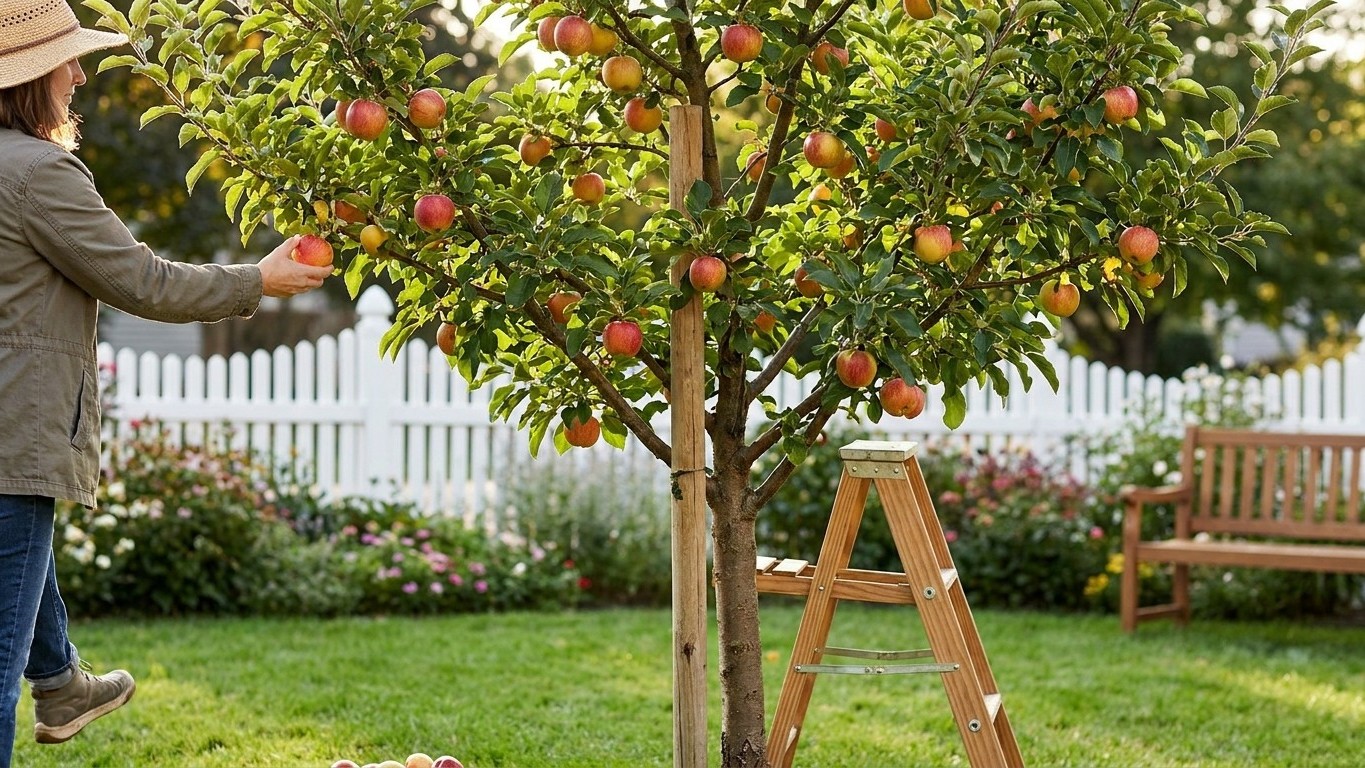

M.9 apple rootstock is the classic dwarfing stock of the home garden: a tree grafted onto it tops out at 8 to 12 feet, according to Utah State University Extension. That’s a tree you prune, thin, and pick from the ground or a short stepladder, never from a full-size orchard ladder. It fruits early and needs a permanent stake for its entire life. Here’s what that trade-off actually looks like in a backyard.
What M.9 does to the tree

Utah State University Extension lists M.9 as producing a mature tree of 8 to 12 feet, the smallest figure among the common rootstocks used for home apple production. Put a number on that: a person of average height can reach most of the canopy without a ladder at all, and a stepstool covers the rest. Compare that to the 30 to 35 feet a tree on MM.111 reaches, or the 35 to 40 feet of a seedling rootstock, and you’re looking at a different kind of gardening entirely, one where a single tree fits against a fence line or in a raised bed rather than swallowing a quarter of the yard.
What the nursery label rarely spells out is that this height comes from a root system, not from pruning discipline. A tree on M.9 stays small even if you never touch it with shears, because the rootstock itself restricts vigor at the roots. That’s different from a full-size tree kept short by aggressive pruning, which will keep pushing vigorous regrowth every season and fighting the gardener for height.
The 8-to-12-foot figure changes four practical things at once:
- The ladder, a stepstool replaces the extension ladder most other rootstocks require
- The spacing, trees can sit far closer together than a seedling or MM.111 tree ever could
- The yield per tree, a smaller canopy simply carries less fruit than a 30-foot tree
- The year it starts cropping, dwarfing rootstocks are known for bringing trees into production earlier than vigorous ones
Here’s how M.9 stacks up against the other rootstocks Utah State University Extension covers for the home garden:
| Rootstock | Mature tree height |
|---|---|
| M.9 | 8-12 feet |
| M.26 | 12-15 feet |
| G.11 | 12-15 feet |
| G.30 | 18-20 feet |
| M.7 | 18-20 feet |
| M.106 | 25-30 feet |
| MM.111 | 30-35 feet |
| Seedling | 35-40 feet |
None of those numbers depend on the variety grafted on top. A Gala on M.9 and a Granny Smith on M.9 land in the same 8-to-12-foot range; the rootstock, not the fruit, sets the ceiling.
Staking, and for how long
A tree this small has a root system to match, and that’s the catch. M.9 produces a brittle, shallow, poorly anchored root mass, which means the tree cannot hold itself upright once it’s carrying a real crop of apples. This isn’t a stake for the first two years while the tree establishes, the way a young shade tree might need. It’s a permanent support for the life of the tree.
Skip the stake, or pull it too soon, and the risk shows up exactly when the tree is doing its job best: a heavy-bearing M.9 tree in a summer thunderstorm or a fall windstorm can lean, snap at the graft union, or topple outright, roots and all, taking the whole season’s apples down with it. The smaller and more dwarfing the rootstock, the less the tree can be trusted to stand on its own, and M.9 sits at the dwarfing extreme of the rootstocks covered here. A sturdy post set at planting time, tied loosely enough to allow some trunk movement but firmly enough to carry the weight of a loaded canopy, is not optional maintenance for this rootstock. It’s part of the design.
How soon it fruits, how long it lives
Dwarfing and vigorous rootstocks pull against each other on two figures that matter to anyone planting for the long haul: how many years before the first real crop, and how many years the tree sticks around afterward.
Years to first crop
Dwarfing rootstocks like M.9 are known for bringing trees into production earlier than vigorous ones. A gardener who wants apples sooner rather than later, and who isn’t planting for the next generation, gets more out of a small rootstock than a large one on this measure alone.
Lifespan
The flip side is a shorter working life. Vigorous rootstocks, the seedling and MM.111 end of the table, are the ones that outlive the gardener who planted them, while the smallest dwarfing stocks tend to wear out sooner. The two figures move in opposite directions because they come from the same root cause: a smaller, more restricted root system fruits sooner precisely because it puts less energy into growing wood and more into producing fruit early, but that same limited root system has less capacity to sustain the tree decade after decade.
The soil and site it suits
A shallow, brittle root system doesn’t just need a stake against wind. It needs decent soil and consistent moisture, because it has far less reach than a vigorous rootstock’s roots to find water and nutrients on its own. M.9 is not the rootstock to plant in thin, rocky, or drought-prone ground and then leave alone.
- Consistent soil moisture — if it’s missing, the shallow root system dries out faster than a vigorous rootstock would, stressing the tree during exactly the weeks fruit is sizing up
- Reasonably fertile, well-drained soil — if it’s missing, the limited root volume can’t compensate for poor ground the way a seedling or MM.111 root system might
- A permanent stake — if it’s missing, see the section above: the tree risks toppling under its own crop
On disease resistance, the source material for this rootstock doesn’t credit M.9 with fire blight resistance. That’s worth noting because it is a real reason some gardeners choose a different dwarfing stock instead: G.11, for instance, lands in the same 12-to-15-foot range as M.26 and was bred with fire blight resistance in mind. Anyone planting in a region with a history of fire blight pressure should ask their local extension office which rootstocks are recommended for that specific disease risk before settling on M.9 for that reason alone.
Who should choose it
The decision comes down to how much space is available, how high the gardener is willing to reach, and how long they expect the tree to be part of the plan. Because rootstock fixes the tree’s size, not the variety, the same apple variety grafted onto M.9 instead of MM.111 or a seedling stock is genuinely a different tree to live with, smaller, faster to bear, shorter-lived, and dependent on a stake for its whole life.
- Choose it if the planting space is small, a patio, a narrow side yard, a raised bed, or a spot where a 30-foot tree simply won’t fit
- Choose it if getting fruit sooner matters more than getting the largest possible harvest per tree
- Choose it if a permanent stake and attentive watering aren’t a burden
- Avoid it if the site is dry, rocky, or thin-soiled with no plan for irrigation
- Avoid it if fire blight has been a problem in the area and disease resistance is a priority
- Avoid it if the goal is a long-lived tree that will still be producing decades from now
Remember that nearly all varieties crop better with a compatible partner nearby, whatever the rootstock underneath. Check bloom groups and pollen compatibility on the variety pages in this series before finalizing a planting plan, since a self-fruitful-sounding tree on M.9 still benefits from a second variety blooming at the same time.
Common questions
Does M.9 change the apple’s flavor or ripening date?
No. Rootstock controls tree size, vigor, and root behavior. Flavor, ripening window, and bloom group all come from the variety grafted on top, not from M.9 itself.
Can two trees on M.9 pollinate each other?
Only if the varieties grafted on them are compatible and bloom at overlapping times. The rootstock has no bearing on pollination; that depends entirely on the varieties, and on avoiding pairs where one has sterile pollen, such as Jonagold, Mutsu, Stayman, or Winesap, per Clemson Cooperative Extension HGIC 1350 and University of Georgia Extension Circular 740.
How close together can trees on M.9 be planted?
Closer than any other rootstock in the Utah State University Extension list, thanks to the 8-to-12-foot mature size. Exact spacing depends on local growing conditions, so check with a regional extension office for a specific recommendation.
Is M.9 a good choice for a first-time apple grower?
It suits anyone with limited space and patience for staking and watering. Gardeners who want a lower-maintenance, longer-lived tree and have the room for it may find a semi-vigorous rootstock like M.26 or G.11 an easier starting point.