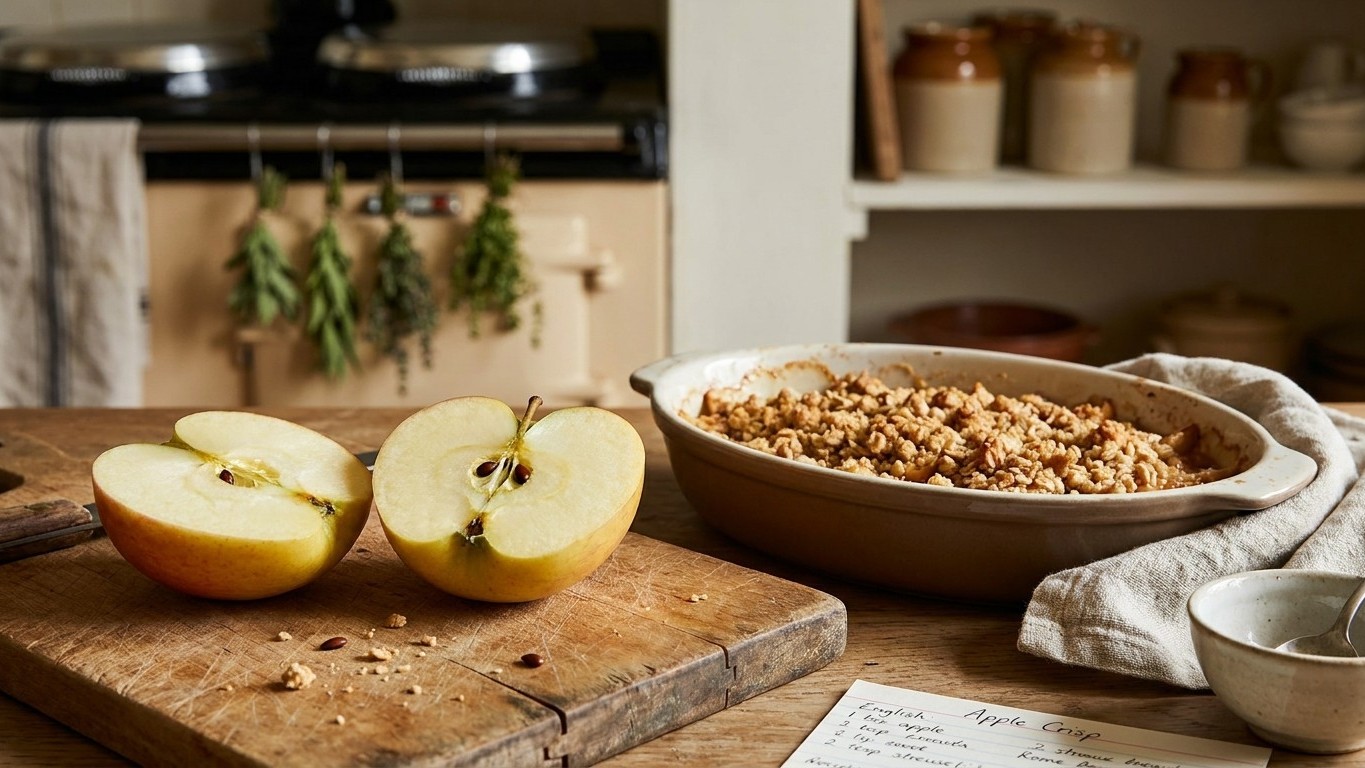

Rome Beauty earns its keep in one place: the oven, not the fruit bowl. If you want a tree that produces reliable baking apples in zones 5 through 8 and you’re not fighting fire blight pressure already, it’s a solid pick. If blight is active in your area, this variety will test you.
What Rome Beauty actually is

Rome Beauty is an old American variety, and growers should know what they’re signing up for before the tree goes in the ground. Here’s the short version:
- Ripens: October
- Tastes like: mildly tart and rather plain eaten fresh, with firm flesh
- Good for: baking, primarily
- Keeps: well, though a specific duration isn’t published in the sources used here
That flavor profile explains why this apple rarely shows up sliced on a cheese board. Clemson Cooperative Extension describes it as mildly tart and rather plain raw, with firm flesh that sweetens with heat. Raw, it’s unremarkable. Baked, that firmness becomes an asset: the flesh holds its shape instead of collapsing into applesauce, and the tartness that seems flat on its own turns into balance once sugar and heat are added. That’s the whole reason Clemson lists it as primarily grown for baking rather than as a dessert apple. A dessert apple is bred to be eaten out of hand, sweet and often softer. A baking apple is bred to survive 45 minutes at 375 degrees without turning to mush, and Rome Beauty was built for exactly that job.
Bloom timing matters as much as flavor for anyone planning a small orchard. Clemson and the University of Georgia place Rome Beauty in bloom group C, and USU Extension separately describes its bloom season as late. That combination puts it toward the back of the flowering calendar, which becomes important once you start thinking about pollination partners, covered further down. Unlike varieties sold under different trade names in the produce aisle, Rome Beauty isn’t one of the apples with a well-known marketing alias. What you buy as Rome Beauty is what you’re planting.
Will it grow where you are
Hardiness zones 5 through 8
USU Extension lists Rome Beauty as suited to hardiness zones 5 through 8. That’s a wide band, stretching from parts of the upper Midwest and New England down through the mid-Atlantic and into warmer pockets of the South. It’s not a single-zone plant, and treating it as one undersells how adaptable it is to winter cold across a large share of the country. If your winter lows regularly stay within that range, cold hardiness itself isn’t the limiting factor here.
Winter chill: an unpublished number, not a nonissue
Hardiness zone only tells you whether the tree survives winter. It doesn’t tell you whether it fruits well, and that’s where winter chill comes in. Chill hours (the accumulated time a tree spends in the cold range roughly between 32 and 45 degrees Fahrenheit) determine whether buds break evenly in spring. Too little chill and a tree flowers erratically, drops buds, or produces poorly even in a technically survivable zone.
None of the sources used for this profile publish a specific chill-hour requirement for Rome Beauty. That’s worth saying plainly rather than guessing a number that sounds reasonable. What can be said is that Rome Beauty’s late bloom season, noted by USU Extension, tends to work in its favor in regions with unpredictable early spring warm spells, since a late-flowering variety is less likely to bloom into a late frost. Gardeners in the warmer end of the 5-8 range, particularly zone 8, should check with a local extension office about chill accumulation in their specific county before committing, since even within one hardiness zone, chill hours can vary by hundreds depending on elevation and local climate.
What to plant beside it
This is the section that decides whether you get apples at all. Nearly all varieties crop better with a compatible partner, and Rome Beauty is no exception. The apples known to pollinate it are:
- Arkansas Black
- Golden Delicious
- Ozark Gold
- Priscilla
Plant one of these within range of your Rome Beauty and you have a working pollination pair, assuming their bloom windows overlap in your specific climate. Remember that bloom group is a relative order, not a fixed calendar date: Rome Beauty’s group C position holds steady from region to region, but the actual date it flowers shifts with local weather every year.
There’s a trap here worth naming directly. Jonagold and Stayman flower at the same time as Rome Beauty, which might suggest they’d make fine partners. They won’t. Both have sterile pollen, meaning they can accept pollen from other trees and produce fruit themselves, but they cannot supply usable pollen to anyone else. Plant only Rome Beauty next to Jonagold or Stayman and you’ll get flowers on both trees and fruit on neither, despite the bloom timing lining up perfectly. If either of those two is already in your yard, you still need a third, pollen-producing variety in the mix, such as one from the list above.
For a fuller breakdown of how bloom groups interact and which combinations fail even when timing looks right, see our apple pollination guide.
Growing it well
Fire blight: the real limiting factor
USU Extension rates Rome Beauty as very susceptible to fire blight, and this is the single biggest reason to think twice before planting it. Fire blight is a bacterial disease that spreads fast in warm, wet spring weather, entering through blossoms and moving down into branches, where it turns leaves and shoots black and shriveled, as though scorched by fire. A very susceptible variety can lose limbs or, in a bad outbreak, the whole tree in a single season. If your region has a history of fire blight (the humid Southeast and parts of the mid-Atlantic see it often), Rome Beauty carries real risk, and you’ll want a spray or pruning program in place before symptoms show up, not after.
Growth habit and biennial bearing
Rome Beauty trees tend toward a vigorous, upright habit typical of many older American varieties, and like a number of heirloom apples, it can lean toward biennial bearing, producing a heavy crop one year followed by a light one the next. This pattern isn’t unique to Rome Beauty, but it’s common enough in older varieties that growers should watch for it rather than assume something went wrong when a bumper year is followed by a sparse one.
Thinning
Thinning the young fruit in late spring, leaving one apple per cluster spaced several inches apart, helps even out that boom-bust cycle over time and also produces larger individual apples, which matters more for a baking variety than for a snacking one, since bigger fruit means fewer apples to peel and core per pie.
Picking it and keeping it
USU Extension places the Rome Beauty harvest in October, but a calendar date is only a starting point. Weather shifts the actual ripening window by a week or two in either direction, so the tree itself is the better guide. Check for these signs in order:
- Lift and twist a fruit gently. If it separates easily from the spur, it’s ready; if you have to tug, give it more time.
- Cut one open and check the seeds. Dark brown, mature-looking seeds signal readiness; pale or greenish seeds mean the apple needs longer on the tree.
- Look at the ground color, the base color visible between any red blush. A shift from green toward yellow is the last confirmation that the fruit has matured.
Storage
None of the sources reviewed for this profile give a specific storage duration for Rome Beauty. As a general rule for firm-fleshed, late-season baking apples, cold storage close to freezing with high humidity extends usable life well past varieties picked earlier in the season, but growers should confirm expected storage life with a local extension service rather than relying on a generic estimate, since storage performance varies with growing conditions and handling at harvest.
Common questions
Is Rome Beauty a good apple to eat fresh?
Not really. Clemson Cooperative Extension describes it as mildly tart and rather plain raw. The firm flesh that makes it shine in a pie doesn’t do much for it on its own.
Can I plant Rome Beauty with a Jonagold tree and expect fruit?
No. Jonagold has sterile pollen, so despite flowering at the same time as Rome Beauty, it can’t pollinate it. You’d need a third variety, such as Golden Delicious, in the yard.
What zones can Rome Beauty survive winter in?
USU Extension lists hardiness zones 5 through 8. Within that range, check local winter chill accumulation separately, since that number isn’t published for this variety.
Why is Rome Beauty considered risky to grow?
USU Extension rates it very susceptible to fire blight, a fast-spreading bacterial disease. In regions where fire blight is common, this variety needs active management.
How do I know when to pick Rome Beauty apples?
USU Extension puts harvest in October, but confirm with the fruit itself: it should twist free easily, the seeds should be dark brown, and the ground color should have shifted from green toward yellow.