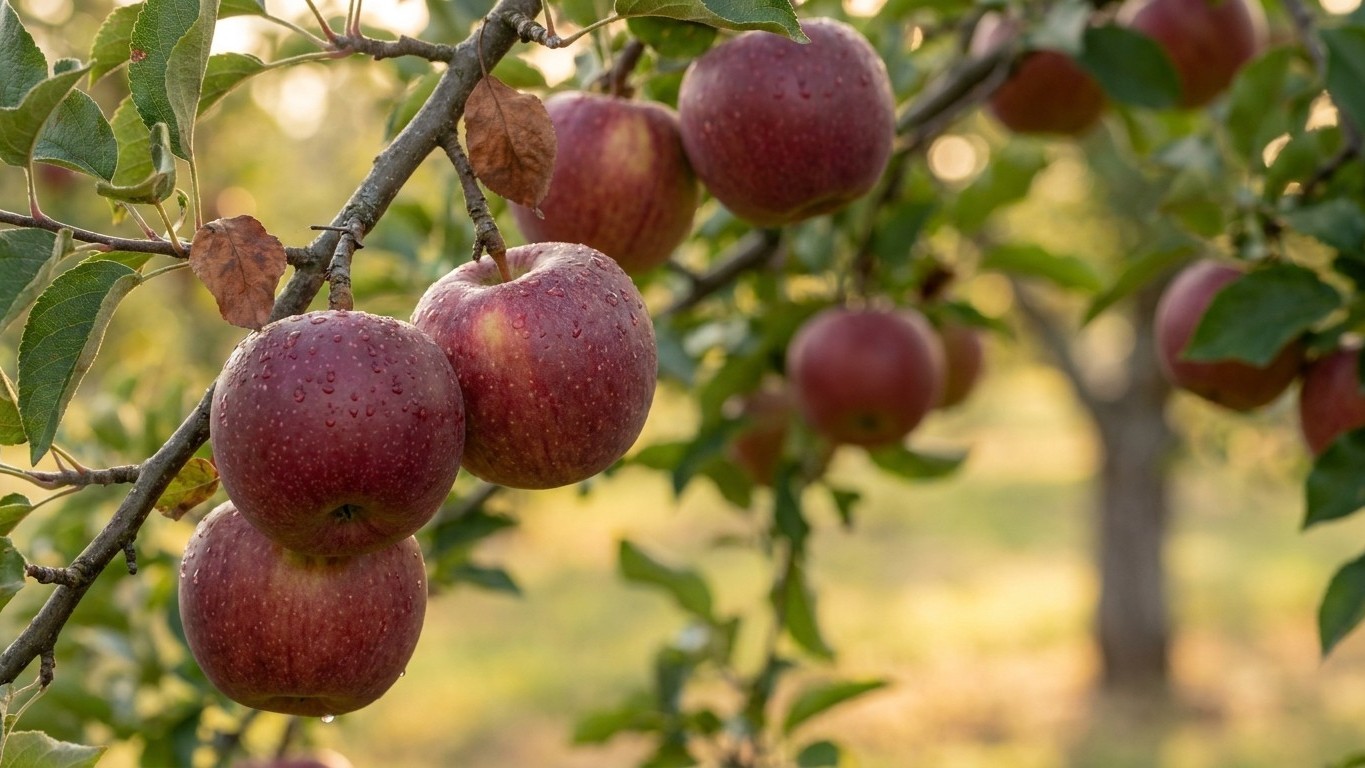

Sweet Sixteen is a September apple bred for the home orchard: sweet, crisp, and famous for a cherry-candy flavor note that sets it apart from most dessert apples. It ripens September into early October, tolerates winters across USDA zones 3 through 7, and needs a pollination partner nearby to crop well. Here’s what a grower actually needs to know before planting one.
What Sweet Sixteen actually is

Before anything else, here’s what you’re getting with this variety, straight from the extension data:
- When it ripens: September to early October
- What it tastes like: Sweet, crisp, uniquely cherry flavored, aromatic
- What it’s good for: Fresh eating and desserts
North Dakota State University Extension (FN1847, Table 1) lists Sweet Sixteen’s eating quality as sweet, crisp, and “uniquely cherry flavored,” with an aromatic finish that makes it easy to pick out in a mixed tasting. That flavor is the reason growers plant it in the first place; it doesn’t taste like a generic sweet apple, it tastes like something specific, which is unusual enough that people who grow it tend to mention it first.
The same source puts its kitchen use as fresh eating and desserts, not general baking or pie work. That distinction matters more than it sounds. A dessert apple needs flesh that stays crisp and a flavor that reads clearly when eaten raw, while a pie apple needs acidity that survives an hour in a hot oven and flesh dense enough not to collapse into sauce. Sweet Sixteen is built for the first job. Use it in a tart or a fresh dessert where the fruit itself is the star, rather than a deep-dish pie where it needs to hold structure under heat.
Utah State University Extension’s guide to apple production for home gardens places harvest at September through early October, which is a normal mid-season to late window for a home orchard, not an early apple and not a long-hanging late-season one.
Will it grow where you are
Two separate questions decide whether this tree will thrive in your yard, and they’re not the same question.
Hardiness zones
USU Extension lists Sweet Sixteen as suited to USDA hardiness zones 3 through 7. That’s a wide range, running from cold pockets of the northern Plains and interior Mountain West through most of the mid-Atlantic and Midwest. If your winter lows regularly sit well below the zone 3 threshold, or your summers run hotter and more humid than zone 7 conditions, this isn’t the safest bet before checking with a local extension office. Inside that range, cold hardiness itself isn’t the limiting factor for most home orchards.
Winter chill
Hardiness zone tells you whether the wood survives winter. Chill hours tell you whether the tree actually flowers and fruits on schedule, and it’s the filter most first-time apple growers skip entirely. Apples need a minimum number of cumulative hours below roughly 45°F each winter to break dormancy properly; too few chill hours and bloom becomes erratic or delayed, even if the tree itself never suffered cold damage.
What the zone range does tell you is the general character of the variety: a 3-7 range points to a tree bred with colder, higher-chill climates in mind, the kind of winter found across the northern tier of the country and the interior Mountain West, rather than the mild-winter conditions of the Deep South or coastal California. Gardeners in warm-winter regions considering this variety should check chill accumulation with a local extension office before planting, rather than relying on hardiness zone alone.
What to plant beside it
What is documented is the bloom timing, which matters just as much as the variety name. USU Extension places Sweet Sixteen’s bloom season as mid to late, meaning any partner needs to flower during that same mid-to-late window to actually exchange pollen with it. A partner blooming two weeks earlier or later, even a well-known variety, won’t help; the flowers simply won’t be open at the same time.
A few general rules apply regardless of which specific variety you choose to plant alongside it:
- Nearly all apple varieties crop better with a compatible partner nearby; very few set a full crop reliably on their own pollen.
- The partner needs to bloom in the same mid-to-late window as Sweet Sixteen, not just sometime in spring.
- A variety cannot pollinate its own parent or its own seedling offspring, even if both are in bloom together, so check parentage before assuming two trees will work as a pair.
- A crabapple with overlapping bloom time can substitute for a second full-size apple tree if space is tight.
For a working list of compatible varieties and bloom-group charts you can match against Sweet Sixteen’s mid-to-late season, see our full guide to apple pollination partners, and confirm the pairing with your local extension office or nursery before buying, since regional bloom timing can shift by a week or two depending on climate.
Growing it well
Sweet Sixteen doesn’t ask for anything exotic, but it does have a few specific demands worth planning around before the tree goes in the ground.
Disease pressure
USU Extension rates Sweet Sixteen as moderately susceptible to fire blight, a bacterial disease that moves fast in warm, wet spring weather and can kill blossoms, shoots, and entire branches if it takes hold. “Moderately susceptible” in practice means this isn’t a variety to plant and ignore in regions with a history of fire blight pressure. Watch new growth each spring for blackened, wilted shoot tips that curl into a shepherd’s-hook shape, the classic early sign. Prune out infected wood well below the visible damage as soon as you spot it, sanitizing pruning tools between cuts, and avoid heavy nitrogen fertilization, which pushes the soft, vigorous new growth that fire blight infects most easily.
Growth habit and cropping pattern
Remember that mature tree size comes from the rootstock, not from Sweet Sixteen itself; a dwarfing rootstock keeps the tree compact and easy to spray and pick, while a standard or semi-standard rootstock produces a much larger tree, so check the rootstock label at the nursery rather than assuming size from the variety name alone.
None of the sources used here document whether Sweet Sixteen is prone to biennial bearing, the pattern where a tree produces a heavy crop one year and almost nothing the next. As a general practice with any apple variety, thinning the young fruit down to one apple per cluster in a heavy-set year helps even out production and protects next season’s crop, whether or not biennial bearing has been specifically documented for this tree.
Picking it and keeping it
USU Extension places Sweet Sixteen’s harvest window at September through early October, but a calendar date is only a rough guide. The tree itself tells you when it’s ready, if you know what to check.
- Lift and twist: Cup the apple in your palm and tilt it upward with a gentle twist. A ripe apple separates cleanly from the spur with almost no resistance; if you have to pull or tug, it needs more time.
- Seed color: Cut one test apple open. Pale or greenish seeds mean the fruit isn’t finished ripening; seeds that have turned brown to dark brown signal the apple is ready to pick.
- Ground color: Check the background color of the skin, the shade underneath any red blush. As the apple ripens, that background shifts from green toward a yellowish or creamy tone, a visual cue that’s easier to read once you’ve compared it against an unripe fruit still on the tree.
Storage
General cold-storage practice for apples applies in the meantime: refrigerate at close to freezing with high humidity, keep the fruit away from ethylene-sensitive produce, and check periodically for soft spots. Given its listed use for fresh eating and desserts rather than long-term storage, treating this as a variety to enjoy within a reasonable window after harvest, rather than one banked for months in a root cellar, is the safer approach until documented storage data becomes available.
Common questions
Is Sweet Sixteen self-pollinating?
No apple variety, including this one, can be counted on to crop well without help. Sweet Sixteen needs a compatible pollinator variety blooming in the same mid-to-late window nearby to set a full crop reliably.
What zone is best for growing Sweet Sixteen apples?
USU Extension lists it as suited to USDA zones 3 through 7, a range that covers much of the northern and mid-latitude United States, from cold interior climates through more moderate mid-Atlantic and Midwest conditions.
Can I use Sweet Sixteen apples for pie?
It’s classified for fresh eating and desserts rather than general baking. Its flesh and flavor are built to shine raw, not to hold structure through the extended heat a deep-dish pie requires.
When should I pick Sweet Sixteen apples?
The general window is September through early October, but the reliable signal is the fruit itself: it should twist free easily, show brown seeds when cut, and have a background skin color shifting away from green.
Is Sweet Sixteen prone to fire blight?
Yes, it’s rated moderately susceptible. Watch spring growth for blackened, hooked shoot tips and prune out infected wood promptly to keep the disease from spreading through the tree.