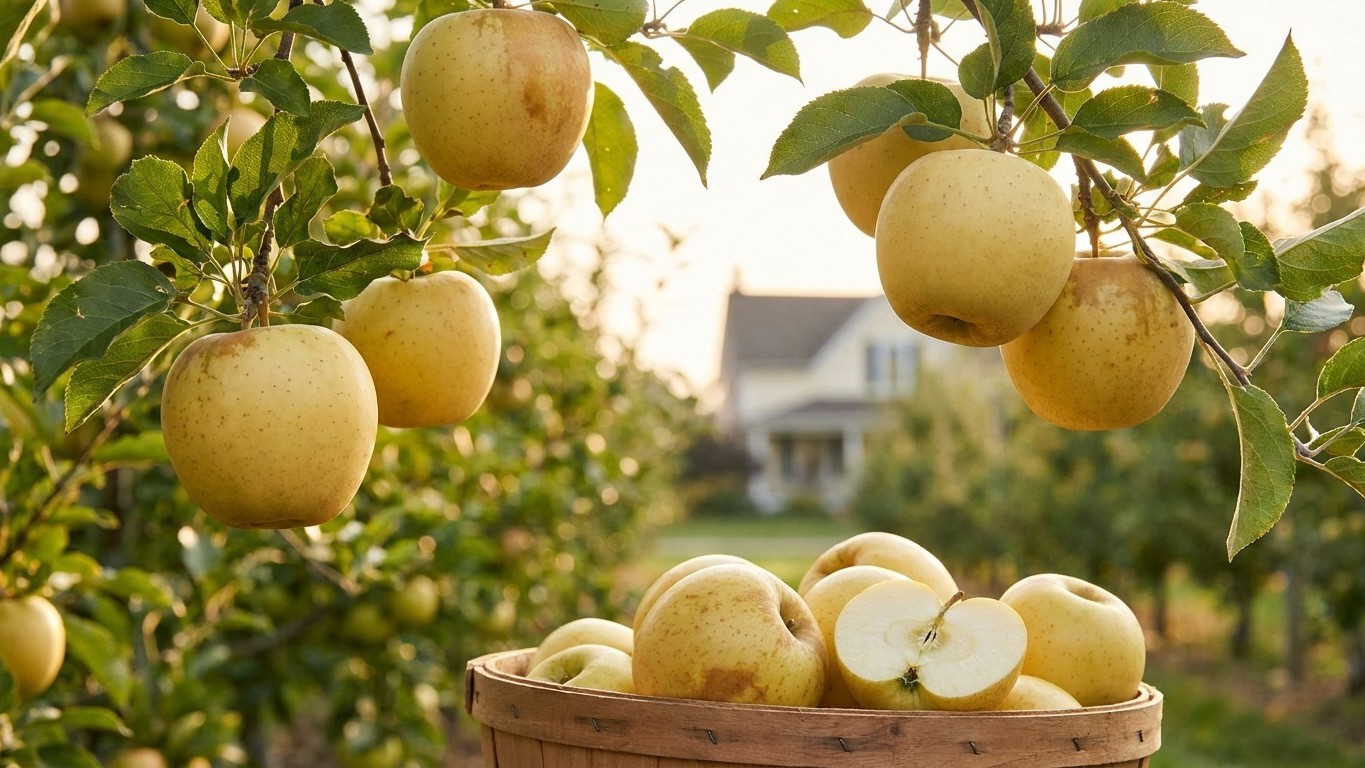

Ginger Gold earns its keep in most home orchards, but one weakness decides whether it’s a smart pick or a headache: fire blight. USU Extension rates it Very Susceptible, which matters far more in humid, blight-prone regions than in dry western states. Everywhere else, it’s a reliable, crisp, early-season apple that ripens from late August into September, works for fresh eating and pies, and needs a pollen partner to crop well.
What Ginger Gold actually is

Before anything else, here’s what a grower gets from this variety:
- Ripens: Late August to September
- Taste: Crisp, fresh eating quality
- Good for: Fresh eating, sauce and pies
- Keeps: Not specified in the sourced extension data reviewed here
According to USU Extension’s Apple Production for the Utah Home Garden, Ginger Gold blooms mid-season and lands in bloom group B, per Clemson HGIC 1350 and UGA Circular 740. That group is a relative order, not a calendar date. It tells you where this variety falls compared to others, not when it will bloom in your particular spring. In a cool Vermont season the flowers might open in early May; in a mild Georgia spring, weeks earlier. What stays constant is the sequence: group B trees open after the earliest bloomers and before the latest ones, which matters when you’re lining up a pollen partner.
Clemson Cooperative Extension’s HGIC 1350 variety table lists the eating quality as crisp and names its kitchen uses as fresh eating, sauce, and pies. That combination is worth noting because not every apple can do all three. A soft, low-acid apple turns to mush in a pie and tastes flat in sauce. Ginger Gold’s crisp texture and enough acidity to survive baking is why extension tables put it in both the fresh-eating and cooking columns, rather than steering it toward one use the way a strictly dessert apple would.
Nobody buys Ginger Gold under a different name the way shoppers unknowingly buy Crispin (Mutsu) or Cripps Pink (Pink Lady). It’s sold and labeled consistently, which at least removes one layer of confusion when you’re comparing nursery catalogs.
Will it grow where you are
Hardiness zones
USU Extension lists Ginger Gold as hardy in zones 4 through 8. That’s a wide band, running from cold-winter states like Minnesota and Vermont down through the mid-Atlantic and into the warmer edges of the Southeast. Treat it as a range, not a single number: a tree that survives in zone 4 winters and one that thrives in zone 8 summers are dealing with very different stresses, and zone alone doesn’t guarantee performance at either extreme. It’s a starting filter, not a final answer.
Winter chill
Zone hardiness tells you whether the tree survives winter. Winter chill tells you whether it fruits well afterward, and it’s the filter most home gardeners skip. Apple trees need a minimum number of hours below roughly 45°F to break dormancy properly and flower on schedule. Skip enough chill hours and you get patchy bloom, delayed leafing, and a disappointing crop even in a tree that looks perfectly healthy.
The sourced data reviewed for this page does not publish a specific chill-hour requirement for Ginger Gold, so no number is given here rather than an invented one. What can be said with confidence: apples as a category generally need moderate-to-high chill compared to peaches or figs, which is why the variety’s hardiness range leans toward zones 4-8 rather than stretching into the low-chill zone 9 and 10 regions of the Deep South, Florida, or coastal Southern California. Gardeners in those warmer zones should check with a local extension office before planting, since low-chill winters are the more common reason an apple tree underperforms there, not cold tolerance.
What to plant beside it
This is the section that decides whether your tree fruits at all. Nearly all apple varieties crop better with a compatible partner nearby, and Ginger Gold is no exception. According to the sourced pollination data, it can be pollinated by:
- Fuji
- Gala
- Granny Smith
- Jerseymac
- Mollie’s Delicious
- Red Delicious
- Yates
Any one of these planted within pollinating range, generally within 50 feet or so and closer in windier or less bee-active sites, gives Ginger Gold the cross-pollination it needs for a full crop.
There’s a trap worth naming directly. Mutsu flowers at the same time as Ginger Gold, sitting in the same bloom window, and it’s tempting to assume matching bloom times means compatible pollination. It doesn’t. Mutsu carries sterile pollen, meaning it can accept pollen from other varieties and set its own fruit, but it cannot supply usable pollen to anything else. Plant only Ginger Gold and Mutsu together and you’ll get two trees in bloom at the same time and little or no fruit on either, because neither one is actually pollinating the other. A garden with these two needs a third variety, drawn from the list above, to make both trees productive.
No parent-seedling exclusion is listed for Ginger Gold in the sourced data beyond the Mutsu sterility note, so the varieties named above should work as functional partners as long as bloom timing overlaps in your specific climate. For a fuller breakdown of bloom groups and how to match partners by flowering window, see our apple pollination guide.
Fire blight
USU Extension rates Ginger Gold Very Susceptible to fire blight, and that rating translates into specific, visible trouble in the garden rather than an abstract score. Fire blight is a bacterial disease that moves fast in warm, wet spring weather, especially during bloom when bees can carry the bacteria from flower to flower. On a susceptible tree like this one, infected blossoms and young shoots blacken and curl over as though scorched by fire, which is where the name comes from. Left unchecked, the infection travels back into branches and can kill limbs or, in a bad year, the whole tree.
Growers in humid climates, particularly the Southeast and mid-Atlantic where warm, wet springs are common, should factor this rating heavily into the decision to plant Ginger Gold at all. Pruning out strikes promptly, well below the visible blackened wood, and avoiding heavy nitrogen fertilization that pushes soft, vulnerable new growth are the standard responses. In the dry-summer West, where bloom-time humidity is lower, the same variety carries far less practical risk even though the genetic susceptibility hasn’t changed.
Growth habit and cropping
Specific data on Ginger Gold’s tendency toward biennial bearing (alternating a heavy crop one year with a light one the next) isn’t published in the extension sources reviewed for this page, so no claim is made here either way. What holds true across nearly all apple varieties, biennial-prone or not, is that thinning young, overset fruit in late spring to space it several inches apart reduces stress on the tree and supports more consistent cropping year to year. It’s a low-cost habit worth adopting regardless of variety.
Picking it and keeping it
USU Extension puts the harvest window at late August to September. That’s a range, not a fixed date, and the actual moment shifts with the specific spring and summer a tree experiences. Rather than circling a date on the calendar, check the fruit itself using this sequence:
- Cup an apple in your hand, lift it gently, and give it a slight twist. Ripe fruit separates from the spur with little resistance; unripe fruit clings and resists the twist.
- Cut one open and check the seeds. Immature apples have pale, greenish seeds; ripe ones show brown to dark brown seeds.
- Look at the ground color, the background shade beneath any red blush. As Ginger Gold ripens, that background shifts from green toward a yellow-gold cast.
Running all three checks on a sample fruit before committing to a full pick avoids the two common mistakes: stripping the tree too early, when apples taste starchy and thin, or waiting too long and losing fruit to drop or over-ripening.
Storage
The sourced extension data doesn’t publish a specific cold-storage duration for Ginger Gold. As a general practice for early-season apples harvested in late summer, refrigerating fruit promptly after picking and using it within a reasonable window for fresh eating, sauce, or pie preserves quality better than counting on long-term cellar storage the way you might with a late-fall variety. If in doubt about how long a specific harvest will hold, check with a local extension office, since storage life can vary with growing conditions and how the fruit was handled at picking.
Common questions
Is Ginger Gold self-pollinating?
No apple variety reliably sets a full crop entirely on its own pollen, and Ginger Gold is no exception. It needs a compatible partner such as Fuji, Gala, Granny Smith, Jerseymac, Mollie’s Delicious, Red Delicious, or Yates planted nearby for good fruit set.
Can I plant Ginger Gold with Mutsu for pollination?
Not on its own. Mutsu blooms at the same time as Ginger Gold but has sterile pollen, so it cannot pollinate Ginger Gold or any other variety. A third, pollen-fertile variety is needed in the garden for either tree to fruit well.
Is Ginger Gold a good apple for pies?
Yes. Clemson Cooperative Extension lists it for fresh eating, sauce, and pies, thanks to crisp flesh that holds its shape under heat and enough acidity to keep the filling from tasting flat.
Why is fire blight such a big deal for this variety?
USU Extension rates Ginger Gold Very Susceptible, meaning warm, wet spring weather during bloom can trigger blackened, scorched-looking shoots and blossoms that spread into branches and kill wood if not pruned out promptly. The risk is far higher in humid climates than in dry-summer regions.
What zones can grow Ginger Gold?
USU Extension lists hardiness zones 4 through 8, a wide range spanning cold-winter northern states down through warmer mid-Atlantic and Southeastern areas. Winter chill requirements aren’t published for this variety, so gardeners in very warm, low-chill zones should check with local extension resources before planting.