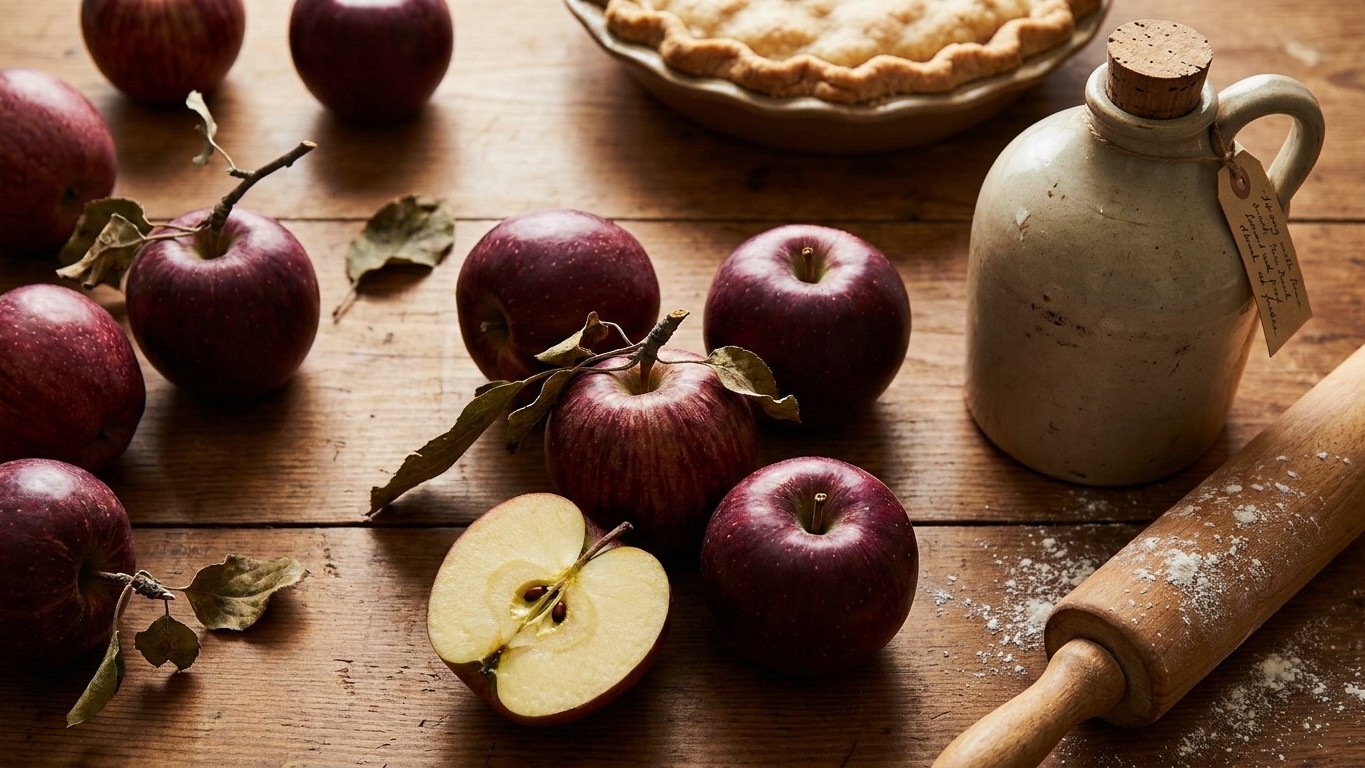

Winesap is a late-blooming, October-ripening apple with hard, tart flesh built for cider and pies rather than eating fresh off the tree. It grows in zones 5-8, carries moderate fire blight resistance, and produces sterile pollen, meaning it needs a pollinator partner but can’t return the favor to any tree nearby.
What Winesap actually is

Before anything else, here’s what a grower is actually signing up for with this variety:
- Ripening time: October, according to USU Extension’s Apple Production for the Utah Home Garden
- Taste: distinctly winey and tart, with hard, dense flesh
- Best use: the traditional cider apple, and firm enough for pies
- Storage life: keeps for months
The name gives away the flavor. This isn’t a sweet, soft-fleshed apple you bite into standing in the orchard. The tartness is sharp enough that it reads almost like a small glass of dry wine, and the flesh is dense enough to push back against your teeth. That combination is exactly why it became a standard cider apple for generations of home orchardists: the acid holds up through fermentation, and the flesh doesn’t turn to mush the way a soft dessert apple would.
That same density is why it holds together in a pie. A dessert apple like a Gala or Honeycrisp is bred to be pleasant raw, with flesh that softens quickly under heat. Winesap’s flesh is structurally tougher, so it survives baking without collapsing into applesauce inside the crust. That’s the real distinction a baker should care about: not which apple tastes better, but which one keeps its shape when the oven does its work.
The October harvest and long storage window make it a fall-and-winter apple in the truest sense. Pick it in October, and with the right storage conditions, you’re still eating and cooking with it well into the colder months, long after most dessert varieties have run out.
Will it grow where you are
Two separate questions decide whether Winesap belongs in your yard, and they’re not the same question, even though people often treat them as one.
Hardiness zones
USU Extension lists Winesap as suited to zones 5 through 8. That’s a range, not a single number, and it matters because a lot of the mid-Atlantic, the Pacific Northwest, and parts of the Mountain West fall inside it. If you’re gardening in zone 4 or colder, or in zone 9 or warmer, this variety sits outside its documented comfort range and you’re taking on risk the source doesn’t back up.
Winter chill hours
Hardiness zone tells you about surviving cold. Chill hours tell you something different: whether the tree gets enough cumulative cold time over winter to break dormancy properly and flower on schedule. A tree can be perfectly hardy in your zone and still under-perform if it doesn’t get its chill requirement met, which is a common problem for growers who try to push northern varieties into warm-winter regions like the Gulf Coast or coastal Southern California.
For Winesap specifically, no chill hour figure is published in the sources used for this page, so it’s worth stating plainly rather than guessing: the number isn’t documented here. Given the zone 5-8 range and the late bloom season, this reads as a variety built for regions with a real winter, not a mild one. Gardeners in traditionally cold-winter states, think the upper Midwest, the interior Northeast, or higher elevations in the Mountain West, are working within the range the source actually supports. Gardeners in mild-winter climates should treat the missing chill data as a reason for caution, not an invitation to assume it’ll be fine.
What to plant beside it
This is where Winesap gets complicated, and it’s the reason a lot of people end up disappointed with a tree that looked great in the catalog. Winesap’s pollen is sterile. It can receive pollen from another variety and set fruit, but it cannot pollinate any other tree in return. Nearly all apple varieties crop better with a compatible partner nearby, since almost none set a full crop reliably on their own pollen. Winesap takes that a step further: plant it next to just one other variety, and that variety gets nothing back.
That has a direct, practical consequence. A two-tree orchard with Winesap and one partner variety is a dead end for that partner. The partner tree flowers, offers pollen to the Winesap, and then sits there unpollinated itself unless something else in the neighborhood, a crabapple, a nearby yard’s tree, or a third variety you planted yourself, does the job. If you’re planning a small home orchard around Winesap, budget for three varieties, not two: Winesap, a pollinator for it, and a pollinator for that pollinator, unless the second variety happens to be self-fertile enough to manage on its own or there’s a compatible tree within bee range nearby.
As for which specific varieties are documented as compatible pollen partners for Winesap, that list isn’t published in the sources used for this page. Rather than naming something at a guess, it’s more useful to say clearly: check locally, and confirm bloom timing overlaps before you commit two trees to the same season, since a partner that blooms early or late relative to Winesap’s late bloom window won’t help even if it’s otherwise compatible. For a fuller breakdown of how apple pollination groups work and how to match bloom times correctly, see our apple pollination guide.
One more thing worth flagging, since it trips people up with other varieties even if it’s not documented as an issue here specifically: a parent variety generally cannot pollinate its own seedling, even when the two bloom at the same time. If you ever pair Winesap with a variety bred from it, don’t assume flowering overlap is enough. Confirm the parentage isn’t the problem before you plant.
Growing it well
Winesap asks for a few specific things that a lot of newer, disease-bred varieties don’t, and knowing what to expect saves a season of confusion.
Fire blight
USU Extension rates Winesap as moderately resistant to fire blight. In practical terms, that means it’s not bulletproof, but it’s also not a variety where you should expect blight to wipe out branches every wet spring. Watch for the telltale shepherd’s-crook wilting of new shoot tips after warm, humid weather during bloom, and prune out any infected wood promptly, cutting well below the visible damage. Moderate resistance buys you some margin, not immunity.
Growth habit and biennial bearing
Winesap has a reputation among long-time growers for uneven cropping from year to year, a pattern often called biennial bearing, where a heavy crop one season is followed by a light one the next. If your tree sets an especially large crop, thinning the fruit down while it’s still small helps even out the swings and protects next year’s flower buds, which tend to form less reliably on a tree that’s been allowed to overbear.
Thinning
Beyond managing biennial bearing, thinning also improves the size and quality of the apples that remain, since a tree with too many fruits competing for the same resources tends to produce a larger number of smaller, less flavorful apples. Removing extras early in the season, leaving space between the fruits that stay, is standard practice for this variety.
Picking it and keeping it
Winesap ripens in October, according to USU Extension, but a calendar date is only a starting point. The tree itself gives better signals, and checking them in order beats guessing based on the month alone.
- Lift and twist a fruit gently. If it separates from the branch with a light twist and doesn’t need to be yanked or pulled, it’s likely ready.
- Cut one open and check the seeds. Fully ripe apples generally show dark brown seeds; pale or greenish seeds mean it needs more time.
- Check the ground color, the background color of the skin beneath any red blush. A shift from green toward a more yellow or cream base tone is a sign of ripening.
Storage
Once picked, Winesap keeps for months, which is one of its main advantages over shorter-lived dessert varieties. Store it in a cool, humid environment, root cellar conditions or a refrigerator’s crisper drawer for smaller quantities, and check periodically for any fruit that’s softening or showing decay, since a single spoiling apple can accelerate breakdown in the ones stored beside it.
Common questions
Can Winesap pollinate other apple trees?
No. Winesap produces sterile pollen. It can be pollinated by a compatible variety and will set fruit, but it cannot supply pollen that fertilizes another tree.
Is Winesap good for eating fresh?
It’s edible fresh, but the flavor is described as distinctly winey and tart with hard, dense flesh, a profile many people find better suited to cider and baking than to eating out of hand.
What zone is best for growing Winesap?
USU Extension lists it as suited to zones 5 through 8. Outside that range, it falls outside the documented growing conditions for the variety.
Does Winesap need a specific pollinator variety?
The sources used for this page don’t publish a specific list of compatible pollinator varieties for Winesap. Confirm locally that any partner variety’s bloom time overlaps with Winesap’s late bloom season, and plan for a third tree since Winesap itself cannot pollinate its partner in return.
How long does Winesap keep in storage?
It keeps for months when stored in cool, humid conditions, making it one of the longer-lasting apples for home storage after an October harvest.