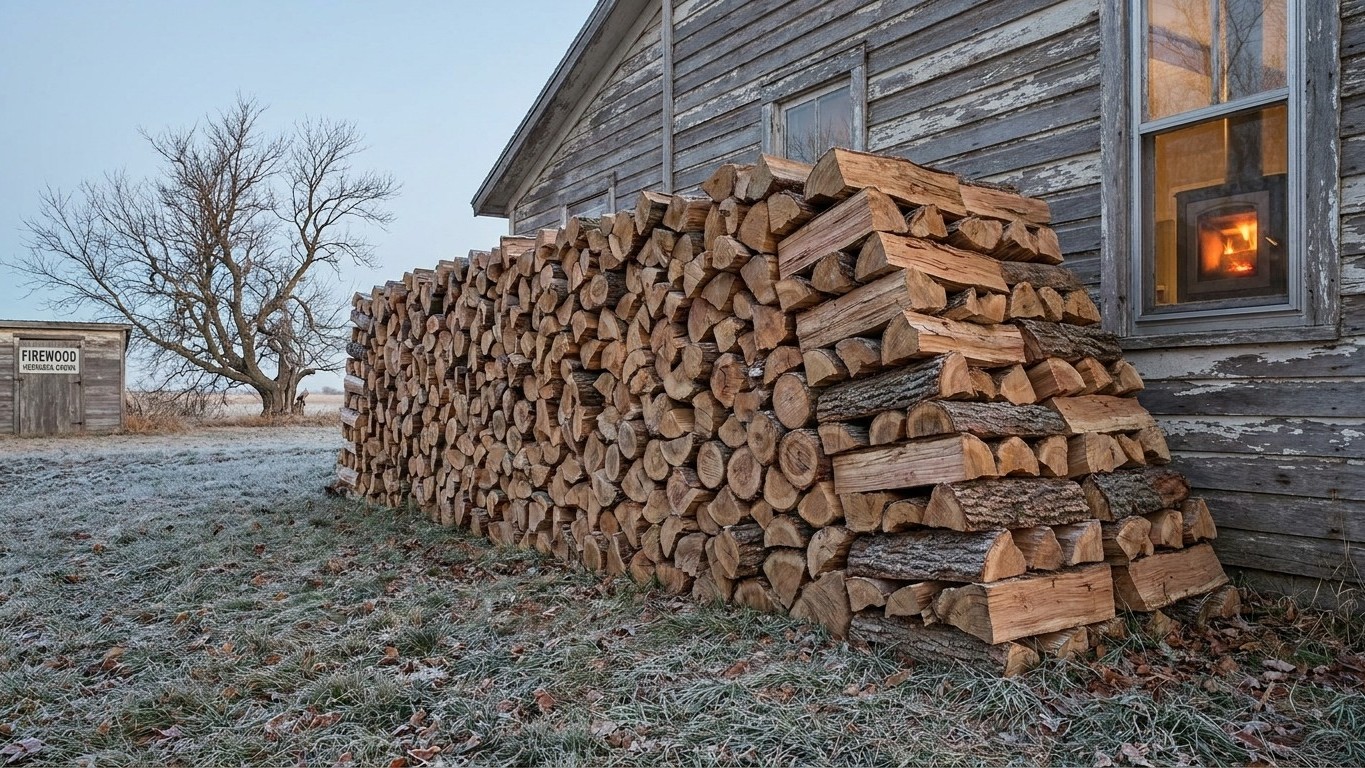

Omaha’s coldest month averages a low of 15.2°F, cold enough that firewood in Nebraska stops being background scenery and starts carrying real weight. That single number decides almost everything that follows: how many cords a household burns before spring, which species earn their space in the woodshed, and how much lead time a stack needs before the first hard freeze. Here’s what that cold actually demands, wood by wood, cord by cord.
How cold it actually gets here
15.2°F is the mean daily minimum for the coldest month at Omaha, according to NOAA’s Climate Normals covering 1991 to 2020. That’s not the record low some old-timer remembers from a bad January decades back. It’s the average low, night after night, across three decades of winters. Nebraska doesn’t dip into the single digits every night, but 15°F as a baseline means the state sits solidly in serious heating territory, not the mild edge where wood is a nice-to-have.
What does heating through a winter that bottoms out there actually look like? A wood stove or insert has to hold a bed of coals overnight without going cold by 4 a.m., because outdoor temperatures in that range pull heat out of a house fast, especially through older windows and uninsulated rim joists common in Nebraska’s farmhouses and mid-century ranch homes. A fire that burns hot and fast for two hours and then dies isn’t doing the job. The wood needs to carry a load.
Why this figure matters more than the record low
A one-night record cold snap is a story you tell. A mean low of 15.2°F across an entire month is a pattern you plan a season around. It’s the difference between buying an extra half cord “just in case” and structuring the whole winter’s wood supply around dense, long-burning species from the start. This is not a climate where wood functions purely as ambiance around a fireplace on a Saturday night. For anyone using it as a primary or serious supplemental heat source, this figure says the stakes are real: underestimate the cold, and the stove runs out of coals before the sun comes up.
It also means the shoulder seasons matter less than they might in a milder state. Nebraska’s winter isn’t a few sharp cold snaps bookended by mild weeks. The cold months settle in and stay, which is exactly why the species choice in the next section carries so much weight. A wood that burns bright and fast might be fine in November. By January, with lows sitting near 15°F night after night, that same wood leaves a stove cold before morning chores start.
Which woods are worth the effort here
Once a winter is running a mean low near 15°F, density stops being a preference and becomes the deciding factor. A cord is a fixed volume, a stack measuring 4 feet by 4 feet by 8 feet, or 128 cubic feet, whether it’s packed with a dense hardwood or a light, airy species. Because the volume never changes, the only way to pack more heat into that same cord is to pack more mass into it. That’s the entire logic behind choosing wood for a genuinely cold winter over one that just needs occasional atmosphere.
Well-seasoned hardwood, on average, yields about 20 million BTU per cord, according to Michigan State University Extension. That’s roughly the heat of 145 gallons of #2 fuel oil, or 215 gallons of LP gas, packed into one stack of split wood. That average covers a range of dense hardwoods, and it’s the number worth measuring any specific load against rather than treating as a guarantee, since species and moisture content both push it up or down substantially.
Dense wood for the coldest nights, light wood for starting fires
Red oak sits at the dense end of that range and is common across Nebraska woodlots and farm windbreaks. It’s the wood built for the overnight burn, the one that holds coals through a 15°F night and still has heat left for the morning fire. The tradeoff: MSU notes red oak dries slowly because of its cell structure, so it demands more patience than most species before it’s ready to burn (more on that below).
Lighter, faster-burning woods still have a job. They’re for getting a fire going quickly, for shoulder-season evenings when the house doesn’t need an all-night burn, and for mixing into a stove load to bring the temperature up fast before switching to denser splits for the long haul. Using only light wood through a Nebraska winter means constant reloading and a stove that goes cold fast. Using only dense wood without anything to kindle it means a slow, frustrating start every single time.
| Wood category | Approx. BTU per cord (seasoned) | Smoke | Sparks |
|---|---|---|---|
| Dense hardwood (e.g., red oak) | Near or above the ~20 million BTU average | Low when properly seasoned | Low |
| Light/fast-burning wood | Below the ~20 million BTU average | Higher if not fully dry | Higher, more prone to popping |
Local availability decides as much as any table. A species that isn’t sold seasoned anywhere near a given county in Nebraska is a worse choice, in practice, than a more modest wood a buyer can actually get dry and ready. The best wood on paper does nothing for a stove if it’s sitting green in a supplier’s yard through January.
How much wood a winter takes
Any published “cords per winter” figure floating around is close to useless without knowing three things about the specific house it’s meant for. A number pulled from a neighbor’s experience, or from a general internet estimate, ignores exactly the variables that move actual consumption up or down by a large margin.
- The cold figure for the area: a winter that bottoms out at 15.2°F, like Omaha’s, demands far more fuel than one that rarely drops below freezing.
- How well the house holds heat: insulation, air sealing, window quality, and even how exposed the house is to Nebraska’s wind all change how fast heat escapes once the stove stops feeding it.
- Whether wood is the main heat source or a supplement: a household running a wood stove as backup to a furnace burns a fraction of what a household relying on wood as primary heat needs.
The mechanism that makes these estimates swing so widely: a poorly insulated house sitting through a hard Nebraska winter can burn double what a tight, well-sealed house uses in that same climate, running the same stove. Two neighbors on the same street, same winter, same species of wood, can land on completely different cord counts because one house leaks heat through an uninsulated attic and drafty original windows while the other doesn’t.
The practical move is to run the estimate down that list rather than search for a single fixed number. Start with the local cold figure as the baseline demand, adjust up sharply if the house is old or poorly sealed, and adjust down if wood is only filling gaps around a furnace that’s doing most of the real work. That gives a working number worth building a woodpile around, rather than a guess borrowed from someone else’s house.
Drying wood in this climate
Seasoning matters more than species selection almost everywhere, and Nebraska is no exception. The target, regardless of climate or wood type, is 20 percent moisture or less. Green wood can sit well above 60 percent moisture when it’s first cut, according to Michigan State University Extension, and every bit of that water has to boil off before the wood gives any usable heat. That boiling process eats the very energy a fire is supposed to produce, which is why green wood hisses, smokes heavily, and struggles to hold a flame.
What actually dries wood is air movement and time, not direct sun exposure. Splitting the rounds and stacking them so air can pass freely through the pile, off the ground and ideally covered on top only, does the real work. Wood piled in a shady spot with good airflow will often dry faster than wood baking in full sun but stacked in a tight, airless heap.
Split, stacked green hardwood generally reaches that 20 percent target after a full summer season, but that assumes it was actually split and stacked, not left in rounds where the bark seals in moisture. Red oak is the named exception here: its cell structure slows the drying process, so it typically needs longer than a single summer to season properly, something worth planning for a year ahead rather than assuming it’ll be ready by the first frost.
Tied to the region’s cold figure, this creates the single most common mistake Nebraska firewood buyers make: cutting or buying green wood in spring and expecting it to carry the household through the winter that follows. Given the 15.2°F baseline this state’s coldest month runs, a stove loaded with wood that never dropped below 30 or 40 percent moisture won’t deliver anywhere near the heat a household is counting on, no matter how dense the species is on paper.