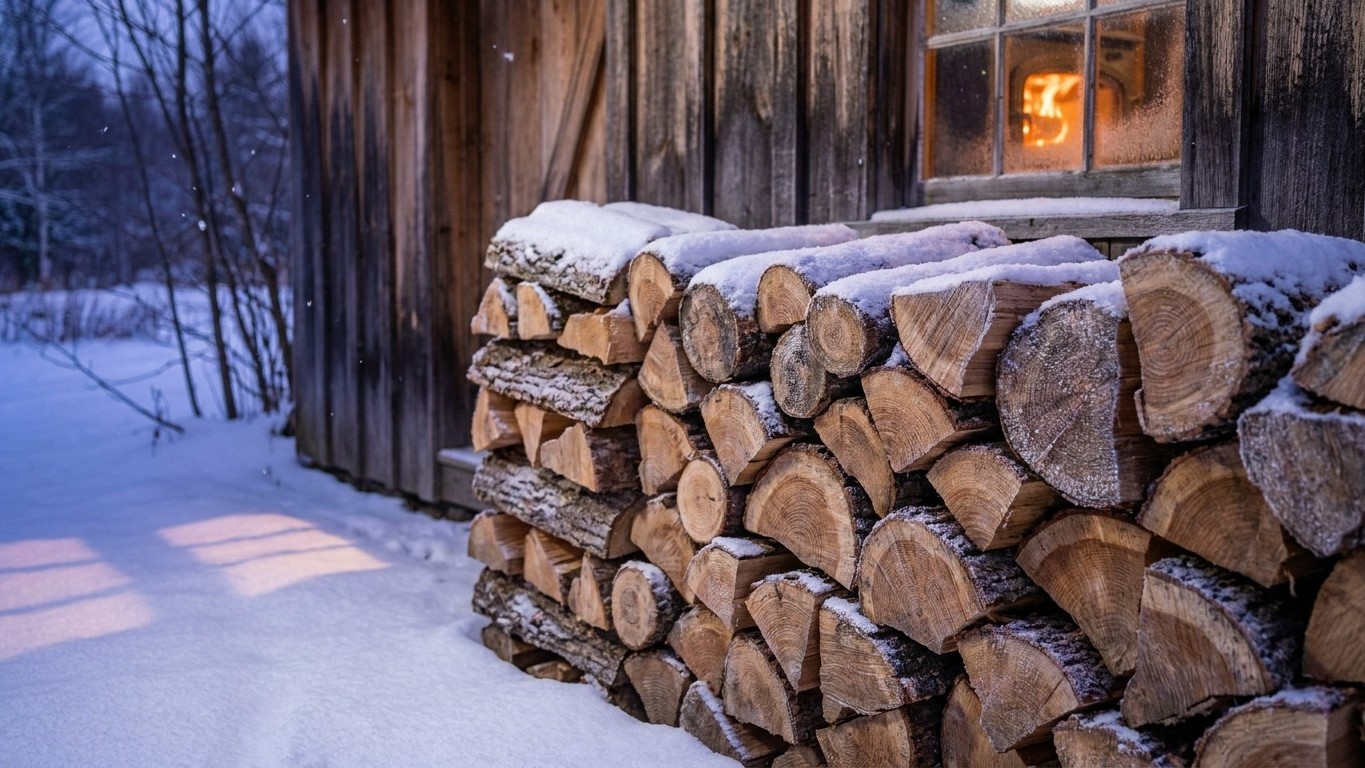

New Hampshire winters bottom out at an average low of 17.1°F in the coldest month, based on NOAA Climate Normals for the Manchester reference station. That number isn’t cold enough to make wood heat optional, and it’s the reason density matters more here than in milder states. What follows is a plain answer: which woods pull their weight through a real New Hampshire winter, how much you’ll burn, and how long it needs to dry before it’s worth stacking near the stove.
How cold it actually gets here

17.1°F is the mean daily minimum for the coldest month at Manchester, drawn from the 1991-2020 NOAA Climate Normals. That’s not the record low, and it’s not some abstract yearly average. It’s the number that tells you what a typical cold night looks like, over and over, for weeks at a stretch. Anyone burning wood through a New Hampshire winter is planning around nights in the high teens, not the balmy 30s.
That figure changes what firewood is for in this state. In a climate where winter lows sit above 40°F, a woodstove is mostly atmosphere: a nice fire on a chilly evening, not something standing between a household and a cold house. New Hampshire isn’t that climate. At 17.1°F, a stove or insert running through January and February is doing real work, often supplementing or replacing a furnace on the coldest stretches, and the wood feeding it needs to actually deliver heat, not just burn.
What that means for wood choice
A night that dips into the high teens burns through a firebox fast. Thin, punky wood or half-seasoned rounds might keep a fire going, but they won’t hold a bed of coals until morning, and they won’t push enough heat to matter when the furnace would otherwise be working overtime. The practical result: New Hampshire households need dense, well-seasoned hardwood for the core of winter, and they need enough of it stacked and dry before the cold arrives, not scrambling in December.
This isn’t a state where you can get away with whatever fell in the yard last fall. The mean low of 17.1°F is common enough, most winters, that it shows up for weeks, not days. That’s the baseline the rest of this guide works from: what wood carries that kind of night, how much of it a typical house needs, and how long it takes to get from a green round to something worth burning.
Which woods are worth the effort here
A cord is a fixed volume, a stack 4 feet by 4 feet by 8 feet, or 128 cubic feet. That means the only way to get more heat out of the same stack is to fill it with denser wood. In a climate that bottoms out at 17.1°F, that difference isn’t cosmetic. A cord of well-seasoned hardwood carries about 20 million BTU on average, according to Michigan State University Extension, roughly the heat equivalent of 145 gallons of #2 fuel oil or 215 gallons of LP gas. But that 20 million figure is an average across hardwood species; density moves it a lot in either direction, and moisture moves it even more.
For the coldest nights and an overnight burn that still has coals in the morning, dense hardwoods native to New Hampshire forests carry the load: red oak, sugar maple, and white ash sit above the average cord, burning slow and hot with a long coal bed. Yellow birch runs a notch lighter but still solid, and it’s easy to find seasoned locally since it’s common in New Hampshire woodlots. On the other end, eastern white pine and hemlock are light, resinous, and fast-burning: good for getting a cold stove going or carrying a mild shoulder-season evening, but they burn down too quickly to hold heat through a January night on their own.
What the table can’t tell you
None of this matters if the wood isn’t seasoned, and local availability decides as much as density does. A load of red oak that’s still at 40 percent moisture underperforms a modest, bone-dry load of birch, every time. Ask any firewood dealer or seller in New Hampshire what’s actually cut, split, and seasoned right now, not just what’s theoretically the densest species, and buy that.
| Species | Heat output | Smoke | Sparks |
|---|---|---|---|
| Red oak | High, above cord average | Low once seasoned | Low |
| Sugar maple | High | Low | Low |
| White ash | High | Low | Low |
| Yellow birch | Medium-high | Moderate | Low-moderate |
| Eastern white pine | Low | Higher, resinous | Moderate-high |
| Hemlock | Low | Higher | High |
How much wood a winter takes
There’s no honest single number for “cords per winter” in New Hampshire, and any figure you see published without conditions attached is close to meaningless. The estimate depends on three things layered together: the cold figure for your area, how well your house holds heat, and whether wood is your main heat source or backup to a furnace. A poorly insulated farmhouse with drafty windows, heated through a 17.1°F winter with wood as the primary source, can burn double what a tightly sealed, well-insulated home uses in that same climate, running the same stove.
That’s the mechanism worth understanding before you order or cut anything: insulation and air sealing don’t just save a little on the margins, they can cut wood consumption in half. A house losing heat through an uninsulated attic or single-pane windows is asking the stove to replace that loss, night after night, and it shows up directly in cords burned.
Run the estimate for your own house
- Local cold severity: how many weeks typically sit near that 17.1°F mean low versus milder stretches
- Insulation and air sealing: attic insulation, window quality, and how drafty the house is overall
- Role of wood heat: whether it’s the sole heat source, or supplementing an oil, gas, or electric furnace
- Stove or insert efficiency: older, leaky stoves waste more of each cord’s BTU than modern sealed units
- House size and layout: square footage and how open or closed the floor plan is around the stove
Run down that list honestly for your own place, and you’ll land closer to a real number than any generic “New Hampshire households burn X cords” claim could give you.
Drying wood in this climate
Species and density matter, but seasoning decides whether any of that potential ever reaches the firebox. Green wood can hold over 60 percent moisture, and that water has to boil off before the wood gives up any heat, eating energy you were counting on. The target, no matter what’s growing in your woodlot, is 20 percent moisture or less, per Michigan State University Extension. What gets wood there is airflow and time, not sunshine, so a woodpile tucked in shade with good air movement between rows dries just as well as one baking in full sun.
New Hampshire’s climate, with humid summers and a drying season that really only runs from spring thaw to first frost, means split and stacked hardwood generally needs a full summer of exposure to reach that 20 percent mark. Red oak is the named exception: its cell structure dries slower than other hardwoods, so a single summer often isn’t enough, and it may need a second season stacked before it burns clean.
The mistake almost everyone makes
Wood cut and split in spring for that same coming winter is, in most cases, not ready. It hasn’t had a full summer of air movement through split faces, and burning it green means a smoky, inefficient fire that wastes a good share of that 20 million BTU per cord boiling off water instead of heating a room. The wood you’ll burn come January, when it’s sitting at 17.1°F outside, should already have been split and stacked since at least the previous spring, ideally longer for oak. Anyone starting a woodpile from scratch this year is really stocking next winter, not this one.