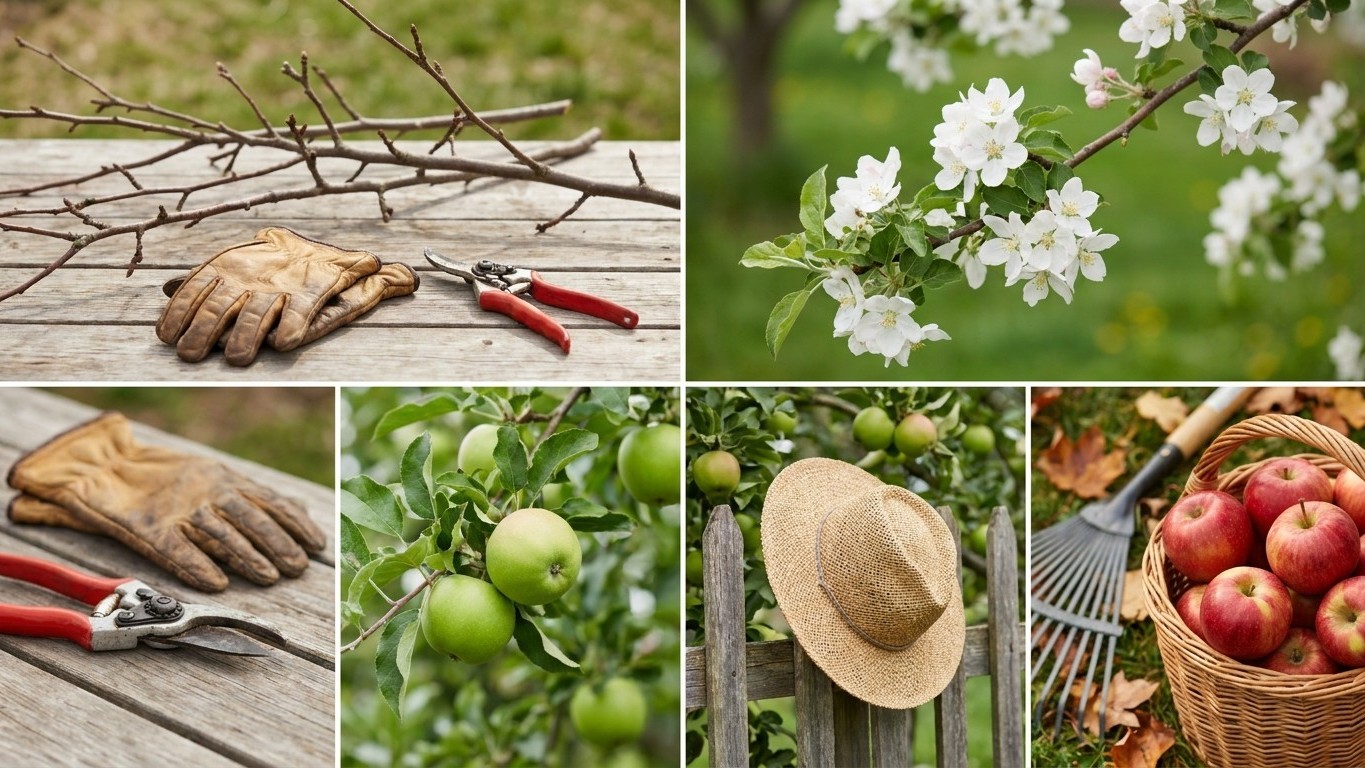

Ontario’s apple calendar runs on the tree’s own stages, not the date on the wall, but those stages still need a frost window to hang against. Environment and Climate Change Canada’s 1981-2010 normals for the Toronto Pearson station put the mean last spring frost at April 30 and the mean first fall frost at October 16, and either can land weeks later in a colder year. Check bud stage before you prune, spray, or pick. The calendar tells you roughly when to look. The tree tells you what to do.
The short answer for Ontario
Near Toronto, dormant pruning runs through late winter into green tip, bloom generally follows the Toronto Pearson station’s mean last spring frost of April 30 (ECCC, 1981-2010 normals) by a couple of weeks, and harvest for most dessert varieties finishes well ahead of the mean first fall frost of October 16 (ECCC, same normals). Those two dates frame the season, but they are not fixed appointments. ECCC’s own normals mean the spring frost lands later than April 30 in one year out of two, so treat the date as a midpoint, never a guarantee.
What actually decides when a stage arrives is accumulated heat, not the month printed on a calendar. A mild March pushes green tip earlier no matter what the date says, and a cold, wet May can hold bloom back by a couple of weeks even after the mean frost date has passed. Cultivar choice moves the whole schedule too: an early bloomer such as ‘Yellow Transparent’ opens flowers well ahead of a late bloomer such as ‘Northern Spy’, so a mixed-planted orchard can carry two different stages within the same week. Before you plant, the Best Apple Varieties for Ontario guide breaks down relative bloom timing and days-to-harvest by cultivar, which is the piece of information that actually shifts these dates for your own trees.
None of this replaces watching the buds directly. A grower who prunes or sprays by the calendar instead of the stage is working from a number that is, by definition, wrong half the time.
Working through it

Seven stages carry the apple year from bare wood to picked fruit, and each one is a visual checkpoint you can confirm by walking out to the tree rather than checking a date.
Dormancy

The tree is bare and the buds are tight and scaled. This is the pruning window, and it is also when winter hardiness gets tested. Toronto’s coldest month has a mean daily minimum of -10.2 °C (ECCC, 1981-2010 normals), which is not the record low for the season, just the average low of the coldest month. That figure is what rules out a genuinely tender rootstock or cultivar for this reference station. It says nothing about whether a tree flowers well, which is a separate question of winter chill.
Green tip

A sliver of green leaf tissue pushes through the split bud scales. Growers who spray for apple scab typically start protective fungicide here, because the newly exposed tissue is what the disease infects first. Green tip usually shows up well before the April 30 mean last frost (ECCC), sometimes by three to four weeks in a warm spring, which is exactly why the stage, not the date, has to trigger the first spray.
Pink

Blossom buds swell into tight pink balls, petals still closed. This is the last easy window to thin flower clusters by hand or to apply a pre-bloom fungicide before the flowers open and bees start working them.
Bloom

White, five-petaled flowers open in clusters. Bloom is the stage most exposed to frost damage, and because it tends to land close to the April 30 mean (ECCC), a late freeze in the half of years when frost arrives after that date can kill open blossoms outright and cut the year’s crop before fruit ever sets.
Petal fall

Petals brown and drop, leaving a small swollen ovary. Fungicide programs generally continue here, since the young fruit tissue is still vulnerable to scab and to fire blight infection in wet, warm weather.
Fruit set

Fruitlets reach pea to marble size. A natural June drop thins some clusters on its own, and growers thin the rest by hand to improve size and reduce limb breakage later in the season.
Harvest
Fruit reaches full size and characteristic color for the cultivar. Ripening order runs by variety rather than by a fixed date: early-season cultivars finish well before mid-season types, and late-season keepers such as ‘Northern Spy’ need every extra week they can get before the October 16 mean first fall frost (ECCC) closes the window.
| Stage | What triggers it | What to do now |
|---|---|---|
| Dormancy | Cold, leafless season | Prune, apply dormant oil |
| Green tip | Accumulated spring heat | First scab fungicide if needed |
| Pink | Blossom buds swell, unopened | Scout insects, pre-bloom spray |
| Bloom | Petals open | Watch for frost, avoid insecticide during bee activity |
| Petal fall | Petals brown and drop | Continue disease protection |
| Fruit set | Fruitlets pea to marble size | Hand-thin clusters |
| Harvest | Full size and color for cultivar | Pick before first fall frost mean |
What changes across Ontario
The Toronto Pearson figures come from that named ECCC station, but Ontario is not one climate and the same stage shows up on a different week depending on where the tree stands. The Niagara Peninsula, sitting between Lake Ontario and Lake Erie, gets a moderating lake effect that delays spring bud break slightly but also holds off the first fall freeze, which is part of why the region carries a long-established fruit and grape industry. The Ottawa Valley, well inland from any large lake, runs a more continental pattern with sharper swings between a warm afternoon and a cold night, and valley floors there can trap cold air overnight, arriving at green tip and bloom later than a Toronto-area orchard in a similar latitude.
Elevation matters just as much as latitude. Orchards in the Bruce Peninsula and Georgian Bay uplands sit higher and closer to open water, which can push both bud break and the safe planting window later into spring compared with the Toronto reference station. Low-lying pockets anywhere in the province, wherever cold night air has nowhere to drain, tend to hold frost longer into spring and pick it back up earlier in fall than a slope or hilltop orchard a short distance away.
None of this changes what a stage means once you see it. It changes how many weeks you should expect to shift the Toronto-based mean dates by, in either direction, before you trust a spray or harvest decision to the calendar rather than the tree in front of you.
The mistakes this climate punishes
Three errors show up again and again in Ontario apple orchards, and each one lines up with a specific stage rather than a season in general.
- Planting an early-blooming cultivar in a frost-prone site. If bloom lands close to the April 30 mean last frost (ECCC), and that mean is exceeded in roughly half of all years, an early bloomer in a low-lying or exposed spot is gambling on the better half of that split every single spring.
- Choosing a low-chill cultivar bred for a milder climate. A variety that needs relatively few winter chill hours can break bud during a false warm spell in late winter, only to have that new growth killed by the return of normal cold, a risk that is separate from whether the tree’s wood itself survives the coldest month.
- Feeding nitrogen too late in the season. Fertilizing after midsummer keeps shoots growing soft and unhardened right up to the October 16 mean first fall frost (ECCC), and that tender new growth is exactly what gets killed back hardest when the first freeze actually arrives.
Each of these mistakes is invisible at the time you make the decision and only shows up months later, at bloom or at the first hard freeze, which is why they get repeated. Matching cultivar and feeding schedule to this specific climate has to happen before the season that will expose the error, not after.
Checking this against your county
The Toronto Pearson figures are a starting reference, not a local forecast for every county in the province. For a planting and spray calendar adjusted to your own district, the Ontario Ministry of Agriculture, Food and Rural Affairs publishes crop-specific guidance, and it is worth confirming local frost patterns with them before locking in a spray schedule based on the dates in this article. Anyone setting up a new planting should also read Growing Apples in Ontario first, since site selection and rootstock choice are decisions this calendar assumes are already made.
Common questions
What month do apple trees bloom in Ontario?
Near Toronto, bloom generally follows the ECCC mean last spring frost of April 30 by a couple of weeks, but the exact week shifts with cultivar and with how warm the preceding weeks have been. Trust the pink and bloom stages on the tree over a fixed date.
Can a late frost kill apple blossoms in Ontario?
Yes, and it is one of the more common ways an Ontario apple crop gets reduced. Because ECCC’s normals show the last frost lands after April 30 in about half of all years, a bloom that opens right at the mean date is exposed roughly every other spring.
How do I know if my apple tree has enough winter chill?
Hardiness and chill are different questions. Hardiness is whether the wood survives the coldest month, which for the Toronto area runs to a mean daily minimum of -10.2 °C (ECCC), while chill is whether the tree has had enough accumulated cold to flower normally the following spring.
Why did my apples ripen unevenly this year?
Uneven ripening usually traces back to an uneven bloom, often caused by a stretch of cool or wet weather during the bloom stage itself rather than anything wrong with the fruit later on. Cultivars with a naturally long bloom window are more prone to this than tighter-blooming varieties.