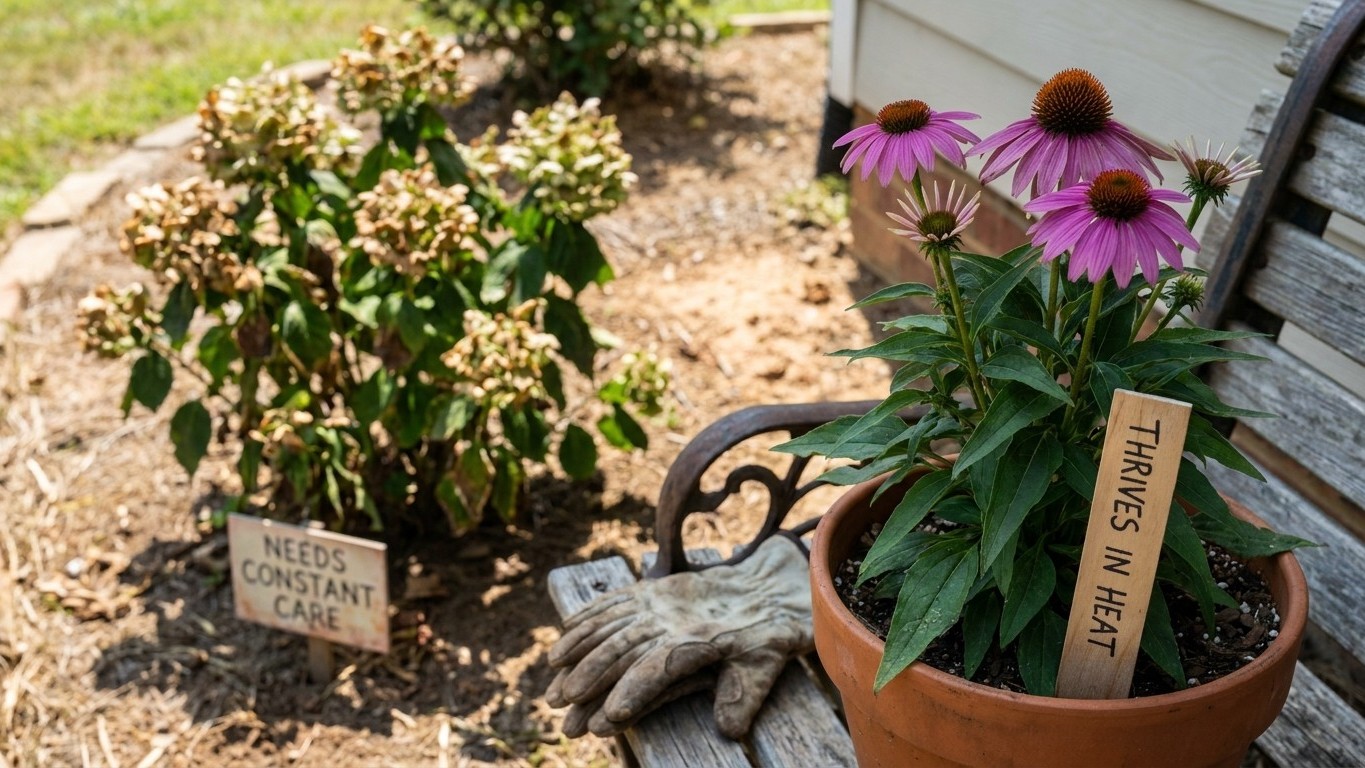

Not every flower sold at the garden center is built for what Alabama actually does to it — the long stretch of humid 90-degree days, the clay soil, the freeze-thaw winters that never quite commit to cold. Coneflower, black-eyed Susan, salvia, and lantana handle all of that without complaint; a lot of catalogue favorites quietly rot or wilt trying. Before you plant anything, check its hardiness zone and heat tolerance against your own county, not the state average, and lean toward natives when you’re unsure.
What thrives in Alabama

The state runs from USDA zone 7a in the higher northern counties down to 9a along the Gulf coast, according to the USDA Plant Hardiness Zone Map’s 2023 update. That’s a wide spread, and it means a flower rated hardy in one part of Alabama can rot, sulk, or simply not go dormant in another. The safest approach is to treat the zone number on a plant tag as a floor, not a guarantee, and to check it against the coldest-month figure for your own area rather than the state as a whole.
Heat is the bigger daily test. With close to two months of 90°F-plus days at the Huntsville reference station, a flower that wilts by early afternoon or drops buds in a heat spike is going to disappoint most Alabama summers, not just an unlucky one. Humidity tolerance matters as much as heat tolerance, because the combination is what breeds powdery mildew, black spot, and root rot in plants bred for drier climates. Flowers from the daisy family (Asteraceae) and the mint family (Lamiaceae) tend to handle both well: coneflower, black-eyed Susan, zinnia, salvia, and lantana all come from lineages built for open, humid, hot summers rather than cool coastal ones.
Drought resistance is the third trait worth weighting, and it’s a little counterintuitive given how much rain the Southeast gets. The issue isn’t total rainfall, it’s that heavy summer downpours followed by baking sun stress a shallow-rooted plant more than a steady dry spell would. Flowers with a deep taproot or a drought-adapted native lineage, like coreopsis or blanket flower (Gaillardia), recover from that boom-bust watering pattern better than shallow-rooted bedding annuals bred mainly for cooler, more even climates.
Native plants worth the space
A native or regionally-adapted flower has already solved the local problem of heat, humidity, and clay soil before you ever bought it. That’s the practical case for planting them: once established, most need far less supplemental water and no regular fertilizer, because they evolved in soils and rainfall patterns close to what your yard already has. The trade-off is patience. A native perennial often spends its first year building roots below ground before it puts on much show above it, which is why a new native bed can look underwhelming the first spring and much fuller by the second.
Plants to consider
Several flowers native to the wider southeastern United States are widely available at Alabama nurseries and do well across most of the state’s zones. Purple coneflower (Echinacea purpurea) and black-eyed Susan (Rudbeckia hirta) are the two most forgiving starting points, tolerating both heavy clay and sandy soil once their roots are down. Butterfly weed (Asclepias tuberosa) brings orange blooms and is a host plant for monarch caterpillars, not just a nectar source. Blazing star (Liatris spicata) sends up tall purple spikes in mid to late summer and handles the dry spells between downpours better than most bedding plants. Bee balm (Monarda fistulosa) draws hummingbirds and bumblebees reliably, though it appreciates a bit more moisture than the others on this list.
- Purple coneflower: full sun, tolerates clay, blooms early to late summer
- Black-eyed Susan: full sun, self-seeds readily, blooms summer into fall
- Butterfly weed: full sun, drought-tolerant once established, supports monarchs
- Blazing star: full sun, tall spikes, best massed rather than planted singly
- Bee balm: part shade tolerant, prefers evenly moist soil, mildew-prone in still air
None of these need the soil amending or winter protection that non-native bedding flowers often demand, which is the real argument for giving them the space. A bed built mostly around natives also draws a steadier stream of pollinators across the whole season, rather than the short burst you get from a single planting of annuals.
Perennials that come back

Whether a perennial actually returns here comes down to matching its hardiness rating against the local winter, and that’s where a lot of gardeners get tripped up by a plant tag. A tag that says “hardy to zone 7” will survive Alabama’s winter almost everywhere in the state, since even the coldest counties sit at zone 7a. A tag that says “hardy in zones 8 to 11” is a different story: it will likely come back reliably along the Gulf coast, but in the northern counties near Huntsville, where NOAA’s normals put the coldest month’s average low at 33.1°F, that same plant may die back to the ground most winters or fail outright in a harder-than-average freeze.
Reading a plant tag against your zone
- Find the hardiness range printed on the tag or in the catalogue listing.
- Compare the lower number to your part of the state, not the state average of 7a to 9a.
- If your zone falls inside the range with margin, treat it as a true perennial.
- If your zone sits at the edge of the range, expect it to behave more like an annual in a hard winter.
Lantana is the clearest example of this split personality. Further south, in zone 9a and warmer, it’s a genuinely perennial woody shrub that just gets cut back hard each spring. In the cooler parts of Alabama it often dies to the roots or dies outright over winter, and most gardeners there replant it as an annual rather than count on it returning. Pentas and tropical hibiscus follow the same pattern: perennial where winters stay mild, annual or container plants everywhere the winter low regularly dips close to freezing.
Reliable true perennials across nearly all of Alabama’s zone range include daylily (Hemerocallis), garden phlox (Phlox paniculata), coneflower, and most salvias in the Salvia greggii and Salvia nemorosa groups. These die back to the crown in winter and return from the root each spring without needing to be dug and stored. Gardeners dealing with a similarly wide hardiness spread will recognize the same tag-reading problem covered in our guide to Flowers That Actually Thrive in Arkansas, and the Ones That Struggle, where the zone range runs almost as wide as Alabama’s.
Putting a border together
A border that looks planned rather than scattered comes down to three habits: layering by height, staggering bloom time, and repeating a color rather than scattering one of everything. Put the tallest flowers, like blazing star or garden phlox, at the back or center of a bed you can see from all sides, then step down through mid-height salvias and coneflowers to low edging plants like coreopsis or dwarf zinnias at the front. Leave real gaps at planting time even though the bed looks sparse for the first season. Most perennials and even vigorous annuals will fill in by their second year, and overcrowding at planting is one of the most common reasons a bed needs thinning and dividing within two years instead of five.
Sequencing bloom across the season
No single flower blooms from spring through fall, so a border needs at least three waves to avoid a dead stretch in the middle of summer or a bare bed by October. Plant something for each window and let the waves overlap rather than follow each other in a straight line.
| Flower | Peak bloom window | Height | Light |
|---|---|---|---|
| Coreopsis | Late spring into summer | Low, 12-18 in. | Full sun |
| Coneflower | Early to late summer | Mid, 2-3 ft. | Full sun |
| Black-eyed Susan | Mid to late summer | Mid, 2-3 ft. | Full sun |
| Blazing star | Mid to late summer | Tall, 3-4 ft. | Full sun |
| Garden phlox | Summer into early fall | Tall, 3-4 ft. | Full to part sun |
Repeating one or two colors through the bed in three or four separate clumps reads as intentional from a distance, where the same colors scattered as single specimens just look busy. A border of purple coneflower, purple salvia, and purple blazing star repeated at intervals, broken up by the gold of black-eyed Susan or coreopsis, does more visual work than the same eight species planted as one of each.
Local help
The Alabama Cooperative Extension System runs Master Gardener programs in counties across the state and keeps plant lists tuned to local conditions rather than statewide averages. Since Alabama spans USDA zones 7a to 9a, the recommendation for a coastal county can differ sharply from one for the Tennessee Valley, and a county extension office is the fastest way to get a list built for your actual zone. Find your local office through the extension service directory at aces.edu, and browse more Alabama guides for planting windows and other state-specific growing questions.
Common questions
What flowers can I plant right after the last frost?
Wait until your local last spring frost date has passed rather than the calendar date, since NOAA’s 1991-2020 normals put Huntsville’s last spring freeze between March 19 and April 3, and note that suburban and rural gardens often see frost linger a week or two past that airport-based figure. Zinnias, cosmos, and marigolds are typically the first annuals gardeners direct-seed once that window has cleared.
Why did the perennial I bought from a big-box store die over winter even though the tag said it was hardy here?
Big-box tags sometimes carry a hardiness range set for the whole country rather than checked against your specific county. Compare the lower number on the tag to the coldest-month figure for your area rather than trusting the tag alone, and treat anything near the edge of its stated range as a plant that might need winter mulch or replacing some years.
Can I leave tropical hibiscus or lantana in the ground over winter?
In the warmer coastal counties near zone 9a, both can survive outdoors most winters as true perennials. In the cooler northern counties, where the coldest month’s average low sits near freezing according to NOAA’s normals, most gardeners either treat them as annuals or dig and overwinter them indoors.
My flower bed is mostly heavy clay. Does that rule out natives?
No, several of the natives covered above, including black-eyed Susan and purple coneflower, tolerate heavy clay well once established. The main risk in clay is standing water around the crown right after planting, so working in some organic matter at planting time helps more than trying to fully replace the soil.
Related guides
- Flowers That Actually Thrive in Mississippi, and the Ones That Struggle
- Flowers That Actually Thrive in Tennessee, and the Ones That Struggle
- Flowers That Actually Thrive in Arkansas, and the Ones That Struggle