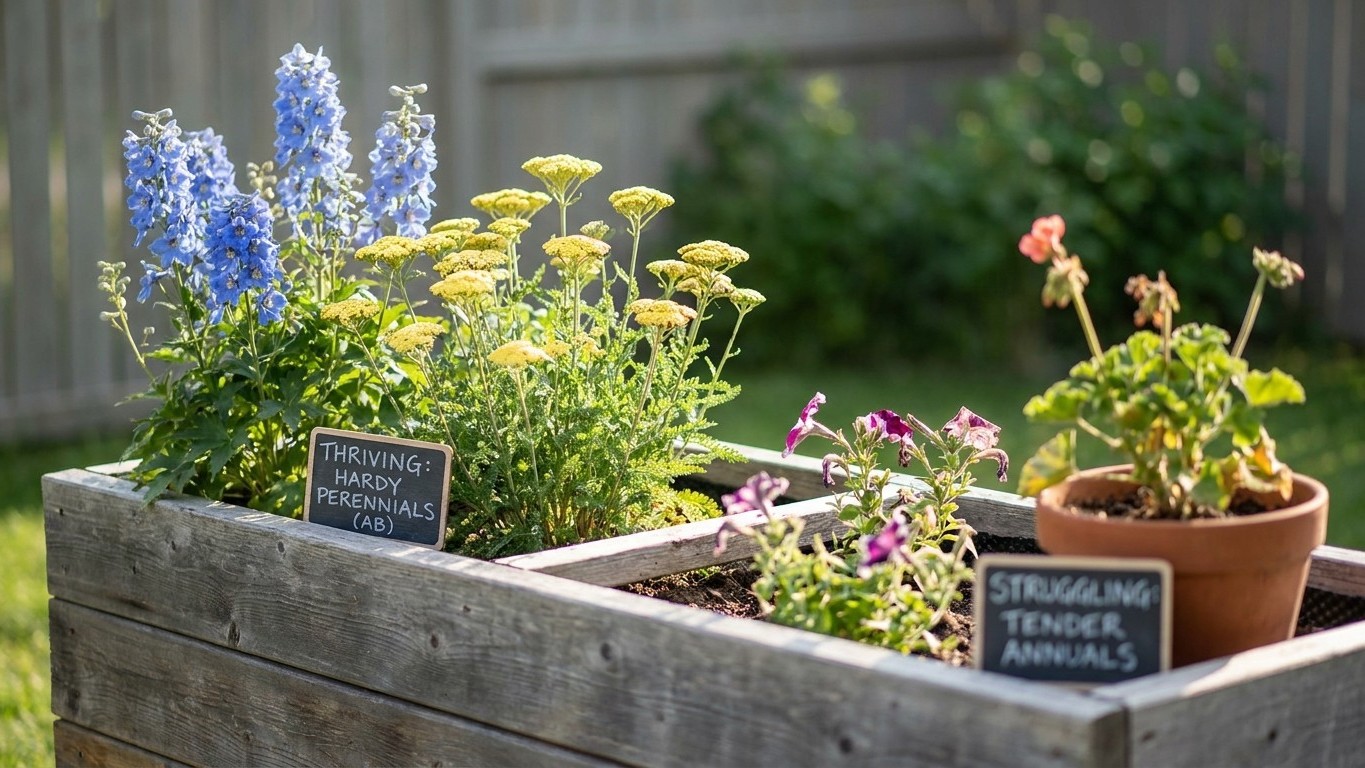

Cold-hardy perennials such as peonies, Siberian iris and delphiniums thrive across Alberta, while tropical and long-season heat lovers like hibiscus and canna struggle badly. Environment and Climate Change Canada’s 1981-2010 normals put the mean daily minimum of the coldest month at Calgary at just 8.2F, and the same normals record zero days a year reaching 90F there, which tells you plainly what a plant here has to survive and what it will never get. Pick perennials rated hardy to at least that winter minimum before anything else, and treat heat-loving annuals as container plants you can bring indoors rather than border stalwarts.
Putting a border together

A border in this climate has to do two jobs at once: look full through a growing season that is genuinely short, and survive a winter that is genuinely hard. Those two problems shape almost every decision below, from what goes at the back to what you plant in front of it.
Layering by height
Put the tallest, toughest plants at the back. Delphiniums running four to five feet and Siberian iris at three feet form a backbone that holds up in wind and doesn’t flop by midsummer. Bring the middle layer down to peonies and daylilies at two to three feet, then finish the front edge with columbine, potentilla and low annuals like calendula or dwarf marigolds. The point of layering isn’t just looks. It also protects the shorter plants from wind, which matters more here than in milder climates because Alberta’s open winters and dry spring gusts can shred tender new growth that a taller neighbor would have blocked.
A succession of bloom through a short season
With a frost-free window that on average runs from May 21 to September 16 by Environment and Climate Change Canada’s Calgary-area normals, a border that only blooms in July wastes most of the season. Start with early bulbs, tulips and daffodils that come up before the last frost date even arrives. Follow with peonies and iris in early summer, then daylilies, echinacea and rudbeckia carrying the middle of the season. Do not rely on a single late-season anchor: asters and hardy mums can carry color into September, but that first fall frost date is also just a mean, and in half the years it arrives earlier, so treat late bloomers as a bonus rather than the plan.
Repeating a color down the row
A border reads as designed, not scattered, when one or two colors repeat at intervals rather than every plant being a different shade. Pick a color that several of your cold-hardy choices share, purple works well since delphinium, Siberian iris and some echinacea cultivars all carry it, and let it recur every few feet rather than clustering it in one spot.
Leaving room at planting
The single most common mistake in a new border is planting to the mature spread on day one, which leaves it looking sparse for two years and then overcrowded for the next ten. A peony needs two to three feet of eventual width even though the nursery pot looks tiny. Space for the plant it will become, not the plant it is now, and fill the gaps in year one with cheap annuals you’re happy to lose.
What actually thrives and what struggles here
The table below groups the perennials that consistently handle Calgary-area winters against the flowers gardeners keep trying and keep losing. Hardiness ratings are the published catalogue figures for each cultivar, not a local recommendation, so check the tag against your own site before you plant.
| Plant | Type | Published hardiness | How it does in Alberta |
|---|---|---|---|
| Peony | Perennial | Zone 2-3 | Thrives, reliable for decades in the same spot |
| Siberian iris | Perennial | Zone 3 | Thrives, tolerates the dry wind well |
| Delphinium | Perennial | Zone 3 | Thrives, needs staking in open sites |
| Daylily | Perennial | Zone 2 | Thrives, forgiving of poor soil |
| Echinacea | Perennial | Zone 3 | Thrives, best in full sun |
| Potentilla (shrub) | Shrub | Zone 2 | Thrives, blooms through the whole summer |
| Tropical hibiscus | Tender perennial | Zone 8-9 | Struggles, must be treated as an annual or overwintered indoors |
| Canna lily | Tender perennial | Zone 7-8 | Struggles, rhizomes must be dug and stored every fall |
| Bougainvillea | Tender vine | Zone 9-10 | Struggles badly, will not survive outdoors at all |
The heat lovers in that bottom group aren’t struggling because of the cold alone. Environment and Climate Change Canada’s normals show zero days a year at Calgary reaching 90F, and plants like canna and hibiscus that evolved to push growth in sustained heat simply never get the trigger they need to perform, even in a summer that feels warm to you. Long-season dahlias run into the same wall from the other end: a mean frost-free window of roughly four months sounds workable on paper, but because both frost dates are averages rather than guarantees, a dahlia that needs its full catalogue days-to-bloom can get caught by an early September frost in years when the season runs short. Gardeners in coastal British Columbia gardens get a longer, milder shoulder season and can push these same tender plants much further outdoors. Compare that to Alaska’s growing conditions, where the frost-free window is shorter still and the cold-hardy list narrows even further than Alberta’s.
Local help
Alberta’s growing conditions shift a lot between Calgary, Edmonton, the Peace Country and the foothills, so a plant list built for one won’t fit them all. The provincial extension service publishes region-specific plant guidance and is the first place to check before you commit a whole border to a single cultivar. Local Master Gardener programs, usually run through municipal horticultural societies, also field specific questions about a given neighborhood’s microclimate, and their volunteers have often grown the exact plant you’re asking about. For broader Alberta planning beyond flowers, our Alberta guides hub covers related topics like vegetable timing and soil prep.
Common questions
Can I just plant whatever I see at the garden center?
Not safely. Garden centers in Alberta stock plenty of stock bred for warmer zones because it sells, not because it survives the winter here. Check the hardiness zone rating on the tag against Calgary’s coldest-month minimum of 8.2F from Environment and Climate Change Canada’s normals before you buy anything perennial.
Why do my hibiscus and canna look fine all summer and then just die?
Because they were never going to survive winter in the first place. Both are tender perennials rated to zones far milder than Alberta reaches, so they grow well through the frost-free months and then simply freeze out once the cold sets in. Dig canna rhizomes before the first fall frost and store them, or plant both as annuals you accept losing.
How early can I actually plant out my flowers?
Later than most people assume. Calgary’s average last spring frost is May 21 by Environment and Climate Change Canada’s normals, but that is a mean date, meaning frost arrives later than that in about half of all years. Treat it as the midpoint of a risk window, not a green light, and hold tender annuals a couple of weeks past it if you can.
Is it worth trying zinnias or morning glories here?
Zinnias generally do fine as long as you choose a shorter-maturity cultivar and start seed indoors, since Alberta’s frost-free window runs roughly four months on average. Morning glories are a harder sell because they typically need sustained heat to flower heavily, and with zero days a year reaching 90F at Calgary by Environment and Climate Change Canada’s data, many summers simply don’t deliver enough warmth for a strong bloom.
Related guides
- Flowers That Actually Thrive in British Columbia, and the Ones That Struggle
- Flowers That Actually Thrive in Saskatchewan, and the Ones That Struggle
- Flowers That Actually Thrive in Manitoba, and the Ones That Struggle