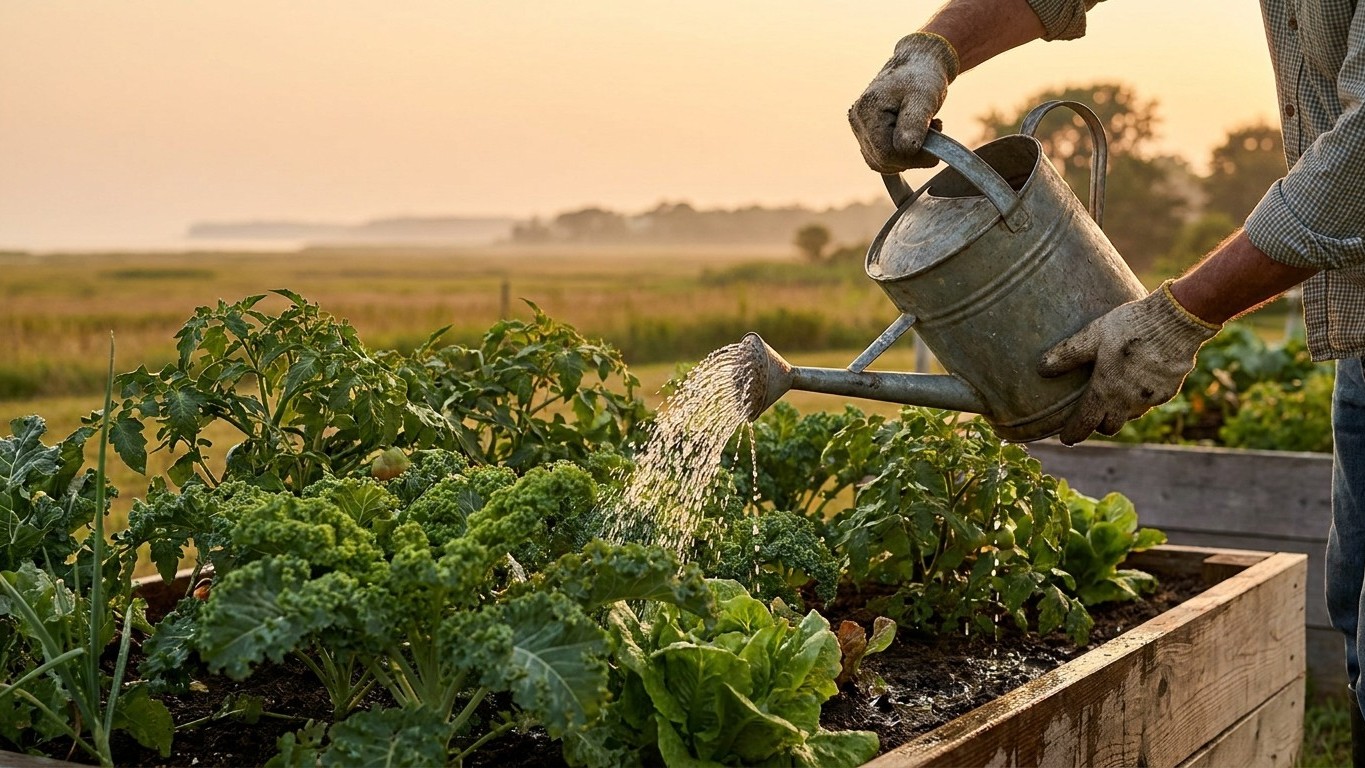

Delaware sits at the edge of two climates: humid enough that a lot of gardeners assume the rain does the work for them, and hot enough for long enough that assumption falls apart every July. Here’s what the numbers actually say about how much water your garden needs, when to give it, and what your local water provider might restrict.
What the climate asks of you

The number that matters most for a Delaware garden isn’t rainfall totals, which shift block to block depending on which thunderstorm cell rolled through. It’s heat load. At the Wilmington reference station, the state averages 17.6 days a year at 90F or hotter, based on NOAA’s 1991-2020 Climate Normals. That’s not a brutal desert number, but it’s enough heat stress, stacked across a humid growing season, to push shallow-rooted plants into wilt by early afternoon on any day that clears 85F, let alone 90F.
The standard horticultural rule of thumb, used across most temperate garden zones in the country, is that a vegetable bed or perennial border wants roughly an inch of water a week, whether that comes from the sky or a hose. Delaware’s coastal-plain geography, low, flat, close to the Chesapeake and Delaware bays, gives it a humid subtropical-to-humid continental transition climate, which means summer rain does fall, but it tends to arrive in short, heavy thunderstorm bursts rather than the slow, soaking rain that actually reaches root depth. A half-inch downpour that runs off a compacted lawn in fifteen minutes doesn’t count the same as a half-inch that soaks in over three hours.
That’s why the honest approach isn’t to trust a seasonal rainfall average, it’s to track what actually lands in your own yard. A five-dollar rain gauge staked near the garden bed will tell you more than any state-wide statistic. If a week goes by with less than an inch registered in that gauge, the difference is on you to make up, and in a Delaware summer, with 17.6 days a year pushing past 90F, that difference shows up fast in tomatoes, squash, and anything planted in a raised bed, which dries out quicker than in-ground soil. Knowing how to keep up with Watering Through a Dry Spell in Delaware matters just as much as the weekly total, since a few missed gauge readings during a heat stretch can undo weeks of steady growth. This is especially true for anyone relying on Watering Pots and Containers in Delaware, since potted plants lose moisture far faster than garden beds during those heat stretches.
Where you garden within the state’s USDA hardiness range of 7a to 8a also shapes the calendar. Wilmington’s frost data puts the last spring freeze between April 3 and April 14, and the first fall freeze between October 26 and November 7, at the reference airport station. Suburban and rural yards away from that station, and especially anywhere with more tree cover or lower elevation pockets, often see frost linger a week or two longer in spring and arrive a week or two earlier in fall. That shortens or lengthens your actual watering season depending on where you live, so check your county extension office before setting a start and stop date for irrigation.
How much, how often
Deep and infrequent beats a light daily sprinkle every time. A quick five-minute sprinkle wets the top half-inch of soil and nothing more, which trains roots to stay shallow, right where the sun bakes them hardest on a 90-degree afternoon. Deep watering, less often, pushes roots down where the soil stays cooler and moisture lasts longer between sessions.
The test for whether your garden actually needs water is simple: push a finger, or better, a trowel, two inches into the soil near the base of the plant. If it’s dry at that depth, water. If it’s still damp, wait. This beats any fixed schedule, because it accounts for whatever the sky did last week without you having to track it.
- Check soil moisture two inches down before watering, using a finger or trowel, rather than watering on a fixed calendar day.
- Water at the base of the plant, not overhead, since wet foliage in Delaware’s humid summer air invites fungal disease within days.
- Water in the early morning, before 9 a.m. if possible, so moisture soaks in before the day’s heat, especially on the 17.6 days a year that reach 90F, pulls it back out through evaporation.
- Apply roughly one inch per week, delivered in one or two sessions rather than several short ones, adjusting downward for whatever your rain gauge already caught.
- Extend the interval on clay-heavy ground, and shorten it on sandy ground, since the two hold water on entirely different timelines.
Soil texture changes that math more than almost anything else. Much of Delaware’s coastal plain runs sandy to loamy-sand, especially in Sussex and Kent counties, ground that drains fast and holds little reserve. That soil type asks for shorter, more frequent soakings, sometimes every other day during a stretch of 90-degree weather, because the water simply doesn’t stick around. Heavier clay pockets, more common inland and in parts of New Castle County, hold a week’s worth of moisture but punish overwatering by drowning roots in low-oxygen, saturated soil. Clay should never be watered, or worked with a shovel, while it’s still wet from the last session; squeeze a handful, and if it forms a slick ribbon rather than crumbling, it’s not ready.
| Soil type | Water retention | Watering frequency | Risk if mismanaged |
|---|---|---|---|
| Sandy / loamy-sand | Low, drains within a day or two | Every 1-2 days in hot stretches | Drought stress, nutrient leaching |
| Loam | Moderate, holds several days | 2-3 times per week | Minor runoff if overwatered |
| Clay | High, holds a week or more | Once weekly, deep soak | Root rot, compaction if worked wet |
Restrictions and rules
Watering restrictions aren’t a fixed statewide rule in Delaware, they’re set locally, usually by municipal water authorities or utility providers during drought conditions, and they change from summer to summer depending on reservoir and groundwater levels. Some years bring no restrictions at all; others bring odd-even day schedules or outright bans on daytime lawn irrigation during declared drought watches or warnings.
Given that Delaware’s summer rain arrives unevenly, in bursts rather than steady soaks, and that the state runs 17.6 days a year at 90F or above, drawing down demand on public water systems, restrictions are a real possibility worth checking before you install an automatic timer or set a fixed watering schedule. The safest move is contacting your local water provider or municipality directly each spring, since a rule that applied last year may not apply this year, and a neighboring town’s rules may differ from yours entirely.
The University of Delaware Cooperative Extension tracks drought conditions and can point you toward current local guidance, along with soil testing and planting advice specific to your county. That’s a better first stop than guessing based on what a neighboring state does, since Delaware’s small size hides real variation between its coastal, inland, and urban water systems.
Using less
Cutting water use in a Delaware garden doesn’t mean cutting corners on plant health, it means making every gallon count instead of losing it to evaporation, runoff, or a lawn zone that never needed watering in the first place.
- Mulch, two to three inches deep, around vegetable beds and perennial borders, cuts surface evaporation dramatically and keeps soil temperature down on the 17.6 days a year that hit 90F, meaning less frequent watering overall.
- Drip irrigation or soaker hoses deliver water directly to the root zone instead of the air, cutting waste from wind drift and evaporation that overhead sprinklers lose, often by half or more.
- Group plants by water need, so drought-tolerant natives aren’t sharing a zone with thirsty vegetables, which stops you from overwatering the tough plants just to keep the needy ones alive.
- Work compost and organic matter into sandy soil, which measurably improves its ability to hold moisture between waterings, a real fix for the fast-draining ground common across much of the state’s coastal plain.
- Rain barrels, where local ordinances allow them, capture roof runoff that would otherwise disappear into a storm drain. A rough industry figure: an inch of rain falling on a 1,000-square-foot roof yields about 600 gallons of runoff. In a state where summer storms can dump an inch in an afternoon, that’s a meaningful reserve, but it also means a barrel fills fast in a wet stretch and can sit empty for a week or more if the rain doesn’t return, so treat it as a supplement to your watering routine, not a replacement for it.
Common questions
What time of day should I water my garden in Delaware?
Early morning, ideally before 9 a.m. Watering at that hour lets moisture soak into the root zone before the day’s heat pulls it back out through evaporation, and it gives foliage time to dry before evening, which cuts down on fungal disease in Delaware’s humid air.
Does Delaware get enough summer rain to skip watering?
Not reliably. Summer rain tends to arrive in short, heavy thunderstorm bursts that often run off compacted soil rather than soak in, so a rain gauge in your own yard is a better guide than any general assumption about the state’s humidity.
How do I know if my soil is sandy or clay?
Grab a moist handful and squeeze. Sandy soil falls apart immediately and feels gritty. Clay forms a slick, bendable ribbon that holds its shape. Loam sits in between, holding together loosely before crumbling.
Where can I check if my town has watering restrictions?
Contact your local water utility or municipality directly, since restrictions in Delaware are set locally and change year to year based on drought conditions. The University of Delaware Cooperative Extension also tracks current drought status and can point you to the right contact for your county.