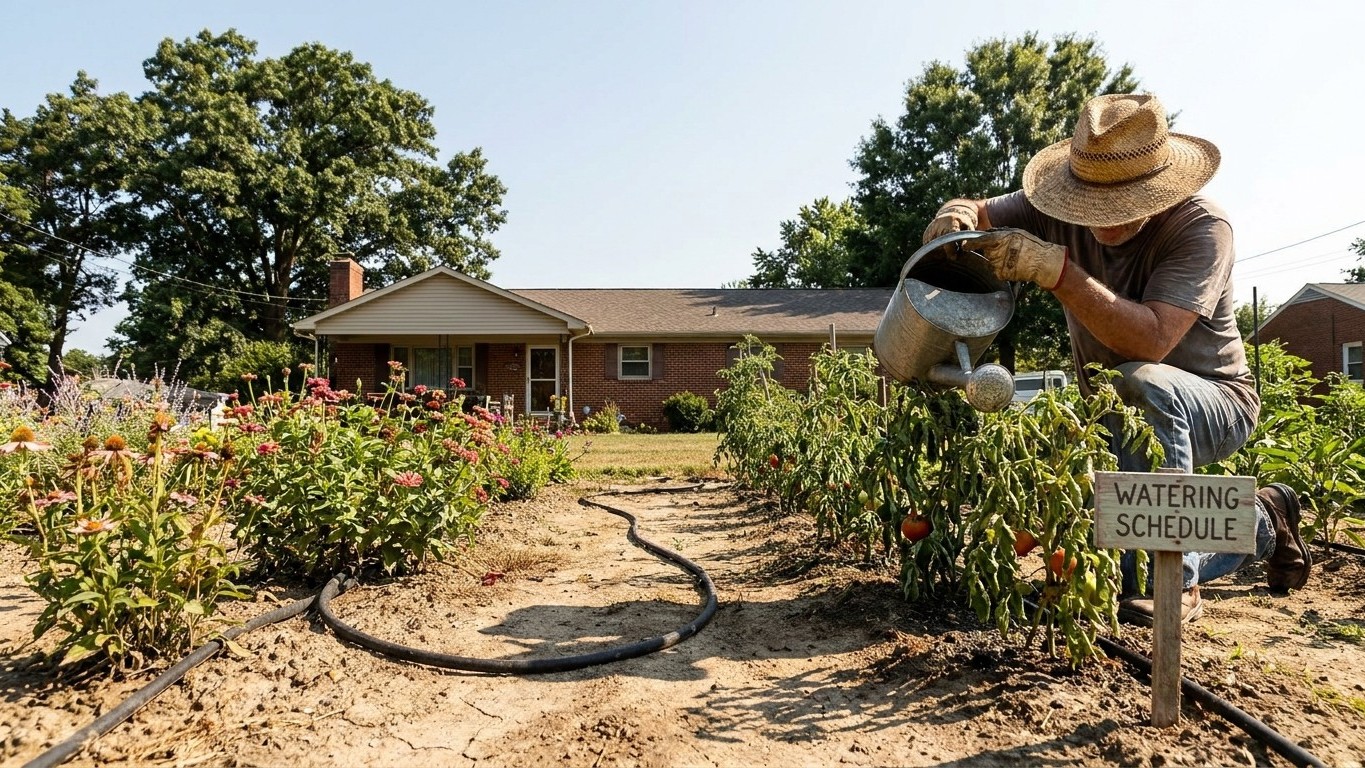

Delaware’s driest summer month, August, still delivers 3.98 inches of rain on average. Compare that to 17.6 days a year that hit 90F or hotter, and the picture is clear: the rain mostly comes, but the heat spends it fast. Here’s how to water a Delaware garden through the weeks when the sky can’t be trusted to keep up.
What changes here

Two numbers set the terms for watering in Delaware. The driest summer month, August, averages 3.98 inches of rain. And the state sees 17.6 days a year at or above 90F, according to NOAA’s 1991-2020 climate normals for the Wilmington reference station. Put together, those figures say something a gardener can actually use: the rain is there on paper, but the heat pulls moisture out of the soil faster than a calendar suggests, and it doesn’t fall evenly across the month.
Run the arithmetic. A vegetable bed or a young perennial border wants roughly an inch of water a week to keep growing without stress. August has close to 4.3 weeks in it, so 3.98 inches spread evenly would work out to about 0.93 inches a week from the sky alone. That’s nearly the full inch. On paper, Delaware’s driest summer month almost covers the target by itself.
The catch is that averages hide the pattern. Summer rain in the Mid-Atlantic tends to arrive as thunderstorms, not steady drizzle. A single storm can dump three-quarters of an inch in twenty minutes and then leave the garden dry for ten days. Averaged over the month, the math looks fine. Lived through week by week, a bed can sit bone-dry for a stretch right when 90-degree afternoons are pulling water out of the leaves fastest.
Soil texture decides how forgiving that gap is. The same inch of rain that soaks a full week into heavy clay can drain through sandy ground within a day, leaving nothing behind for the days that follow. Delaware runs the gamut, from the sandier ground common near the coast to heavier soils further inland, so there’s no single number that fits every yard in the state. What holds everywhere is the principle: sandy ground needs watering checked more often, clay-heavy ground needs it checked less often but watched for standing moisture. A rain gauge on your own property, checked after each storm, tells you more than the monthly average ever will.
How to water when it matters
The method that works in Delaware isn’t different in kind from good watering anywhere. It’s different in timing, because the heat load here (17.6 days a year at 90F or above) punishes shallow habits faster than it would in a cooler state. Deep, infrequent watering at the base of the plant, done in the morning, is the standard for a reason tied directly to what the plant is doing at each hour.
Morning watering lets the soil absorb moisture before the day’s heat starts pulling it back out through evaporation, and it gives foliage time to dry before evening, when damp leaves overnight become an open invitation for fungal disease. Watering at the base rather than overhead means the water goes to the roots instead of misting off leaves that don’t need it. Deep watering, rather than a light daily sprinkle, trains roots to grow downward into cooler, more stable soil instead of staying shallow near a surface that bakes hard by early afternoon.
Here’s a sequence to work from, adjusted to your own soil once you’ve watched it for a week or two:
- Check moisture at root depth, not just the surface, by pushing a finger or a trowel about two inches down before deciding to water at all.
- Water early morning, before 9 a.m. if possible, so leaves dry fully before nightfall.
- Apply water slowly at the base of each plant until the top six inches of soil are damp, aiming for the equivalent of about an inch a week as a starting point.
- On sandy ground, split that inch into two shorter sessions rather than one, since sandy soil holds little and dries out between waterings faster than clay.
- On heavy clay, wait until the soil has visibly dried before watering again; clay can hold a week’s worth of moisture, and watering too soon drowns roots that haven’t used what they already have.
- Re-check with a finger two days after any rain before assuming the garden is covered.
Treat the one-inch figure as a starting point to test against your own ground, not a rule carved into the calendar. A raised bed with sandy fill and a shaded clay border thirty feet away can need two completely different schedules in the same yard.
What goes wrong
“I water a little every day, just to be safe”
This is the mistake that costs the most in Delaware summers, given how many days push past 90F. Frequent light watering wets only the top inch or two of soil, and roots follow the water. They stay shallow, right in the layer that heats up fastest and dries out first. When a truly hot stretch hits, those shallow roots have nowhere cooler to draw from, and the plant wilts by midafternoon even though it was “watered” that morning.
“I water in the evening so it’s cooler out”
Evening watering feels sensible because it’s more comfortable to be outside, but it leaves foliage wet through the night. Fungal spores that cause powdery mildew and leaf spot thrive in exactly those humid, dark, still-wet conditions. Morning watering avoids the problem simply because the sun does the drying that the evening never gets to do.
“It rained yesterday, so I don’t need to water”
A summer thunderstorm can look like a soaking and still only wet the top half-inch of soil, especially on ground that’s already dry and compacted. Push a finger down two inches after any rain before crossing watering off the list. If it’s dry below the surface, the storm didn’t do the job the sky seemed to promise.
“I didn’t bother with mulch this year”
Bare soil in a Delaware summer loses moisture to sun and wind almost as fast as it’s applied. A two- to three-inch layer of mulch slows that evaporation, keeps soil temperature more stable at root depth, and stretches the interval between waterings. Skipping it means redoing work that mulch would have held onto for free.
Local help
Local watering rules shift by water provider and can tighten during dry stretches, so check with your municipal or county water supplier for current restrictions before setting an automatic schedule. For soil testing, plant selection suited to Delaware conditions, and season-specific guidance, the University of Delaware Cooperative Extension is the state’s land-grant resource for home gardeners.
Common questions
How often should I water my garden in Delaware during summer?
Check soil moisture two inches down every two to three days rather than watering on a fixed daily schedule. Sandy soil typically needs checking more often; heavy clay less often.
Is August really the driest month in Delaware?
Yes, based on NOAA’s 1991-2020 normals, August averages 3.98 inches of rain, the lowest of the three summer months, compared to 4.67 inches in June and 4.41 in July.
Does Delaware get hot enough to stress a garden?
The state averages 17.6 days a year at 90F or above. That heat load is what drives most of the water demand in a home garden, more than rainfall totals alone suggest.
Can I rely on a garden hose sprinkler left running overnight?
No. Overhead watering at night keeps foliage wet for hours, raising the risk of fungal disease. Water at the base, in the morning, even if it means setting an earlier alarm.