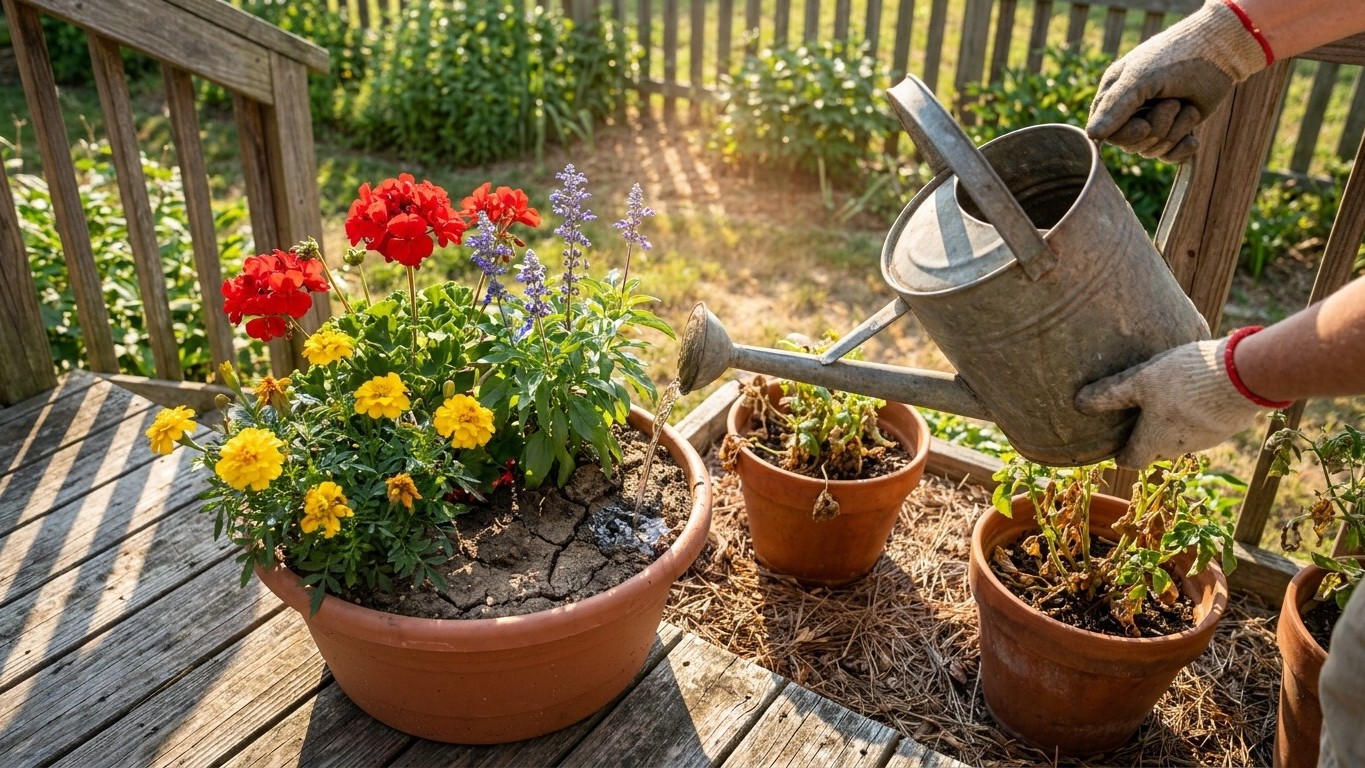

Delaware gardeners get more help from the sky than most of the country, but the state’s summer heat still empties Containers and pots faster than the rain refills them. Knowing the actual numbers behind that gap is what separates a healthy planter from a wilted one by August.
What changes here

Two figures set the terms for every watering decision in this state. The driest summer month, August, averages 3.98 inches of rain. And the state sees about 17.6 days a year at or above 90F. Put together, that means Delaware isn’t short on rainfall the way a desert state is, but the heat load is high enough that whatever rain falls gets pulled back out of the soil fast, and pots dry out faster still because they hold so little soil to begin with.
Here’s the arithmetic a gardener can actually use. A planted bed wants roughly an inch of water a week. August has 31 days, so 3.98 inches spread evenly across the month works out to about 0.90 inch in an average week (3.98 divided by 31, multiplied by 7). That’s close to the target, but not quite there, meaning the gardener needs to add only about a tenth of an inch a week to a garden bed during the driest stretch of summer, at least in an average year. That’s a small top-up for beds. Containers are a different story: with no surrounding soil reservoir to draw on, a pot’s growing medium can lose that same tenth of an inch, and much more, in a single hot afternoon, especially on a day pushing past 90F.
Soil texture changes how that rainfall behaves once it lands. On the sandy, well-drained soils common in Delaware’s coastal areas, water moves through quickly and doesn’t stick around for roots to use over several days. On the heavier clay-loam found further inland, the same rain is held longer, sometimes for the better part of a week, which changes the rhythm of watering more than it changes the total amount needed. Pots and containers sidestep a lot of this variation because the gardener controls the growing mix directly, but the surrounding climate, that 3.98 inches and those 17.6 hot days, still sets how often that mix needs refilling.
How to water when it matters
The method that works in Delaware’s climate isn’t complicated, but each part of it does a specific job. Watering deeply and infrequently pushes roots downward and outward, chasing the moisture rather than sitting shallow near the surface where the day’s heat can reach them. Watering at the base rather than overhead keeps water where roots can actually use it instead of evaporating off leaves before it soaks in. And watering in the morning gives the plant a full day to take up moisture before evening humidity and cooler night air create the damp conditions fungal disease needs to take hold.
Checking soil moisture at root depth matters more than checking the surface, because the surface dries first and fastest, especially in the kind of heat this state sees on its 17.6 days above 90F. A finger pushed two inches down, or a trowel pulled up for a quick look, tells the real story. If that depth is dry, it’s time to water. If it’s still cool and damp, waiting another day costs nothing.
- Check soil moisture two inches down before watering, not just the surface.
- Water containers when the mix feels dry at that depth, which in Delaware’s summer heat can mean daily or every other day for smaller pots.
- Water garden beds on sandy soil every 2 to 3 days with shorter soakings, since sand holds little reserve.
- Water beds on heavy clay soil about once a week with a deeper soak, letting it dry between waterings so roots don’t sit in saturated ground.
- Apply water slowly at the base until it reaches root depth, roughly one inch total per week as a starting point to adjust against your own soil.
- Do this in the early morning, before the day’s heat and evaporation set in.
What goes wrong
Watering a little every day
A light daily sprinkle wets only the top inch or so of soil, which trains roots to stay shallow and close to the surface. On a 90F day, that shallow zone heats up and dries out fast, leaving the plant more stressed than if it had been watered deeply just twice a week.
Wetting the leaves in the evening
Overhead watering after work feels convenient, but leaves that stay wet overnight in Delaware’s humid summer air are an open invitation to fungal disease. Water sits on the foliage for hours with no sun or breeze to dry it, and by morning the plant has spent the whole night in conditions that mildew and blight thrive in.
Trusting a rain shower
A quick summer thunderstorm can look like it solved the watering problem, but much of that rain runs off a hot, dry surface rather than soaking in, and what does soak in often wets only the top half-inch of soil. The fix is the same finger check described above: don’t assume, check two inches down before skipping a scheduled watering.
Skipping the mulch
Bare soil around a plant, or an unmulched container surface, gives the sun a direct path to pull moisture right back out after it’s been applied. A layer of mulch slows that loss significantly, which matters most during the stretch of 17.6 days a year when temperatures push past 90F and evaporation is working hardest against whatever water was just given.
Local help
For planting advice suited to Delaware’s specific soils and seasons, the University of Delaware Cooperative Extension is the go-to resource. Watering restrictions aren’t part of the verified data here, and they vary by local water provider and can change with drought conditions, so check with your own utility or municipality for current rules before setting an outdoor watering schedule.
Common questions
How often should I water container plants in Delaware during summer?
Check the soil two inches down; on hot days above 90F, small containers often need water daily since they hold little soil volume compared to garden beds.
Does Delaware get enough rain to skip watering garden beds?
Close, but not quite. August, the driest summer month, averages 3.98 inches, which works out to about 0.90 inch in a typical week, just under the one-inch target most beds want.
Is morning or evening better for watering in Delaware?
Morning. It lets plants take up water before the day’s heat, and it avoids leaving foliage wet overnight, which raises the risk of fungal disease in humid summer air.
Why do containers dry out faster than garden beds here?
Pots hold a limited volume of growing mix with no surrounding soil to draw moisture from, so on days reaching the state’s average of 17.6 days above 90F, that mix can lose its moisture within hours rather than days.