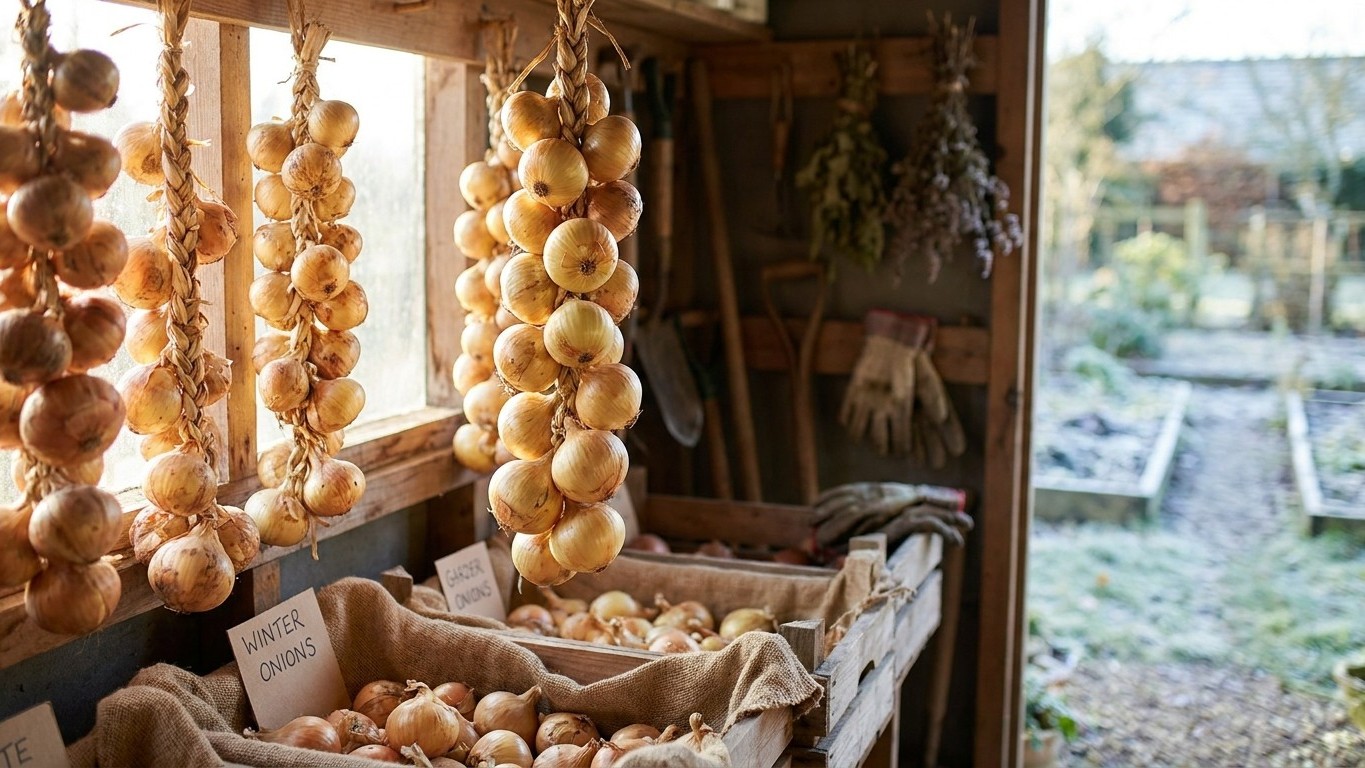

Soft, weeping onions in the pantry by December are the surest sign the wrong variety went into storage, not that storage was done badly. Sweet, short-day onions keep for only weeks to a couple of months no matter how carefully you cure and store them. Sort onions by type before you stack them for winter: sharp keepers in one spot, soft sweet ones set aside to eat first.
Storing Onions Through Winter
How long an onion lasts on the shelf is decided before it ever reaches the shelf. It comes down to which variety you grew, far more than to the cellar, the crate, or the mesh bag you put it in. Two onions that look identical in September can behave completely differently by January, and the difference is genetic, not managerial.
Sweet onions versus keepers
Sweet, short-day onions are bred for eating fresh. They hold in storage for weeks to a couple of months at best, and that is true even in a cold, dry, well-ventilated space. Sharp, long-day onions are bred the opposite way. They are the keepers, holding for several months, with some varieties lasting past half a year in the right conditions.
The reason is chemical, not just practical. No storage method makes a sweet onion keep, because sweetness and keeping ability sit on opposite ends of the same chemistry. The compounds that make an onion mild and juicy are the same ones that make it break down fast once it is out of the ground. A sharp onion has less water and more of the pungent sulfur compounds that double as natural preservatives. You cannot cure a sweet onion into becoming a keeper any more than you can cure a keeper into becoming sweet. If you want both, you grow both, and you eat them in the right order.
What the storage space needs to do
Once the variety is settled, the job of storage is simple: slow down decay, not stop it. Onions want a space that is cool, dry, and dark, with steady air movement around the bulbs. Damp is what actually ends a stored crop. Moisture in the air, moisture from crowding, or moisture wicking up from a concrete floor all do the same thing: they soften the outer skins, invite mold, and start the rot that spreads bulb to bulb. Dry air and moving air matter more than a specific temperature number, because there isn’t one figure that fits every cellar, garage, or pantry shelf. The goal is a space where the air changes, not one that sits stagnant around a pile of bulbs.
How to do it

Start with a crop that was pulled and cured correctly. If you’re not sure your onions were ready or dried down properly before storage, that step happens earlier, and it’s worth reading through When to Harvest Onions before you go further, because a poorly cured onion will not store well regardless of what you do afterward.
The order of operations
- Sort before you stack. Separate sweet, short-day onions from sharp, long-day keepers the moment they come off the curing rack. Mixing them means the sweet ones rot unnoticed among bulbs you’re not checking as often.
- Check every bulb by hand. Squeeze gently at the neck and shoulders. Anything soft, spongy, or damp-smelling goes into the kitchen pile for immediate use, not into storage.
- Choose mesh, not plastic. Mesh bags, wire baskets, or slatted crates let air move through the pile. Sealed plastic bags trap the moisture that starts rot.
- Keep layers shallow. A single layer, or two at most, lets air reach every bulb. A deep pile hides a rotting onion until its neighbors have already caught it.
- Label by type. A quick tag on the bag or crate saves you from reaching for a “keeper” that was actually a sweet onion three months past its window.
- Use the sweet ones first. Work through short-day onions within their first weeks in storage, and save the long-day keepers for the months ahead.
If some of your crop never formed proper bulbs at all, that’s not a storage failure, it’s a different vegetable. Treat those green-topped stragglers as you would Growing Scallions: Onions That Never Bulb, using them fresh rather than trying to cure them into storage onions they never were.
What goes wrong
Most storage failures show up the same way: a soft spot, a smell, or a bulb that’s gone from firm to mushy overnight. What matters is catching it fast, because one rotting bulb takes its neighbors with it if it sits unnoticed in a pile.
Recognizing and handling the common failures
A bulb that’s turned soft, wet, or slimy at the neck is already rotting from the inside. Pull it the moment you find it, and check every onion touching it, since rot spreads by contact and moisture, not through the air. Compost the ruined bulb rather than tossing it back near the others, and wipe down the shelf or crate where it sat before restocking it.
Sprouting is a different failure, usually caused by a space that’s too warm or too bright rather than too damp. A sprouted onion is still edible, it just won’t keep much longer, so move it to the front of your kitchen rotation instead of leaving it in storage.
Shriveling and papery, lightweight bulbs point to a space that’s too warm and too dry, drawing moisture out of the onion faster than it should lose it. These onions are still usable but have lost a lot of their storage life already. There’s no fixing this after the fact beyond using them soon and adjusting the storage spot for the next batch.
If you find sweet, short-day onions still sitting in storage two or three months in and starting to soften across the board, that’s not a storage mistake at all. It’s the variety reaching the end of its natural window, exactly as the earlier chemistry would predict. The fix isn’t better storage, it’s growing fewer sweet onions than you can eat within their first weeks and relying on Onions from the long-day, sharp side of your crop to carry you through the rest of winter.