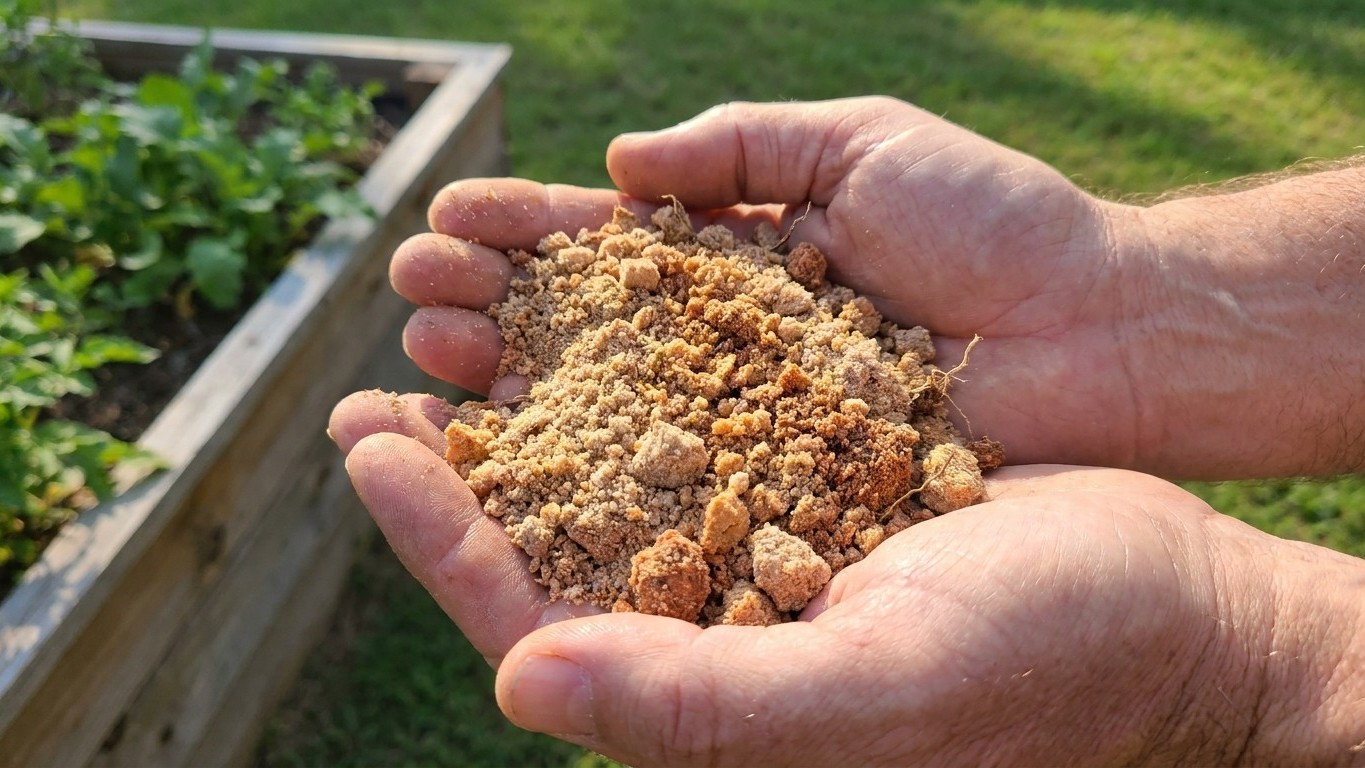

Georgia’s official state soil, the Tifton series, is sandy, acid, and thin on organic matter, and that combination shapes almost everything a home gardener in the state deals with: fast drainage, nutrient leaching, and a need for lime most years. Here is what the numbers actually say, and how to check whether your own yard matches them.
What is under your garden

Georgia’s representative soil is the Tifton series, an Ultisol. Ultisols are old, heavily weathered, heavily leached soils that formed under a long, warm, wet history, and they arrive naturally acid and short on nutrients because centuries of rainfall have washed the minerals downward, out of easy reach of roots. That’s the soil USDA points to when it names a representative series for Georgia, and it is a fair description of huge stretches of the Coastal Plain that runs across the southern half of the state.
The numbers below come from USDA’s Soil Data Access records for the surface horizon of the Tifton series, averaged across 173 mapped components.
| Reading | Value |
|---|---|
| Surface pH | about 5.5 (slightly acid) |
| Sand | 84 percent |
| Silt | 9 percent |
| Clay | 6 percent |
| Organic matter | about 0.8 percent |
| Drainage class | well drained |
Read that table honestly. It describes the soil that stands for Georgia on a national map, not the dirt under your specific tomato bed. A state this size holds hundreds of mapped soil series, and river-bottom ground, mountain-cove soil in the north, and anything a builder scraped, graded, or backfilled during construction can look nothing like Tifton. A subdivision lot with six inches of trucked-in topsoil over compacted subsoil clay tells you almost nothing about the county’s native series. Treat the Tifton numbers as a starting expectation, not a verdict.
Read your own dirt in five minutes
Two quick checks tell you more than guesswork ever will. First, the ribbon test: take a small handful of moist soil, squeeze it between thumb and forefinger, and try to push out a ribbon. Sandy soil (something close to that 84 percent figure) won’t hold a ribbon at all, it just crumbles. Loam forms a short ribbon before breaking. Heavy clay stretches out a long, greasy ribbon two inches or more before it snaps.
Second, the jar test: fill a clear quart jar about a third full of soil, top it off with water, shake hard, then leave it undisturbed overnight. By morning the particles settle by weight into visible bands, sand at the bottom, silt in the middle, clay on top, with any floating organic matter as a dark layer at the very top. Compare what settles out against the table above, and you’ll know in plain terms what you’re digging into.
Testing before you amend
Buying lime or sulfur before you test is a coin flip with your own money. A soil test tells you the actual pH and nutrient levels of your specific bed, something no amount of staring at the dirt will reveal. Given the Tifton series sits around pH 5.5, a Georgia gardener has reason to expect acid ground, but expecting isn’t knowing, and plenty of yards run more acid or less than the regional figure depending on history, fill dirt, and years of prior fertilizing or liming.
Sampling well matters as much as testing at all. A single scoop from one spot can mislead you if that spot happens to sit near an old brick pile or a downspout. Pull several small cores from across the bed, mix them in a clean bucket, and pull your test sample from that mix.
- Walk the bed and pick 8 to 10 spots spread evenly across it.
- At each spot, dig a small core down to the depth where roots actually feed, roughly 4 to 6 inches for vegetable beds, deeper for trees and shrubs.
- Drop each core into a clean plastic bucket, avoiding metal, which can skew certain readings.
- Break up clumps and mix the cores together thoroughly.
- Pull about two cups of the mixed soil, let it air dry, and pack it for the lab following your extension office’s instructions.
- Label the sample by bed and note what you plan to grow there, since recommendations depend on the crop.
The result comes back with an actual pH reading plus levels for phosphorus, potassium, and often calcium and magnesium. That’s the number you amend to, not the state average.
Amending it
Georgia’s representative soil points in a clear direction: acid ground that’s short on organic matter and drains fast because it’s mostly sand. The corrections that actually work follow directly from those three facts, and none of them are one-size-fits-all garden advice pulled from a generic list.
Lime, not sulfur, for acid ground
At a pH near 5.5, lime is the tool, and sulfur would be a mistake that pushes the soil the wrong direction entirely. Acid soil in this range locks up phosphorus so roots can’t take it up even when it’s present in the ground, and it makes life miserable for brassicas like broccoli and cabbage, which prefer a more neutral range and also become more prone to clubroot disease in acid conditions. Lime raises pH slowly, over a season or two, not overnight, because it has to react with soil moisture and work through the root zone gradually. Apply it based on your actual soil test recommendation, not a guess, and don’t expect a fall application to show its full effect before spring planting.
If a soil test on your own property ever comes back above roughly 7.3, the instructions reverse completely: lime must never go on that ground. In that case elemental sulfur and steady additions of organic matter are the slow, honest route back down, and high pH is worth watching for because it locks iron out of a plant’s reach, which shows up as yellow leaves with the veins still green, a classic iron deficiency symptom on alkaline ground. That scenario is uncommon on native Tifton soil but does turn up on yards that have been over-limed for years.
Organic matter for sandy soil
At 84 percent sand and only 0.8 percent organic matter, Georgia’s representative soil holds almost nothing back, water runs through it, nutrients leach with the water, and structure is close to nonexistent. Compost, aged manure, and leaf mold worked into the top several inches build the organic matter that sandy soil is missing, and that organic matter is what starts holding water and nutrients in the root zone instead of letting them drain straight past. This is a multi-season project. A single fall application of compost helps, but building real organic matter and structure in sandy ground realistically takes three seasons of steady additions, not one.
Never solve a sand problem by adding more sand, and the same rule runs the other way on true clay ground elsewhere in the state: working sand into clay creates something closer to concrete than soil. And because sandy soil drains and dries fast, plan on shorter, more frequent watering rather than the deep occasional soak that works on heavier ground, since nothing stays put in soil this loose for long.
Drainage and compaction
USDA lists the Tifton series as well drained, which in practical terms means water rarely stands in the garden after a normal rain and roots generally get enough air. That’s the upside of a mostly sandy profile. The tradeoff is that water leaves just as fast as it arrives, taking nutrients with it, which is exactly why the organic matter work above matters so much on this ground.
Don’t take “well drained” on a map as gospel for your own bed, though. Run a simple percolation test: dig a hole about a foot deep and a foot wide, fill it with water, let it drain once, then fill it again and time how fast the water level drops. A drop of an inch or two per hour is typical and workable for most garden plants. Water that barely moves after an hour usually means a compacted layer or clay lens sitting somewhere below the surface, even on ground mapped as well drained overall, since foot traffic, past construction equipment, or years of tillage at the same depth can create a hardpan that a map can’t show.
Compaction is worth taking seriously on its own. Double digging, once the standard fix, has fallen out of favor because it disturbs soil biology and structure more than it helps, and the effect doesn’t last against continued foot traffic anyway. When a percolation test comes back slow, or when a yard is mostly compacted fill from construction, a raised bed is often the honest answer rather than three years of patient amending that fights the same traffic and the same subsoil the whole time.
- Do: keep foot traffic on defined paths, not on planting beds, to prevent new compaction.
- Do: add organic matter yearly to sandy, well-drained ground to slow how fast it dries out.
- Avoid: working any soil, sandy or not, while it’s wet, since that’s when compaction damage happens fastest.
- Consider elsewhere: plants that want consistently moist soil are a poor match for fast-draining sandy ground and do better in a bed amended heavily with organic matter or in a spot with natural clay content.
Local help
The University of Georgia Cooperative Extension runs the state’s soil testing program through county offices, and it’s an inexpensive way to replace guesswork with an actual number for your yard. Bring or mail in a sample following your county office’s instructions, and an agent there reads the results with you and translates them into what to add and how much, tailored to what you’re growing.
Common questions
Is all Georgia soil like the Tifton series?
No. Tifton is the series USDA names as representative of the state, common across much of the Coastal Plain, but river bottoms, mountain soils in the north, and any yard with fill dirt or grading from construction can differ completely. A soil test is the only way to know your own ground.
How do I know if my soil is too acidic?
A soil test gives the real answer, but yellowing brassicas, poor pea and bean growth, and moss taking over lawn patches are common signs of acid soil in this region. If the reading comes back below about 5.5, lime is the standard fix, applied at the rate your test recommends.
Can I fix sandy soil in one season?
Partially. A single compost application improves water holding right away, but building lasting organic matter and structure in soil this sandy realistically takes about three growing seasons of steady additions, not one.
When should I choose a raised bed instead of amending in place?
When a percolation test shows very slow drainage from subsoil compaction, or when the yard is mostly construction fill rather than native soil, a raised bed with brought-in soil often beats years of amending ground that’s fighting you the whole time.
Related guides
- Florida Soil: What You Are Digging Into, and How to Improve It
- Alabama Soil: What You Are Digging Into, and How to Improve It
- Hawaii Soil: What You Are Digging Into, and How to Improve It
- Beet Soil in Georgia
- The Georgia Apple Calendar, Stage by Stage
- Watering Pots and Containers in Georgia
- Arizona Soil: What You Are Digging Into, and How to Improve It
- North Dakota Soil: What You Are Digging Into, and How to Improve It