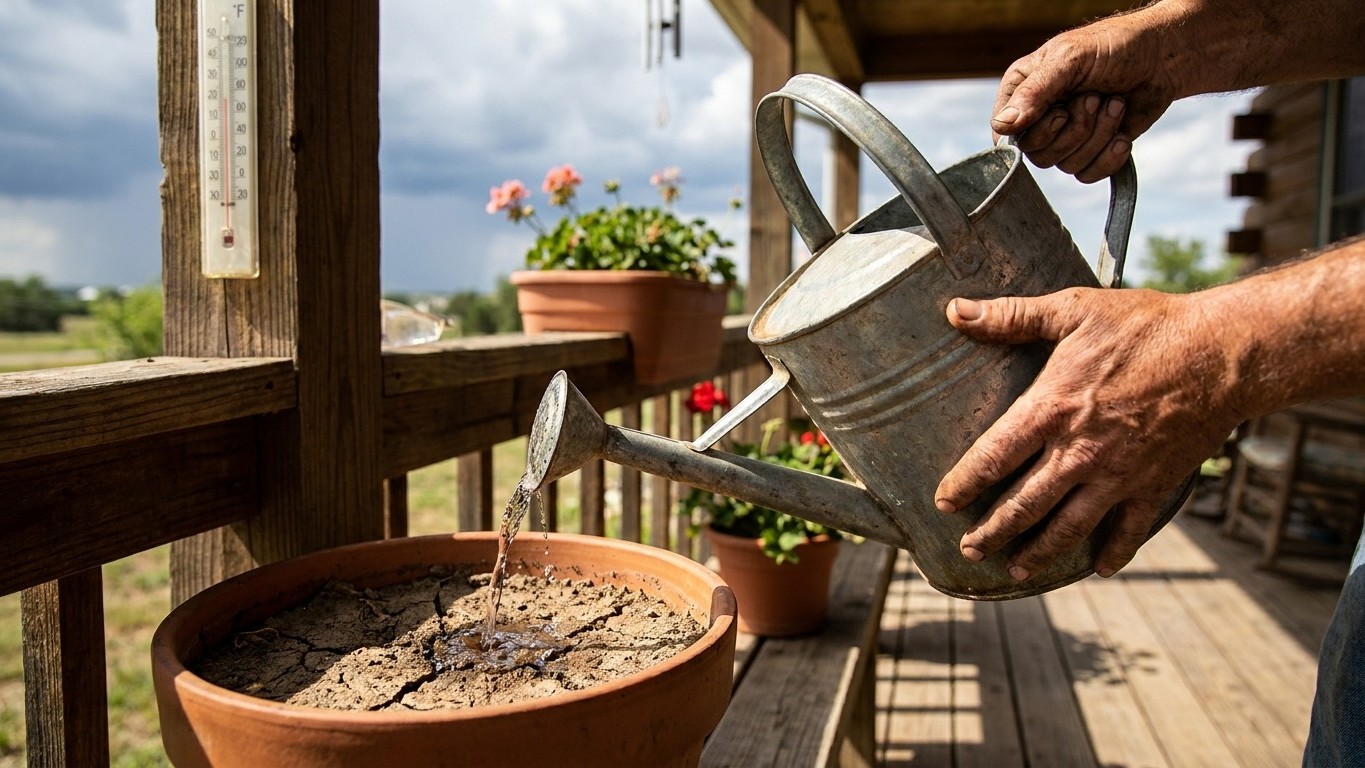

Watering pots and containers in Georgia comes down to two numbers: August delivers just 4.3 inches of rain, spread over roughly 4.4 weeks, while the state logs 35.8 days a year at 90F or hotter. That combination means containers dry out fast, and a weekly rain check on a garden hose or gauge does more good than any fixed schedule.
What changes here

Start with the two figures that actually run the show: 4.3 inches of rain in August, the driest month of the Georgia summer, and 35.8 days a year that hit 90F or above. Together they mean the sky provides a modest, steady base of moisture, but heat pulls it back out of the soil faster than most gardeners expect. That’s the number that should change how you think about a watering can in a Georgia August.
Do the arithmetic and it gets concrete. August has about 4.4 weeks in it, so 4.3 inches of rain spread evenly would come out to roughly 0.97 inch a week, almost the one inch a week that a typical garden bed wants. On paper, that looks close enough to ignore. In practice, Georgia rain in August rarely falls evenly. It tends to arrive as a single afternoon thunderstorm that dumps hard for twenty minutes and runs off a compacted bed rather than soaking through it, so the average hides long dry stretches between storms.
Containers make this worse than an in-ground bed ever could. A pot has no reservoir of deep, moisture-holding subsoil to fall back on, so the same week that leaves an in-ground bed comfortable can leave a container bone dry by the third day, especially with 35.8 days a year pushing past 90F and pulling water out of a small volume of potting mix through the surface and through the plant itself. The lesson isn’t that Georgia is short on rain. It’s that the rain doesn’t arrive on the schedule a container needs, and the heat load empties a pot faster than it empties a garden bed.
How to water when it matters
Containers in Georgia do best with a deep soak rather than a light daily splash, delivered at the base of the plant, in the morning. Each part of that has a reason behind it. A deep soak pushes water through the entire root ball instead of just wetting the top inch, which trains roots to grow down and out where the mix stays cooler and more stable. Watering at the base, rather than overhead, keeps the leaves dry and gets the water where the roots can actually use it instead of losing it to evaporation off the foliage. Morning watering gives the plant a full supply before the heat of the day arrives, and it lets any moisture that does land on leaves dry out before evening, which matters more once daily highs start clearing 90F.
The surface of a container can look dry while the root zone underneath is still damp, or the reverse, so checking with a finger beats guessing every time. Push a finger about two inches into the mix, near the edge of the pot rather than right against the stem, and water only when that spot feels dry rather than just cool or slightly moist.
Where the potting mix runs sandy and fast-draining, water moves through quickly and holds little, so containers on that kind of mix need shorter, more frequent soakings rather than one big weekly dose. A mix with more compost or clay-like density holds a week’s worth of moisture but can drown roots if it’s watered again before the top few inches have dried out. A reasonable starting point for a mid-size container in a Georgia summer is water until it runs from the drainage holes, then check again in two to three days rather than on a fixed calendar, and adjust from there based on what that finger test actually shows in your own pots.
- Check the mix two inches down with a finger or a small trowel before watering, regardless of how the surface looks.
- Water slowly at the base of the plant until it runs from the drainage holes, rather than a quick surface pass.
- Water in the early morning, before the heat of the day sets in, rather than in the evening.
- Recheck in two to three days on fast-draining mixes, or up to a week on denser, moisture-retentive ones, and adjust based on what you find rather than the calendar.
What goes wrong
A daily sprinkle that never soaks in
A quick splash every morning feels responsible, but it only wets the top half-inch of mix. Roots follow the water, so they stay shallow, right where the surface bakes hardest once the afternoon sun hits and the day pushes toward 90F. A plant with shallow roots wilts faster on the one day watering gets skipped, which is the opposite of what a daily routine is supposed to prevent.
Watering the leaves at night
Wetting foliage in the evening leaves it damp for hours in the dark, exactly the setup fungal disease needs to take hold. Georgia’s humid summer air already slows evening drying under normal conditions, so water on the leaves overnight is an invitation, not a convenience.
Trusting a thunderstorm instead of checking
Georgia’s summer rain tends to arrive as short, hard thunderstorms rather than steady all-day rain, and a heavy-looking storm can still leave the mix dry two inches down if most of the water ran off the surface. This is the mistake that costs the most in a Georgia summer, precisely because the storms look convincing from a window. A finger test after the rain settles the question in a way that watching it fall never can.
Skipping the mulch
A bare container surface gives the sun a direct line to the moisture just delivered, and with 35.8 days a year at 90F or better, that moisture doesn’t last long once it’s exposed. A layer of mulch or bark on top of the mix slows that evaporation and stretches the time between waterings.
Local help
For soil testing, plant-specific guidance, and questions about container mixes suited to Georgia’s climate, the University of Georgia Extension is the state’s land-grant resource. Watering restrictions vary by water provider and can change with drought conditions, so check current rules with your local utility or municipality rather than relying on a statewide assumption.
Common questions
How often should I water container plants in Georgia during the summer?
There’s no single fixed schedule that fits every pot, since mix type and container size change the answer. Check the mix two inches down every two to three days and water when it’s dry at that depth, adjusting more often during stretches of 90F-plus heat.
Does Georgia get enough summer rain to skip container watering?
August averages 4.3 inches of rain, close to the one inch a week a garden bed wants, but that rain tends to fall in short thunderstorms that run off rather than soak in, and containers hold far less reserve than garden soil. Skipping watering based on rainfall alone usually leaves pots dry.
Is morning or evening better for watering containers?
Morning. It gives the plant moisture before the day’s heat sets in and lets any water that lands on the leaves dry before nightfall, which lowers the risk of fungal disease overnight.
What’s the biggest watering mistake in Georgia’s climate specifically?
Trusting a summer thunderstorm to have done the job. Georgia’s rain often arrives fast and hard, wetting the surface without soaking deep enough to reach the roots, so a finger check after the storm is the only way to know for sure.