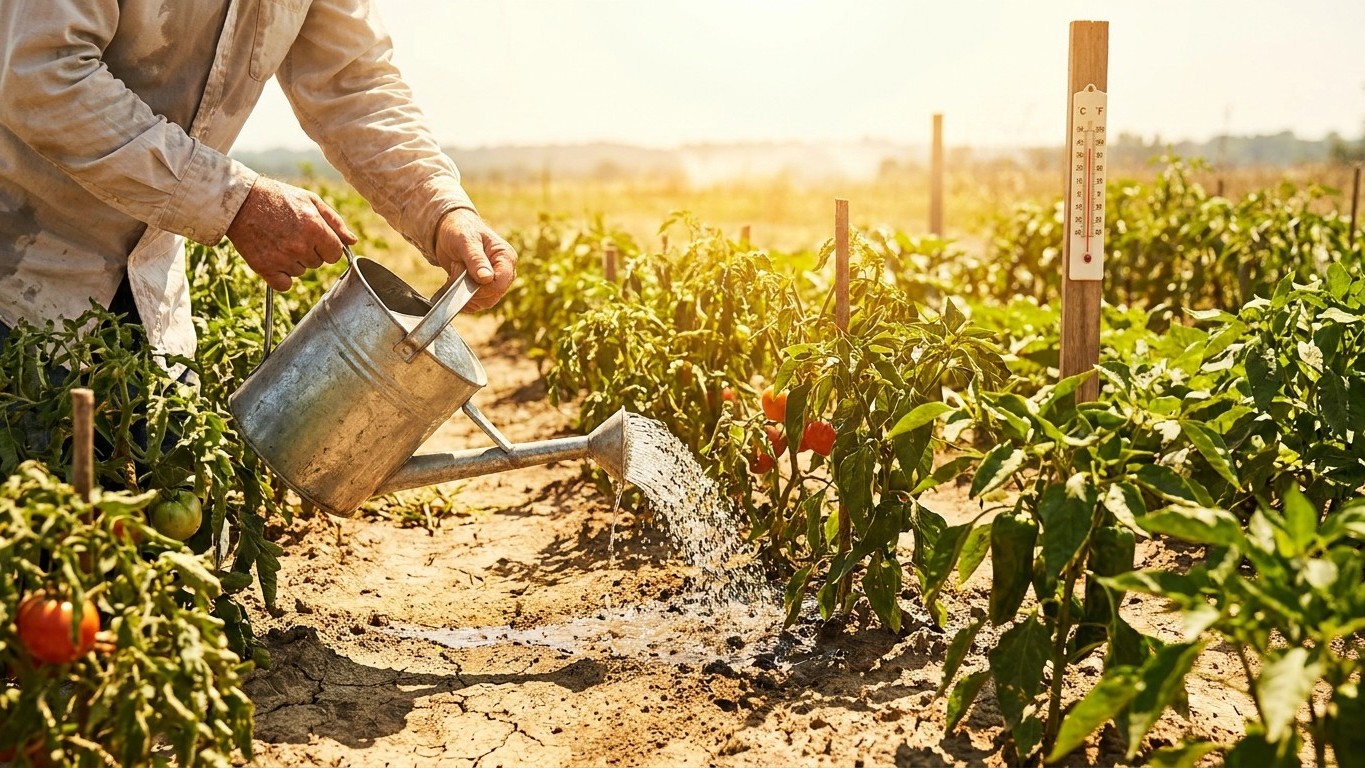

Georgia gardens live and die on two numbers: how many days push past 90 degrees each summer, and how fast that same sun pulls water out of the ground. Add the state’s checkerboard of soils and its history of drought restrictions, and “just water it” stops being useful advice. Here’s what actually works, and what to check before you turn on the hose.
What the climate asks of you

Start with the figure that rules out any lazy approach to summer gardening in Georgia: an average of 35.8 days a year hit 90F or higher at the Atlanta reference station, based on NOAA’s 1991-2020 climate normals. That’s not a few hot afternoons. That’s more than a month of the growing season spent in conditions where a garden bed can lose visible moisture by early evening.
The state’s growing season backs this up. Atlanta’s last spring frost typically falls between March 11 and March 29, and the first fall frost arrives between November 13 and December 1, per NOAA’s 32F freeze probability data. That leaves a long stretch, close to eight months, where a garden is actively growing and actively demanding water, with the hottest third of that window falling squarely in the June-through-August stretch where those 35.8 days above 90F cluster.
Georgia doesn’t hand every gardener the same conditions, either. The USDA Plant Hardiness Zone Map puts the state anywhere from zone 6a in the north Georgia mountains to zone 9b along the coast. A gardener in Blairsville is working a different calendar and a different heat load than one in Brunswick, and the same is true for rainfall patterns, which vary widely across that same north-to-south stretch. There isn’t one honest statewide figure for “how many inches fall in July” that applies equally to the mountains, the Piedmont, and the coastal plain, so don’t trust anyone who hands you a single number for the whole state.
What doesn’t vary as much is the region’s clay. Much of the Piedmont, the band running through Atlanta and central Georgia, sits on dense red clay that behaves nothing like the sandy soils of the coastal plain. Clay holds onto water for days after a storm, then cracks like a dried lakebed once it lets go. Sandy coastal soil does the opposite: water passes through it in hours. That single difference in the ground under your feet can matter more to a watering schedule than anything happening in the sky above it, which is part of why so many gardeners in unpredictable soil zones turn to raised beds and containers instead, where Watering Pots and Containers in Georgia becomes a far more manageable, controllable task. Because rainfall totals genuinely differ block to block depending on which side of the state you’re gardening in, the most reliable move is checking current local rain gauge data through the UGA Cooperative Extension office in your county rather than relying on a single statewide average.
How much, how often
The old rule still holds: gardens want roughly an inch of water a week, delivered deep and infrequent rather than shallow and daily, a principle worth revisiting in detail through this guide on Watering Through a Dry Spell in Georgia. A quick five-minute sprinkle every evening feels productive, but it trains roots to stay near the surface, exactly where Georgia’s summer heat bakes them hardest during those 35.8-plus days above 90F. Deep watering, done less often, pushes roots downward into cooler, more stable soil that survives a heat wave without daily intervention.
The test for whether it’s time to water again is simple and doesn’t require a gauge. Push a finger, or better, a trowel, about two inches into the soil near the base of the plant. If it comes out dry at that depth, water. If it’s still cool and damp, wait. This matters more in Georgia than in drier climates because red clay can look bone-dry on the surface while staying soaked two inches down, and watering into that trapped moisture is how root rot starts.
A watering sequence that fits Georgia soil
- Check soil at two inches down before watering at all, using a finger or trowel at the plant’s base.
- Water early morning, ideally before 9 a.m., so moisture soaks in before the day’s heat starts pulling it back out through evaporation.
- Aim at the base of the plant, never the leaves, since Georgia’s humidity already sets up favorable conditions for fungal disease, and wet foliage overnight makes it worse.
- On sandy coastal soil, water in shorter, more frequent sessions, since sand holds little moisture and lets it drain through within hours.
- On Piedmont clay, water less often but longer, letting the soil fully absorb one deep soaking rather than several light ones, and never work or soak clay that’s still visibly wet from a prior rain.
- Increase frequency during the stretch of days above 90F, since that’s when evaporation outpaces anything a weekly schedule assumes.
Because rainfall contribution differs so much by region within Georgia, treat any fixed weekly watering schedule as a starting guess, not a rule. A garden on coastal sand during a dry July is functionally on irrigation, not on rain, and needs to be treated that way regardless of what a general watering calendar says.
Restrictions and rules
Georgia has a documented history of drought-driven watering restrictions, particularly across metro Atlanta and the Lake Lanier watershed, where water utilities have imposed outdoor watering schedules during past dry years. Whether restrictions are active right now, and what they specify, changes from year to year and county to county, so nothing here should be treated as a current rule.
The only reliable way to know what applies to your address is checking directly with your local water utility or county water authority before setting an irrigation timer or installing a sprinkler system. Restrictions typically cover things like which days of the week outdoor watering is allowed, permitted hours, and whether hand-watering with a hose is treated differently than automatic sprinklers, but the specifics vary enough between jurisdictions that guessing isn’t worth the risk of a fine.
Given how unevenly rainfall lands across the state, from the wetter mountains to a coastal plain that can run through dry summer stretches, a gardener in a drier pocket of Georgia should assume restrictions are more likely to be in effect, and check before assuming a rain-fed schedule will be legal to run on full automatic. The UGA Extension office for your county is also a solid starting point for finding out which water authority governs your area and how to reach them.
Using less
Cutting water use in a Georgia garden isn’t about watering less carefully. It’s about making the water that does go down stay where it’s needed longer, so the 35.8 days a year of 90-plus heat don’t force a daily fight against evaporation.
- Mulch, two to three inches deep, around the base of plants. It blocks direct sun from baking the soil surface and can cut how often you need to water in half during peak summer heat.
- Drip irrigation instead of overhead sprinklers, since drip lines put water directly at the root zone instead of losing a chunk of it to evaporation in the air or wind drift, which matters most during those 90-degree afternoons.
- Group plants by water need, so drought-tolerant natives aren’t sharing a zone with thirsty vegetables that need watering twice as often. Mixed zones almost always mean overwatering one group to satisfy the other.
- Work organic matter into clay soil, which helps break up dense Piedmont clay so it drains better and stops choking roots after a heavy rain, while also helping sandy coastal soil hold onto moisture longer.
- Rain barrels, where locally legal, capture roof runoff for later use. A rough industry figure holds that an inch of rain falling on a thousand square feet of roof yields about 600 gallons of runoff. In a state where the mountains and coastal plain see genuinely different rainfall patterns, that math plays out very differently depending on where you garden: a barrel can fill fast during a heavy spring storm and then sit empty through a dry stretch in the hottest part of summer, right when the garden needs it most. Treat a rain barrel as a supplement to a watering plan, not a replacement for one.
Common questions
What time of day should I water my garden in Georgia?
Early morning, before 9 a.m. if possible. Watering early gives moisture time to soak into the soil before the day’s heat starts evaporating it, and it keeps foliage from staying wet overnight, which matters in Georgia’s humid climate where damp leaves invite fungal problems.
Does Georgia have a watering schedule I need to follow by law?
It depends entirely on where you live and what’s currently in effect. Georgia counties and water utilities have imposed outdoor watering restrictions during past drought years, especially around metro Atlanta. Check with your local water authority directly, since rules change and aren’t uniform statewide.
Why does my garden need water more often on one side of the yard than the other?
Soil texture. Georgia properties often mix pockets of dense clay with sandier, better-draining patches, especially near driveways or foundations where fill dirt was used during construction. Clay holds water and needs less frequent watering; sandy patches drain fast and dry out sooner, needing more frequent, shorter sessions.
Is it normal for my garden to need daily watering during a Georgia summer?
During the hottest stretch of days above 90F, container gardens and raised beds with fast-draining soil sometimes do need daily attention, especially sandy or coastal plots. In-ground beds with amended, moisture-retentive soil usually don’t need daily watering even in peak heat if they were soaked deeply beforehand. Daily watering of surface-dry in-ground beds is often a sign the soil needs mulch or organic matter, not just more water.