
South Louisiana gardens live or die on two numbers: 70.7 days a year above 90F at the New Orleans reference station, and a growing climate that spans USDA zones 8a to 10a. Add a frost season so short it barely qualifies as one, and the real question isn’t when to plant here. It’s how to keep a bed alive through a summer that never really lets up.
What the climate asks of you

Start with the heat, because it’s the number that actually rules this garden: 70.7 days a year reach 90F or higher at the New Orleans station, per NOAA’s 1991-2020 Climate Normals. That’s not a heat wave. That’s most of June through September, back to back, with soil temperatures climbing right along with the air.
Louisiana’s reputation as a wet state is real on an annual basis, but summer rain here doesn’t arrive the way a garden needs it. It comes as short, violent thunderstorms, heavy for twenty minutes, then nothing for a week or two. A bed that wants roughly an inch of water spread evenly across seven days doesn’t get that from a single downpour that dumps most of it in one afternoon and runs straight off before the roots can use it. That mismatch between total rainfall and usable rainfall is the whole story of watering here.
Soil texture decides how much of that mismatch you actually feel. South Louisiana runs heavy on clay and silty clay in a lot of yards, especially closer to the river and the coast, while pockets of sandier, better-drained ground show up further inland and in parts of the north. Clay holds water for days after a storm, which sounds like an advantage until it turns a bed soggy and starves roots of oxygen. Sandy ground does the opposite: rain sinks through fast, and a garden on sand can be bone dry two days after a storm that looked generous.
The USDA hardiness range of 8a to 10a tells the same story from a different angle. That’s a wide spread for one state, and it means a gardener in the state’s north with its harder winters is managing a different plant calendar than someone near the coast, where the growing season barely pauses. What both ends share is the summer heat load. Whatever zone you’re in, the 90-degree days are the constant that decides how often the hose comes out.
How much, how often
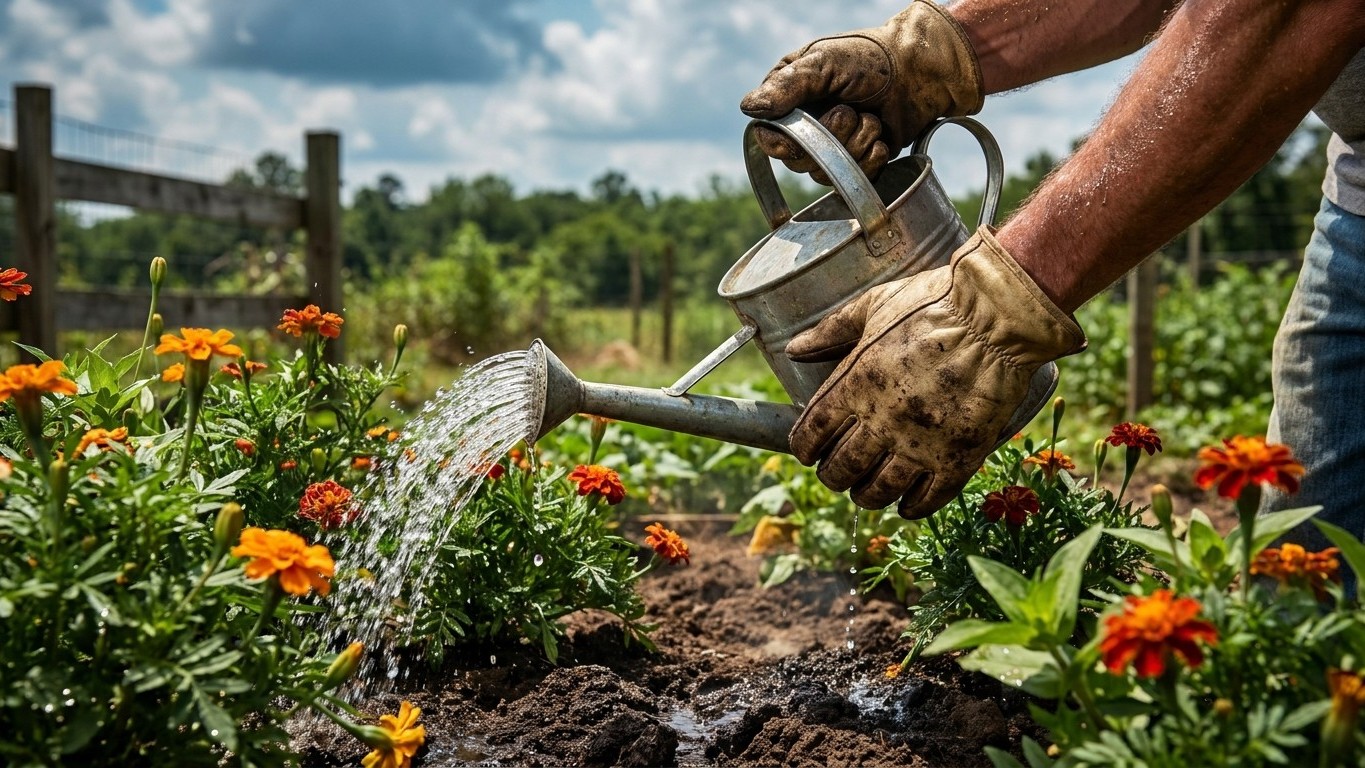
The rule that matters most is also the one most gardeners break: water deep and infrequent, not shallow and daily. A quick sprinkle every evening feels productive, but it only wets the top inch or two of soil. Roots follow the water, so they stay shallow, close to the surface where the ground heats up fastest and dries out first. A deep soak that reaches six to eight inches down pulls roots with it, and deeper roots survive the string of 90-degree days a lot bette. The same principle applies at a smaller scale for Watering Pots and Containers in Louisiana, where limited soil volume means the margin for error shrinks even furtherr than shallow ones.
Knowing when to water beats watering on a fixed schedule, a lesson that matters most during Watering Through a Dry Spell in Louisiana. Push a finger or a trowel two inches into the soil next to the plant, not right against the stem. If it’s dry at that depth, water. If it’s still damp, wait, even if it’s been a few days since the last check. That one habit does more than any watering app.
A watering routine for Louisiana beds
- Check the soil first. Two inches down with a finger or trowel, every two to three days during the hottest stretch of summer.
- Water at the base, not overhead. Wet leaves in Louisiana’s humidity sit damp for hours and invite fungal disease; direct the hose or drip line to the soil around the root zone.
- Water in the early morning. Before 9 a.m. if possible, so moisture soaks in before the day’s heat starts pulling it back out through evaporation.
- Adjust for soil type. On sandy ground, water more often but in shorter sessions since the soil can’t hold much at once. On clay, water less often but longer, and never work or soak clay that’s already wet, since compacting saturated clay ruins its structure for the season.
- Treat summer as irrigation season, not rain season. With 70.7 days a year above 90F concentrated in the growing months, don’t count on storms to cover the gap between them. Plan to supply water on the days rain skips.
Established perennials, shrubs, and anything with a few seasons of root growth behind it can often ride out a dry stretch longer than new transplants or vegetable beds, which need closer attention through their first summer.
Restrictions and rules
Watering restrictions aren’t universal in Louisiana, but they do exist in specific parishes and municipal water systems, usually triggered by drought conditions, infrastructure strain, or seasonal demand spikes rather than a fixed statewide calendar. Rules can limit watering to certain days of the week, restrict hours to early morning or evening, or ban hose-end sprinklers outright during a declared shortage.
Because these rules shift with local conditions and change from one water provider to the next, the only reliable source is your own water utility or parish government, not a general guide. Check before setting an automatic timer, especially if you’ve just moved or if your area has recently seen drought coverage in local news.
Given how much of Louisiana’s summer rainfall arrives unevenly, in short bursts rather than steady soakings, a dry spell that triggers restrictions can develop faster than it would in a place with more consistent rain distribution. That makes it worth checking your local rules at the start of each summer, not just when a drought is already in the news. The LSU AgCenter is a useful place to start for both current guidance and parish-level extension contacts who track local water conditions.
Using less
Cutting water use in a Louisiana garden isn’t about giving plants less. It’s about wasting less of what you give them, since heat and uneven rain already put the garden at a disadvantage. A few changes do most of the work.
- Mulch, two to three inches deep. A layer of pine straw, shredded bark, or leaf mulch cuts surface evaporation dramatically and keeps soil temperature down, which matters directly when the air is hitting 90F on 70.7 days a year. It also slows the crust-and-runoff cycle that clay soils are prone to after a hard rain.
- Drip irrigation or soaker hoses. Delivering water at the soil line instead of spraying it overhead avoids both evaporation loss and wet foliage, which matters more here than in drier states because Louisiana’s humidity already keeps leaves damp longer after any watering.
- Group plants by water need. Put drought-tolerant natives together and thirstier vegetables or annuals in their own zone, so you’re not overwatering the tough plants to keep the needy ones alive.
- Work organic matter into the soil. Compost improves both extremes: it helps sandy soil hold water longer and helps clay drain better, softening the texture problem that defines so much of the state’s ground.
- Rain barrels, where local rules allow them. An inch of rain falling on a 1,000-square-foot roof yields roughly 600 gallons of runoff. In a state where summer storms are heavy but irregular, a barrel can fill fast during a downpour and then sit empty through the following dry stretch, so it works best as a supplement during wet weeks, not a full replacement for watering during a dry one.
None of these fixes are dramatic on their own. Together, they change how often you’re standing outside with a hose at 7 a.m. trying to beat the day’s heat.
Common questions
How often should I water a vegetable garden in Louisiana in summer?
Check the soil two inches down every two to three days rather than watering on autopilot. With 70.7 days a year above 90F, vegetable beds usually need supplemental water between rain events, especially new transplants without established roots.
Does Louisiana ever have watering restrictions?
Yes, in specific parishes and municipal systems during drought or high-demand periods, though there’s no single statewide rule. Contact your local water provider directly, since restrictions vary by area and season.
Is clay or sandy soil more common in Louisiana gardens?
It depends heavily on location. Much of south Louisiana runs toward clay and silty clay, especially near the coast and river systems, while sandier, better-drained pockets appear further inland and in parts of the north. Testing your own soil texture matters more than assuming a statewide pattern.
Can rain barrels supply enough water for a Louisiana summer garden?
They help but rarely cover a whole dry stretch. A 1,000-square-foot roof yields about 600 gallons per inch of rain, which fills a barrel quickly during a storm but leaves it empty during the gaps between storms that define the hottest months.