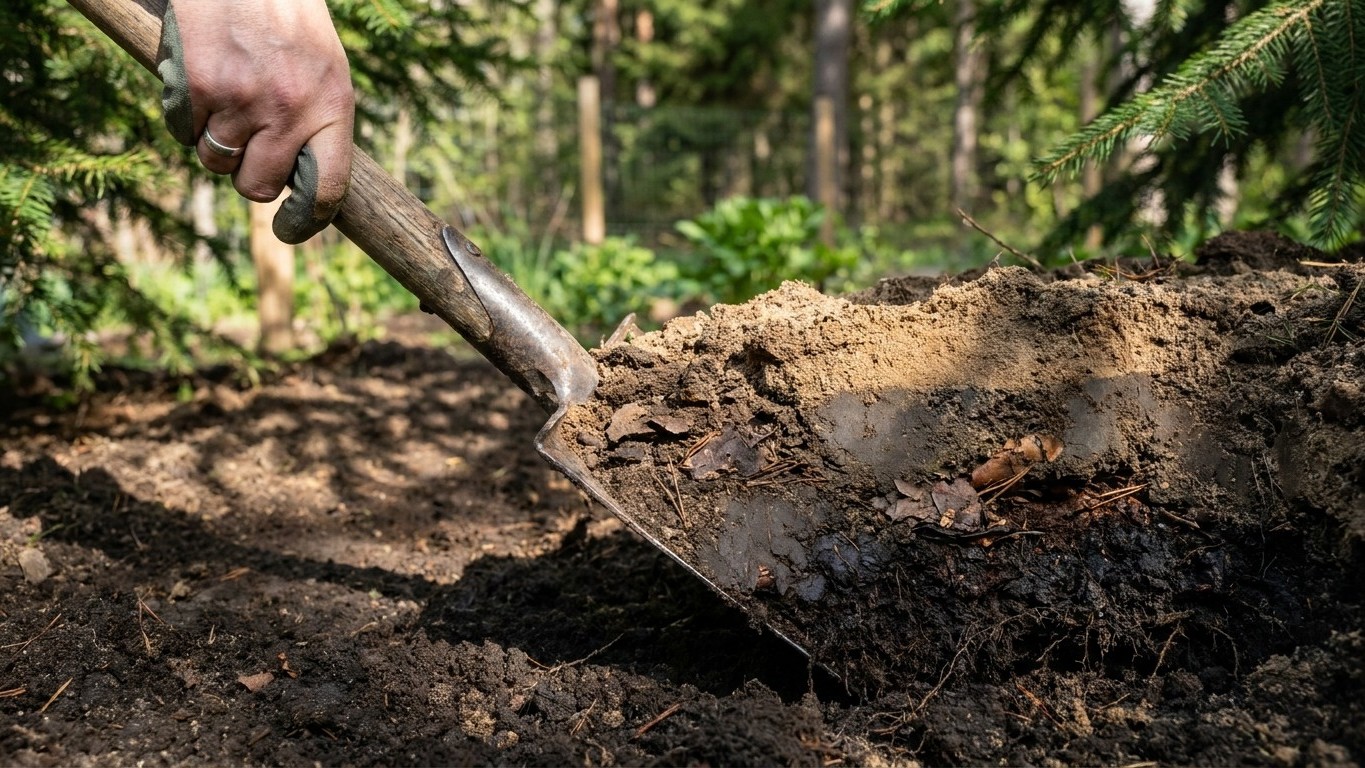

Dig a spade into most Maine ground and you’ll hit sandy, acid, silty soil that drains at a moderate pace and holds onto very little lime. That’s the state’s official soil series talking, not a guess. Here’s what it actually is, what the numbers mean for your own dirt, and how to fix what needs fixing.
What is under your garden

Maine’s official state soil is the Chesuncook series, named by state law in 1999 through the USDA NRCS State Soils program. It’s a Spodosol, the soil order that forms under conifer forests through centuries of acid leaching, and it’s the textbook example of what happens when rain moves steadily through sandy ground for a long time: minerals wash downward, organic acids build up, and the surface ends up sharply acid and low in the nutrients plants pull hardest for.
The USDA’s Soil Data Access records give exact figures for the surface horizon of the series, averaged across 61 mapped components. Surface pH runs about 5.1, which is strongly acid. Texture is a loam-to-silt mix: 35 percent sand, 53 percent silt, 12 percent clay. Organic matter comes in around 53.0 percent, and drainage is rated moderately well drained.
| Reading | Value |
|---|---|
| Surface pH | about 5.1 (strongly acid) |
| Sand | 35 percent |
| Silt | 53 percent |
| Clay | 12 percent |
| Organic matter | about 53.0 percent |
That organic matter number deserves a pause before you get excited. Fifty-three percent is not a garden-bed reading, it’s what you find in a natural forest floor, thick with needles, moss, and half-decayed litter that hasn’t been touched by a tiller. A cultivated vegetable bed, even a well-managed one, will run in the low single digits. So take the pH and texture numbers as a fair description of the mineral ground under a Maine forest, and leave the organic-matter figure as a reminder of what undisturbed Maine soil looks like before anyone gardens it.
None of this is a substitute for looking at your own dirt. A state spans hundreds of soil series, and any lot that’s been scraped, filled, or graded during construction is a different animal entirely from what a soil survey maps. Two quick checks tell you more about your yard than any state average.
Reading your own soil in five minutes
Wet a small handful of soil and squeeze it between thumb and forefinger, trying to push out a ribbon. Clay-rich soil forms a long, shiny ribbon over an inch or two before breaking. Loam forms a short, crumbly one. Pure sand won’t ribbon at all, it just falls apart. For the second check, fill a clear jar about a third full of soil, top it with water, shake it hard, and let it sit overnight. Sand settles first and sits on the bottom, silt layers in above it, and clay stays suspended longest, often leaving the water cloudy for a day or more. The thickness of each layer gives you a rough percentage breakdown you can compare against the table above.
Testing before you amend
Guessing at soil chemistry wastes money twice: once on the wrong amendment, and again buying the right one after the first attempt fails. A soil test measures things your eyes simply can’t, pH, phosphorus, potassium, and often organic matter percentage, for the price of a mailing envelope and a short wait.
Given the pH the state’s official soil carries, a Maine gardener can reasonably expect their own ground to test on the acid side too, especially anywhere near conifers or on ground that’s never been limed. But expecting is not knowing. Sandy, acid ground varies block to block depending on old land use, drainage, and whatever fill went down decades ago.
Taking a sample correctly matters as much as sending it in.
- Pick 6 to 8 spots scattered across the bed or lawn area you’re testing, avoiding spots right next to a foundation, a gravel path, or a compost pile.
- At each spot, dig a small core 4 to 6 inches deep, roughly where vegetable and lawn roots actually live.
- Drop all the cores into a clean bucket and break up any clumps by hand.
- Mix the cores together thoroughly and pull about two cups of the blended soil for your sample bag.
- Let the soil air-dry on a tray for a day if it’s wet, then label the bag with the bed’s location and send it in.
When results come back, the pH reading tells you which direction to correct, and the nutrient numbers tell you whether you need a balanced fertilizer or something targeted, like extra phosphorus or potassium alone. Skip this step and every amendment after it is a guess dressed up as a plan.
Amending it
The state’s representative soil sits at pH 5.1, well under the 5.5 mark that separates merely acid from a soil that’s actively locking up nutrients. If your own test comes back anywhere close to that, the fix is lime, not sulphur.
Lime for acid ground
Acid soil below 5.5 ties up phosphorus in forms roots can’t reach, even when there’s plenty of it in the ground. It also punishes brassicas, cabbage, broccoli, and their relatives, by favoring clubroot disease, which thrives in acid conditions. Ground limestone raises pH slowly, working over a season or two rather than overnight, because it has to dissolve and react with soil particles before it does anything. Fall applications give lime a full winter to start working before spring planting. Skip sulphur here entirely, it lowers pH further, which is the opposite of what acid Maine ground needs.
Organic matter for silt-loam structure
At 35 percent sand, 53 percent silt, and 12 percent clay, this is a fairly balanced loam rather than heavy clay or straight sand, but the low clay content means it holds less nutrient-binding capacity than gardeners might assume. Silt-dominated soils also have a habit of crusting on the surface after hard rain and settling into a dense cap that seedlings struggle to push through. Regular compost or aged manure worked into the top few inches breaks up that crusting tendency, adds the nutrient-holding capacity the low clay percentage lacks, and improves the soil’s ability to hold moisture between waterings. This is a multi-season project, structure built with organic matter doesn’t happen in one application, it builds year over year.
If your own soil skews sandier or heavier
Gardeners whose test comes back sandier than the state average should lean harder on organic matter and shorter, more frequent watering, since sandy ground drains fast and holds little between rains. Anyone sitting on genuinely heavy clay should add organic matter as well, but never work clay wet, and never dump sand into clay hoping to lighten it, that combination often bakes into something closer to concrete than garden soil.
Drainage and compaction
The Chesuncook series carries a moderately well drained rating, meaning water moves through it at a reasonable pace but not instantly, and a heavy rain can leave the ground damp for a day or two before it clears. Standing water for longer than that in your own yard means something local is different, compaction, a high water table, or a layer of clay or hardpan the survey doesn’t capture at your address.
A simple percolation test settles the question. Dig a hole about a foot deep and a foot wide, fill it with water, let it drain once to saturate the surrounding soil, then fill it again and time how fast the water level drops. A drop of an inch or more per hour points to reasonably good drainage. Anything under half an inch per hour signals a slow-draining spot that needs attention before you plant anything that hates wet feet.
Compaction from foot traffic, wheelbarrows, or old construction equipment can turn even a moderately well drained soil into a puddle-holder. Double digging, once the standard fix, has fallen out of favor because it disturbs soil biology and structure built up over years, undoing as much good as it does. For a spot that stays soggy or compacted no matter what you add, a raised bed filled with quality soil mix is often the honest answer rather than three seasons of amendment that may never catch up.
- Do: work compost into the top layer yearly rather than digging deep and disturbing soil structure.
- Do: build raised beds over any spot that fails the percolation test badly.
- Avoid: walking or parking on garden beds when they’re wet, since that’s when compaction does the most damage.
- Plant elsewhere: anything that demands sharp drainage, like lavender or rosemary, unless the bed is raised or amended heavily.
Local help
The University of Maine Cooperative Extension runs the state’s soil testing lab and is the fastest way to get an actual number instead of a guess. County offices review results with gardeners directly, walking through what the pH and nutrient levels mean for whatever’s planned for the bed. Details on submitting a sample are available through University of Maine Extension.
Common questions
Is all Maine soil acid?
The state’s representative soil runs strongly acid at pH 5.1, and that tendency holds across much of the forested, glacially derived ground common in Maine. But river bottoms, old farmland, and filled lots can test very differently, so a soil test is the only way to know for a specific yard.
Can I use sulphur to fix acid soil faster?
No. Sulphur lowers pH further, making acid soil more acid. For ground testing below 5.5, lime is the correction, applied in fall when possible so it has months to react before spring.
Why does my soil crust over after rain?
Silt-dominated soils, like the state’s representative series with 53 percent silt, are prone to surface crusting because silt particles pack tightly when wet and dry. Regular organic matter additions break up that tendency over time.
Is a raised bed really necessary if my soil drains slowly?
Not always, but if a percolation test shows less than half an inch of drop per hour and the spot stays soggy for days after rain, a raised bed filled with better-draining mix usually solves the problem faster than years of amending in place.