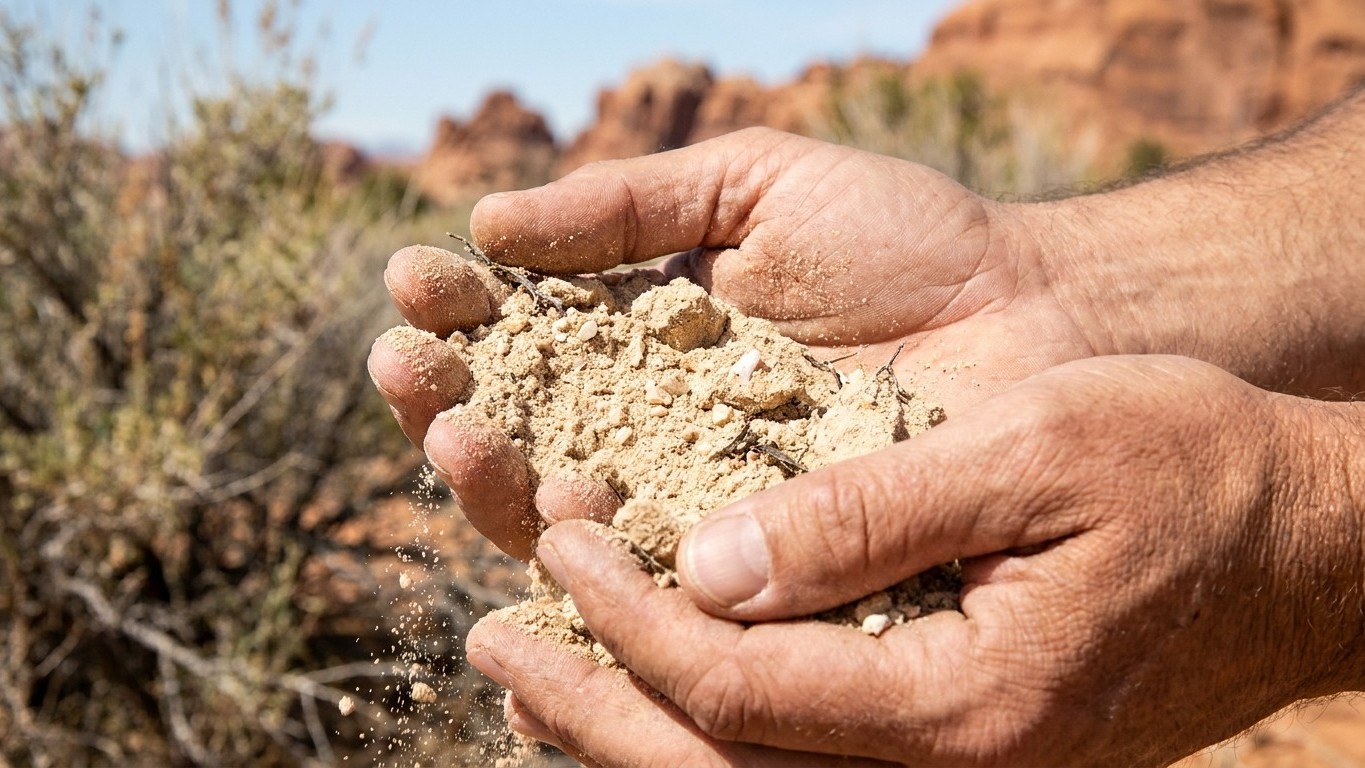

Utah soil, according to USDA’s representative state series, is the Mivida series: a dry-climate Aridisol that runs alkaline, sandy, and low in organic matter. That combination shapes almost every decision a home gardener in the state makes, from what fertilizer to buy to how often to water. Here’s what the numbers actually say, and what to do with your own dirt once you’ve checked it against them.
What is under your garden

USDA NRCS names the Mivida series as the soil that represents Utah in its State Soils program. It’s an Aridisol, the soil order that forms under dry climates, and it tends to be alkaline and to carry salts near the surface, a legacy of low rainfall and high evaporation rather than any single mineral. The Soil Survey Geographic Database gives representative surface-horizon values drawn from 24 mapped components of the series, and those values are worth knowing exactly, not roughly.
| Reading | Value |
|---|---|
| Surface pH | about 8.1 (alkaline) |
| Sand | 72 percent |
| Silt | 19 percent |
| Clay | 9 percent |
| Organic matter | about 1.5 percent |
| Drainage class | well drained |
That’s a soil that’s mostly sand by weight, alkaline at the surface, thin on organic matter, and quick to drain. It fits the picture most people carry of the Intermountain West: gritty, pale, and unforgiving of anything that expects steady moisture. But this is the series USDA lists as representative of the state as a whole, not a measurement of your particular bed. Utah spans desert basins, mountain valleys, and irrigated river bottoms, and the soil under a fifty-year-old farm plot in Cache Valley has little in common with the soil under a new subdivision in the Salt Lake basin, where a builder’s grading equipment likely scraped off the original topsoil and left subsoil or fill in its place.
The fastest way to find out what you’re actually working with takes about five minutes and no equipment beyond your own hand. Take a small handful of moist soil and squeeze it into a ball, then push it between your thumb and forefinger to form a ribbon. Sandy soil won’t hold a ribbon at all, it just falls apart. Loam forms a short ribbon before breaking. Heavy clay forms a long, shiny ribbon that holds its shape. A second test tells you more: fill a straight-sided jar about a third full of soil, add water to near the top, shake hard, and let it sit overnight. Sand settles within minutes and forms the bottom layer, silt settles over the next few hours, and clay stays suspended longest, settling last as the thinnest top layer. The proportions you see in the jar are a rough version of the same numbers in the table above, just measured in your own yard.
Testing before you amend
Guessing at soil chemistry costs money twice: once on the amendment you didn’t need, and again when the plant that failed has to be replaced. A soil test measures things your eyes simply can’t, pH, phosphorus, potassium, and often salinity and organic matter, and it turns amending from a hunch into an instruction sheet. Given the state’s alkaline, low-organic-matter baseline, a Utah gardener can reasonably expect pH readings in the high 7s to low 8s and a lean organic matter number. Expecting isn’t knowing, though, and salinity in particular varies enormously from lot to lot depending on irrigation history, so a test is the only way to know where your ground actually sits.
Taking a sample that means something is simpler than it sounds, and it comes down to consistency:
- Pick the bed or area you want tested and ignore odd spots like old paths or compost piles.
- Dig 8 to 10 small cores across that area, each 6 to 8 inches deep, roughly the depth where vegetable and flower roots do their work.
- Mix the cores together in a clean bucket, breaking up clumps and removing rocks or roots.
- Let the mixed soil air dry on a tray indoors for a day or two before bagging it, since wet samples can skew lab results.
- Bag about a pint of the mixed, dried soil and label it with the bed name and date.
- Submit it through your county extension office along with the crop or plant type you intend to grow there.
When the results come back, the pH number tells you which direction to correct in, the nutrient levels tell you whether you actually need fertilizer or just organic matter, and a salinity reading, if included, tells you whether leaching with extra irrigation water needs to happen before anything else.
Amending it
The Mivida figures point in one clear direction: alkaline pH, low organic matter, and a soil that’s three-quarters sand. Each of those calls for a specific fix, and mixing them up wastes a season.
Correcting alkaline pH
At a surface pH around 8.1, lime should never go anywhere near this ground. Lime raises pH, and this soil is already well past neutral. The honest, slow route is elemental sulfur, which soil bacteria convert to sulfuric acid over time, gradually pulling the pH down. It works in seasons, not weeks, and heavy, one-time applications risk burning roots, so it’s applied in modest amounts and retested the following year. Organic matter helps too, buffering pH swings and feeding the same bacteria that process sulfur. High pH also locks up iron, which is exactly what’s happening when leaves turn yellow while their veins stay green, a condition called iron chlorosis that’s common on alkaline western soils. A foliar iron chelate spray treats the symptom for one season, but chelated iron worked into the soil alongside sulfur is the longer fix.
Building up organic matter
At 1.5 percent organic matter, this soil has almost nothing to hold moisture or feed microbial life on its own. Compost, aged manure, and leaf mold worked into the top 6 to 8 inches every season raise that number gradually and improve almost everything else at the same time, water retention, nutrient availability, and soil structure. This is a multi-season project. A single application won’t move the needle much, but three or four years of consistent additions changes the soil’s behavior noticeably.
Managing sandy structure
With sand at 72 percent, water and nutrients pass through this soil fast, which means shorter, more frequent watering beats deep, infrequent soaking here, since there’s little clay to hold moisture between waterings. Adding sand to a sandy soil accomplishes nothing, the fix is organic matter, again, working as a sponge between the sand grains. Mulch on the surface slows evaporation and buys time between waterings, which matters in a climate already defined by low rainfall.
Drainage and compaction
The series is listed as well drained, which fits a soil that’s mostly sand. Water moves through quickly, so standing puddles after a storm are unlikely on unaltered ground, but that same speed means nutrients and moisture move through just as fast, out of reach of roots before they can use them.
Confirming drainage in your own yard takes one simple test. Dig a hole about a foot deep and a foot across, fill it with water, and let it drain completely once. Then fill it again and time how long it takes to drop, measuring in inches per hour. A rate above 2 inches per hour is fast, typical of sandy ground and consistent with the Mivida numbers. A rate under half an inch per hour signals a compacted layer or a clay-heavy pocket, even on ground that’s supposed to be well drained overall, often the result of construction equipment compacting subsoil during a home’s original grading.
Compaction from foot traffic, parked equipment, or construction changes the picture even on naturally well-drained soil, since compacted sand loses the pore space that let water and roots move through it in the first place. Double digging used to be the standard fix, but it’s fallen out of favor because it disrupts soil biology and structure for a temporary gain, and on compacted ground the more honest answer is often a raised bed rather than years of trying to rehabilitate compacted subsoil in place. If your percolation test came back slow, building up rather than digging down is usually the faster route to a working garden bed.
- Do: water in shorter, more frequent sessions rather than deep soaks on naturally sandy, fast-draining ground.
- Do: mulch heavily to slow evaporation and moderate soil temperature swings.
- Avoid: working sandy soil while it’s wet, which encourages clumping in isolated pockets rather than even structure.
- Consider a raised bed if a percolation test shows compacted, slow-draining subsoil that garden amendments alone won’t fix quickly.
Local help
Utah State University Extension runs the soil testing lab most county offices use, and it’s the direct route to a number for your own yard instead of a statewide average. Submit a sample through your local county extension office, and staff there will walk through the results with you and suggest amendments suited to your specific reading. Find contact details and submission instructions at extension.usu.edu.
Common questions
Is all Utah soil alkaline? The state’s representative series runs around pH 8.1, and much of the Intermountain West trends alkaline for the same climate reasons, but pockets of more acidic or neutral soil exist, particularly in higher-elevation, higher-rainfall areas. A test is the only way to confirm your own reading.
Can I just add lime to fix a nutrient problem? Not on ground that’s already alkaline. Lime raises pH further, which is the wrong direction here and will make iron and other micronutrients even less available to plants.
Why does my soil dry out so fast? A sand-heavy profile like Mivida’s, at 72 percent sand, simply doesn’t hold water the way clay or loam does. Organic matter and mulch are the practical fix, along with adjusting your watering schedule to shorter, more frequent sessions.
How often should I retest my soil? Every two to three years for an established garden, or yearly while you’re actively correcting pH with sulfur, since it’s easy to overshoot or undershoot without checking progress along the way.