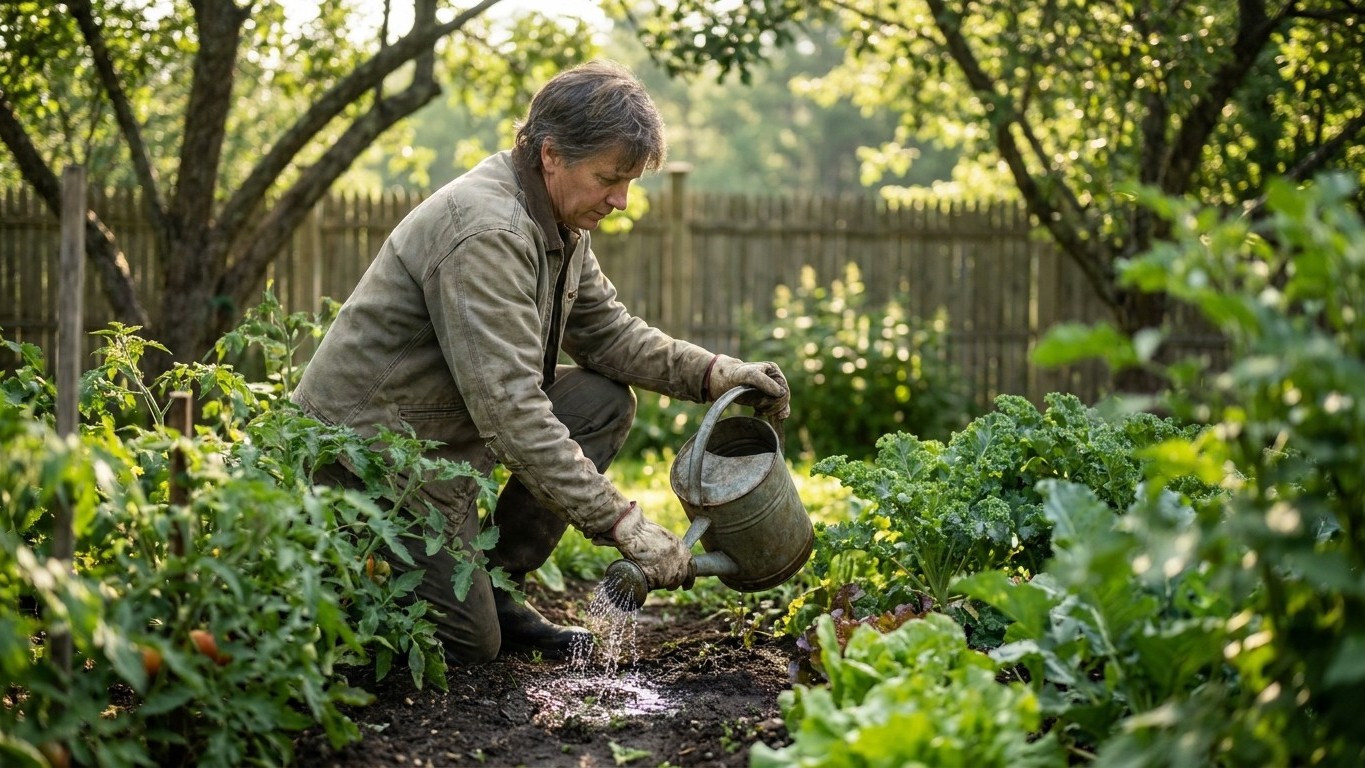

Maine gardeners don’t fight the sky the way Southwest or Plains gardeners do. Watering here is less about survival and more about timing: knowing when the soil has actually dried, matching the calendar to a short growing season, and checking local rules before running a hose or filling a barrel.
What the climate asks of you

Start with the number that rules out easy assumptions: at the Portland reference station, Maine averages just 3.8 days a year at 90F or above (NOAA NCEI Climate Normals, 1991-2020). That’s not a heat state. It’s a state where a garden rarely bakes, where evaporation losses stay modest most weeks, and where a missed watering session doesn’t turn into a crisis by afternoon the way it might in Kansas or Arizona.
What the sourced climate data doesn’t hand us is a precise June-July-August rainfall total for this state, and that gap matters more than it looks. Rather than substitute a number pulled from memory, the honest move is to say plainly: check your local National Weather Service cooperative station or the University of Maine Cooperative Extension for the current season’s rainfall tally in your county, because totals swing noticeably between the coast, the interior, and the north.
What we do have is the growing season itself, and it’s short by national standards. Last spring frost at the Portland station runs April 22 to May 1, and first fall frost lands October 9 to October 21 (NOAA NCEI 1991-2020 Climate Normals). That’s the mild end of the state. Inland and northern Maine push spring frost later and pull fall frost earlier, sometimes by weeks, which compresses the window even further for anyone gardening away from the coast.
The state also spans USDA hardiness zones 3b to 6a (USDA Plant Hardiness Zone Map, 2023), a range wide enough that a planting and watering schedule built for coastal Portland can be badly wrong for Aroostook County. A garden bed generally wants close to an inch of water a week during active growth. Whether the sky delivers most of that or almost none of it in your specific location isn’t something this dataset settles, and it shouldn’t be guessed at. It’s the single most useful thing to confirm locally before setting a watering routine for the season.
How much, how often
The instinct to water a little bit every evening is almost always the wrong one. Shallow, frequent watering trains roots to stay near the surface, where soil dries out fastest and where a hot, dry stretch does the most damage. Deep, infrequent watering pushes roots down into cooler, more stable soil, and that’s what gets a plant through the inevitable dry week without daily attention. The same principle applies to pots and raised containers, though the details differ enough that it’s worth reading a dedicated guide to Watering Pots and Containers in Maine.
The test for when to water isn’t the calendar, it’s the soil. Push a finger two inches down near the base of the plant, or pull a small trowel of soil and look at it. If it’s dry at that depth, especially during a stretch without rain, it’s time to act — see Watering Through a Dry Spell in Maine for how to handle it, and water. If it’s still damp, wait. This single habit does more to prevent both underwatering and overwatering than any fixed schedule, because it responds to what actually happened that week rather than what usually happens.
Soil texture changes the math, and it’s worth knowing yours. Where the ground runs sandy, water drains through quickly and holds little, so shorter, more frequent soakings work better than trying to stretch the interval. Where the ground runs to heavy clay, a single watering can hold moisture for the better part of a week, but clay punishes impatience: working or soaking clay soil while it’s still wet compacts it and starves roots of oxygen, sometimes for the rest of the season. Because the sourced data here doesn’t specify a texture for Maine as a whole, and soils vary block to block even within one yard, a simple squeeze test (moist soil that holds a shape but crumbles under light pressure is in the workable range) tells you more than any general rule.
Put together, a practical routine looks like this:
- Check the soil two inches down at the base of the plant before deciding whether to water at all.
- Water deeply, aiming for the equivalent of about an inch across the bed, delivered in one session rather than split into several light passes.
- Water in the morning, so moisture soaks in before the day’s evaporation and foliage has time to dry before evening.
- Aim at the base, not the leaves, to cut down on fungal disease that spreads in Maine’s cooler, often humid air.
- Adjust the interval to soil texture: shorter and more frequent on sandy ground, longer and less frequent on clay, and never on clay that’s already wet.
- Watch the short season: with frost arriving as early as October 9 in some years, taper watering as nights cool rather than keeping a mid-summer schedule into fall.
Restrictions and rules
Watering restrictions aren’t rare in Maine, but they aren’t uniform either, and they can appear or lift within a single summer depending on local conditions. Some municipal water districts issue voluntary conservation requests during dry stretches; a smaller number move to mandatory odd-even watering days or time-of-day limits when a reservoir or well field runs low. Many Maine households, especially outside town centers, draw water from private wells rather than a municipal system, and private well owners answer to no municipal ordinance, though a well running dry mid-summer is its own kind of restriction.
None of that can be stated as a fixed, statewide rule here, because it isn’t one. Restriction schedules, exempt hours, and enforcement all vary by water district and change from year to year based on that year’s rainfall and reservoir levels. The only reliable move is to contact your local water utility or town office directly before setting an automatic timer or planning a heavy watering week, and to check again if a dry spell stretches on.
Given how little the state’s driest stretches typically deliver in the way of steady rain, and given that some interior and northern areas run drier and hotter relative to their own averages than the coast does, treating a restriction check as a routine part of garden planning, not just a crisis response, is the safer habit anywhere in Maine.
Using less
Cutting water use in a Maine garden isn’t about extreme rationing. It’s mostly about not wasting what falls for free and not fighting evaporation you could easily block. A few techniques do most of the work:
- Mulch a two- to three-inch layer of straw, shredded bark, or leaf litter over the root zone, which slows evaporation enough that beds often need watering noticeably less often, especially on sandy ground that drains fast.
- Drip irrigation or soaker hoses deliver water straight to the root zone instead of spraying it into the air, cutting evaporation loss compared with an overhead sprinkler and keeping foliage dry, which also helps with the fungal issues Maine’s humid air can encourage.
- Group plants by water need so thirsty vegetables aren’t sharing a zone with drought-tolerant perennials; it stops the common habit of overwatering the whole bed to satisfy the one plant that’s struggling.
- Work organic matter into the soil, compost especially, which improves both sandy soil’s water retention and clay soil’s drainage, moving either extreme closer to the ideal middle ground.
- Rain barrels, where local rules allow them, capture roof runoff that would otherwise just run into the storm drain. As a rule of thumb, an inch of rain falling on 1,000 square feet of roof yields roughly 600 gallons of runoff. Whether that barrel stays full through a Maine summer or runs dry depends on how much rain actually falls in your specific month and location, which is exactly the local rainfall figure worth confirming with your town or extension office rather than assuming.
None of these techniques replace the soil check described earlier. They reduce how often that check turns up dry soil, which is the whole point: less water hauled, less time spent, and a garden that still gets what it needs before the short season runs out.
Common questions
How often should I water vegetables in a Maine summer?
Check the soil two inches down rather than following a fixed schedule. In most weeks, one deep watering delivering close to an inch is enough; sandy soil may need a second, lighter session, while clay soil often needs less.
Does Maine have statewide watering restrictions?
No single statewide rule applies. Restrictions are set by individual municipal water districts and change year to year based on local conditions, so check with your town or water utility directly rather than assuming a rule based on a neighboring town.
Is Maine’s short growing season a bigger concern than drought?
For most gardeners, yes. With last spring frost typically between April 22 and May 1 near the coast and first fall frost as early as October 9, timing plantings around the frost window matters at least as much as managing water, especially inland and to the north where the season runs shorter still.
Are rain barrels legal in Maine?
Rules on rain barrels are set locally and can vary by municipality. Before installing one, a quick check with your town office or water district confirms whether any permit or restriction applies in your specific area.