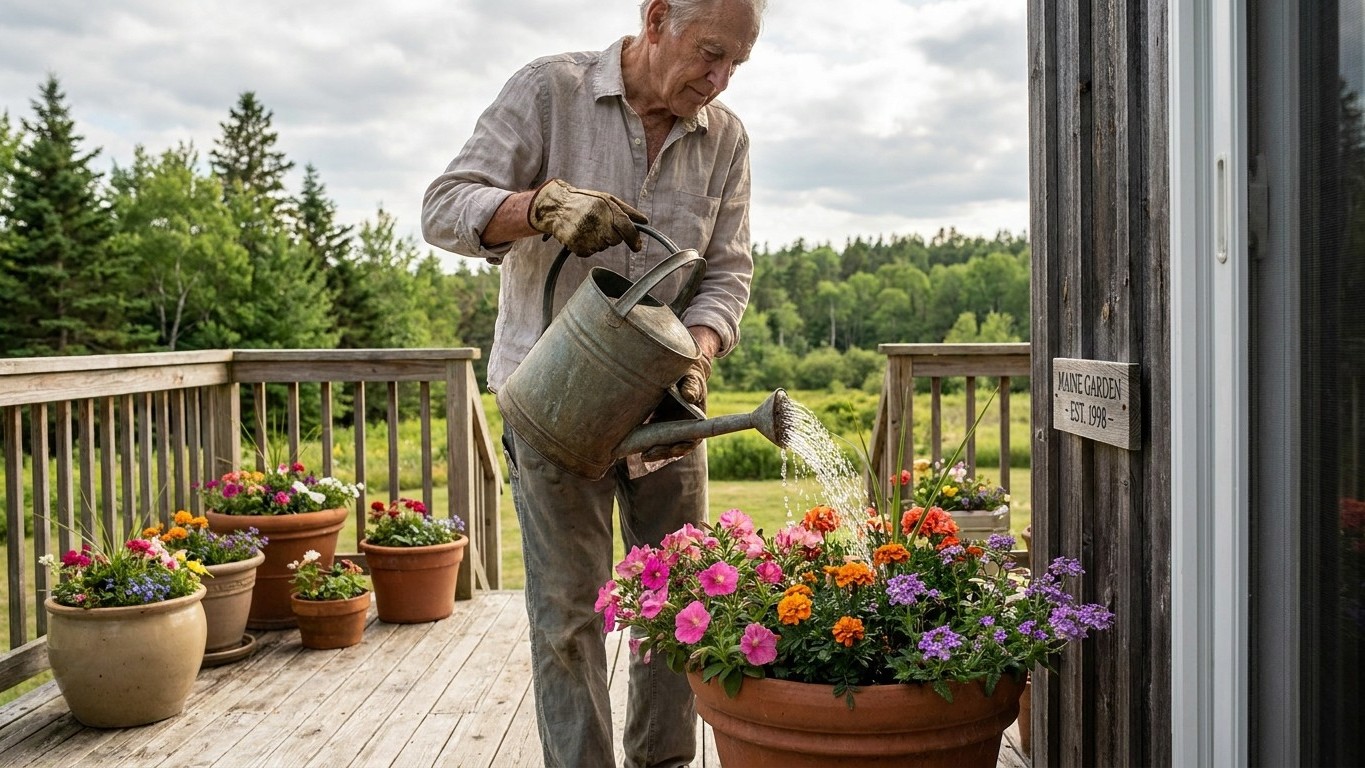

Maine gardeners get an answer most of the country would envy: about 11.2 inches of rain falls across June, July and August, and only 3.8 days a year hit 90F or hotter. That combination means containers and garden beds here rarely face the punishing dry stretches common further south or west, but “rarely” isn’t “never”, and the driest month still leaves a gap only a watering can or hose can close.
What changes here

Two numbers set the terms for every watering decision in this state. The driest summer month is July, averaging 3.43 inches of rain. The heat load pushing that water back out of the soil is small: just 3.8 days a year reach 90F or above. Read together, that’s a garden that gets decent natural moisture but doesn’t face the evaporative pressure of a hot, arid climate, the risk here shifts from scorching to soggy roots more often than gardeners expect.
Run the arithmetic and the gap becomes concrete. A vegetable bed or a container of annuals wants roughly an inch of water a week. July’s 3.43 inches, spread across the month’s roughly 4.3 weeks, works out to about 0.8 inch a week arriving from the sky. That leaves around 0.2 inch a week for the gardener to make up by hand or by hose, in an average July, a modest top-up compared to what dry-summer states carry, but real, since normals average out both soaking rains and rainless stretches.
That 0.2-inch gap also isn’t evenly distributed. Maine’s summer rain often arrives as a thunderstorm that dumps half an inch in twenty minutes rather than a steady drizzle spread over the week. On sandy soil, that water drains through fast and the topsoil can look dry again within a day, so the effective gap a gardener needs to fill can run higher than the monthly average suggests. On heavy clay, the same storm can sit near the surface for days, meaning a container or bed watered on schedule right after a downpour risks drowning roots rather than helping them. The 3.43-inch figure is a normal for the reference station, covering 1991-2020, a real garden a few miles inland, on a slope, or in a low spot that collects runoff will see something different, which is why a rain gauge on the actual plot settles the question better than any regional average.
How to water when it matters
The method that fits Maine’s climate favors depth over frequency, and there’s a reason for each part of that approach. Watering deeply pushes moisture several inches into the soil, which trains roots to grow downward chasing it, shallow, frequent watering does the opposite, keeping roots near the surface where they dry out and bake during the handful of 90F days the state does get. Watering at the base rather than overhead keeps leaves dry, since wet foliage sitting overnight in Maine’s cool, humid summer air is an open invitation to fungal disease. Morning watering matters for the same reason: it gives any splashed leaves hours to dry in the sun before evening humidity sets in.
Knowing when to water starts with checking, not guessing. A finger pushed two inches into the soil, or a trowel pulled up for a quick look, tells the truth that the surface can’t, soil can look dark and moist on top while sitting bone-dry an inch below, especially after one of Maine’s brief summer storms.
- Check soil moisture two inches down with a finger or trowel before watering, not after glancing at the surface.
- On sandy soil, water in shorter, more frequent sessions, roughly every two to three days in July, since sand holds little moisture and drains fast.
- On heavy clay, water less often but more deeply, and let the soil dry partway between sessions, since clay can hold a week’s worth of water and drown roots if watered too soon.
- Water at the base of the plant, avoiding the leaves, using a soaker hose, drip line, or the spout of a watering can held low.
- Water in the early morning, before 9 a.m. if possible, so any incidental splash dries before evening.
- Start with about 0.2 inch of supplemental water per week during July as a baseline, then adjust up or down based on what the finger test actually shows in that specific bed or container.
What goes wrong
Most watering mistakes in Maine come from habits imported from drier climates, or from the drought-vs-flood confusion a modest, storm-prone rainfall pattern tends to create.
A daily sprinkle that never soaks in
Giving a bed a quick splash every day feels responsible, but it wets only the top inch of soil. Roots follow the water, staying shallow and exposed, so on the rare Maine day that hits 90F, those roots have nowhere cool to retreat to and the plant stresses fast.
Watering the leaves at night
An evening soak with an overhead sprinkler leaves foliage wet through the cool, humid Maine night, ideal conditions for fungal disease to take hold before morning sun has a chance to dry anything off.
Trusting the rain gauge in the sky
A passing thunderstorm can look like it solved the watering problem, but many summer storms here drop intense rain for a short burst that runs off compacted or clay soil before it soaks in. The only way to know is the same finger test used before watering: if the soil two inches down is still dry, the storm didn’t do the job.
Drowning a bed that never got the chance to dry
With Maine’s heat load this low, the bigger local risk often isn’t drought, it’s watering on a fixed schedule regardless of conditions, which on clay soil means adding water to ground that’s already saturated from the last rain. Waterlogged roots suffocate and rot just as surely as dry ones wither, and it happens more quietly, which is why it catches gardeners here off guard.
Skipping the mulch
Bare soil left uncovered gives up moisture to the sun and air fast, undoing whatever the rain or the hose just provided. A two- to three-inch layer of mulch slows that loss and evens out the swings between Maine’s brief hot spells and its more frequent cool, damp stretches.
Local help
The University of Maine Cooperative Extension offers state-specific guidance on soil testing, plant selection and seasonal care for gardeners anywhere in the state. Watering restrictions vary by town and water district and can change with drought conditions, so check with the local water provider for current rules before assuming any statewide policy applies.
Common questions
How often should I water a Maine vegetable garden in summer?
Check soil moisture two inches down every two to three days during July, the driest month, and water only when that depth is dry rather than on a fixed calendar.
Do Maine gardens need less watering than gardens in hotter states?
Generally yes, with only 3.8 days a year reaching 90F, evaporative demand is lower, and the roughly 0.2 inch weekly shortfall in July is smaller than in drier, hotter climates.
Can clay soil in Maine actually be overwatered?
Yes. Clay holds moisture for days after rain, and adding more water before it dries can suffocate roots, checking soil moisture before watering matters as much here as remembering to water at all.
Is morning or evening watering better for Maine gardens?
Morning. It gives leaves time to dry in daylight, cutting the risk of the fungal disease that thrives when foliage stays wet overnight in Maine’s cool, humid summer air.