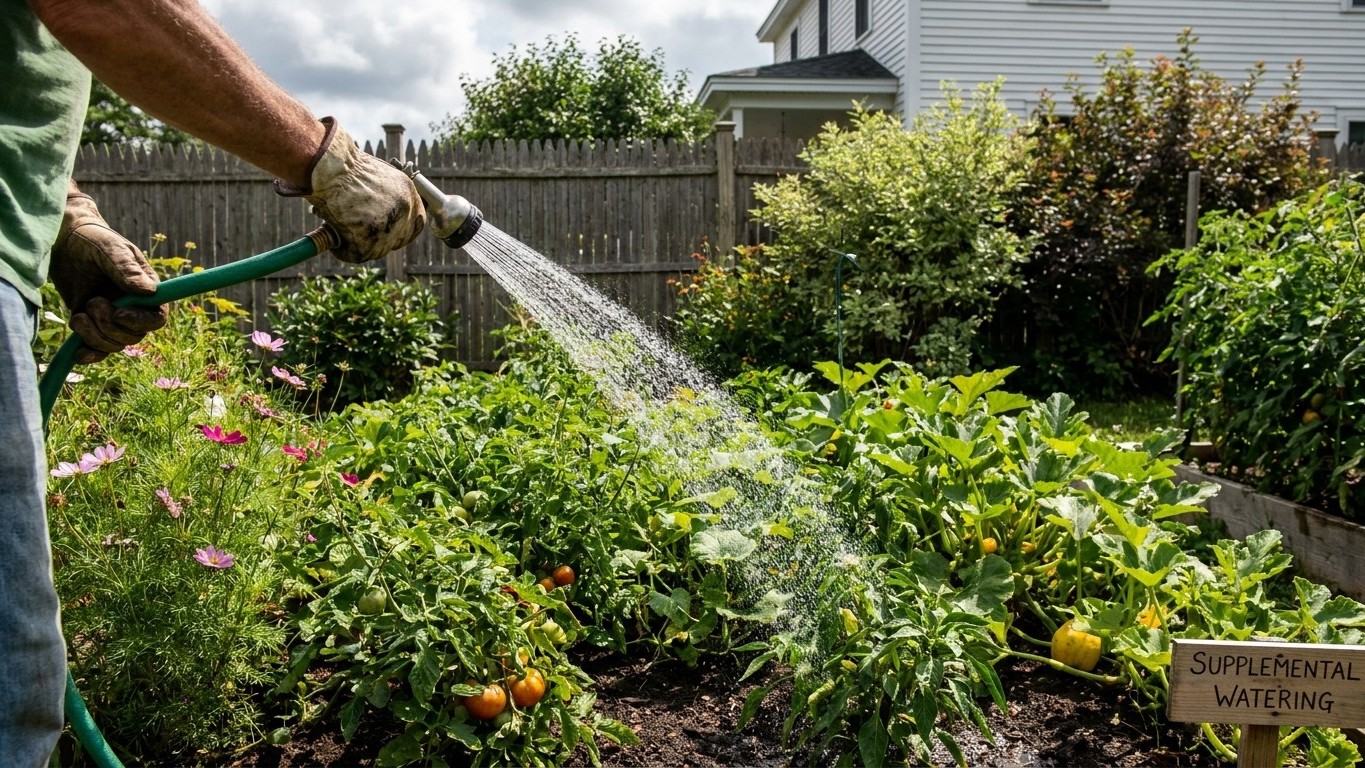

Maine’s driest summer stretch, July, still delivers 3.43 inches of rain on average, and the state sees only about 3.8 days a year at or above 90°F. That combination means a real dry spell here is less about scorching heat and more about timing: knowing when the sky has done its job and when the hose needs to pick up the slack.
What changes here

Two numbers set the terms for watering in Maine: 3.43 inches of rain in July, the driest summer month, and 3.8 days a year that reach 90°F or higher. Put together, they say something practical: Maine rarely bakes for weeks on end, but its driest month still falls well short of what a garden bed actually wants, so the gap has to be filled by hand rather than assumed away.
Doing the math
A vegetable or flower bed generally wants around an inch of water a week to keep roots supplied through summer heat. Spread July’s 3.43 inches evenly across the month’s roughly 4.4 weeks, and the sky is delivering something like three-quarters of an inch in an average week, not the full inch. That leaves a gardener responsible for the remainder, somewhere around a quarter inch a week, on a typical July week in a typical year. It sounds small, but a quarter inch skipped week after week during a genuine dry stretch adds up to a stressed root system by August.
The 3.8 days above 90°F matter here too, even though that number is modest compared to states further south or inland. Those handful of hot days concentrate evaporation into short windows: a bed that looked adequately moist on Monday can be crusted dry by Thursday if one of those 90-degree days lands mid-week. Soil texture decides how forgiving that gap is. The same rainfall soaks quickly through loose, sandy ground and disappears within a day, while dense clay holds onto it for the better part of a week, sometimes to the point of staying too wet at root depth. Neither the FACTS for this page nor a garden’s own soil test can be assumed from a state average, so the numbers above are the starting point, not the last word, on any given plot.
How to water when it matters
The best defense against a Maine dry spell isn’t a bigger watering can, it’s a different rhythm. Deep, infrequent soaks beat a light daily splash because they push moisture down to where roots actually live, training the plant to grow downward rather than skimming the surface for whatever fell overnight. Watering at the base, rather than overhead, keeps that moisture aimed at roots instead of evaporating off leaves before it does any good. Morning watering rounds out the method: it gives the plant a full, cool day to draw up what it needs before the afternoon sun and any of those 90-degree days pull moisture back out of the soil.
Knowing when to water starts with the soil, not the calendar. A finger pushed two inches into the bed, or a trowel turned to check below the surface, tells the real story. If it’s dry at that depth, water; if it’s still damp, wait, even if the top layer looks parched. Sandy soil, which drains fast, tends to need shorter, more frequent sessions to keep pace with how quickly it lets water pass through. Heavy clay holds a week’s worth of water but punishes impatience: watering it again before it’s had a chance to dry invites root rot rather than growth. Either way, treat any single number as a beginning to test against your own ground, not a fixed rule.
- Check moisture two inches down with a finger or trowel before deciding whether to water at all.
- Water at the base of the plant, early in the morning, rather than overhead in the evening.
- Apply roughly an inch of water in one or two sessions per week as a starting point, adjusting for whatever July’s rain has already supplied.
- On sandy soil, shorten the interval between waterings and reduce the amount each time.
- On clay soil, wait for the top few inches to dry before watering again, even if that stretches past a week.
- Reassess after any day at or above 90°F, since those days can undo several days of stored moisture quickly.
What goes wrong
A little water every day
Daily sprinkling feels responsible, but it keeps roots shallow and close to the surface, where they’re first to bake once a 90-degree day arrives. Deep, less frequent watering is the fix, not more frequent light watering.
Watering the leaves at night
Wetting foliage in the evening leaves it damp all night, exactly the condition fungal diseases need to take hold. Water the soil, not the leaves, and do it early enough in the day that any splashed moisture dries before dusk.
Trusting a passing shower
A quick summer storm can look like it solved the problem while wetting only the top half-inch of soil. Check with a finger before skipping a scheduled watering; Maine’s 3.43 inches of July rain often arrives in bursts, not steady soaking rain, so a single storm rarely does as much as it appears to.
Drowning a bed that never dried
Given how much rain Maine’s summers actually deliver, about 11.2 inches across June, July and August combined, the costlier mistake here is often the opposite of underwatering: sticking to a fixed watering schedule during a stretch that’s already wet enough. On heavier soils especially, adding water to ground that hasn’t dried at root depth drowns roots as surely as neglect starves them.
Local help
Watering rules shift by town and by water district, and they can change quickly once a dry stretch sets in, so check current restrictions with your local water provider rather than assuming last year’s rules still apply. For soil testing, plant recommendations, and season-specific guidance, the University of Maine Cooperative Extension is the state’s land-grant resource.
Common questions
How often should I water during a Maine dry spell?
Start with about an inch a week, split into one or two deep soakings, then adjust based on how much rain July has actually delivered and what a finger test two inches down tells you.
Does Maine get real drought conditions in summer?
Maine’s climate is comparatively wet, with 3.43 inches even in its driest summer month, but short dry spells still happen, especially when they coincide with one of the state’s roughly 3.8 annual days above 90°F.
What time of day should I water in Maine?
Morning. It gives plants a full day to absorb water before evaporation peaks, and it avoids leaving foliage wet overnight, which invites fungal disease.
Is Maine’s soil sandy or clay-heavy?
It varies by region and even by yard, so check your own soil with a simple finger test or a soil sample rather than assuming; sandy ground needs more frequent, lighter watering, while clay holds moisture longer but drains poorly.