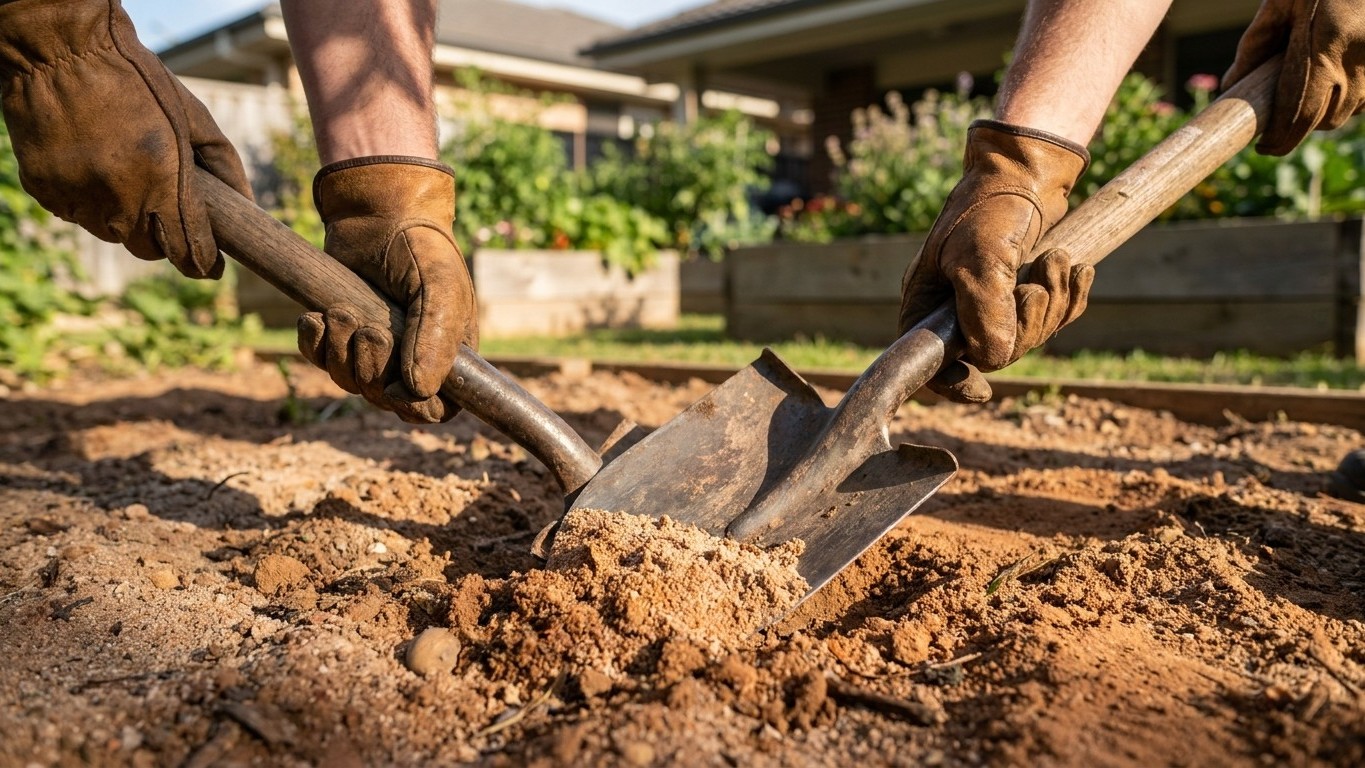

Dig a spade into most Maryland ground and you’ll hit sandy, reddish-brown soil that drains fast and resists your effort to make a mudpie out of it. That’s the Sassafras series talking, the soil USDA singles out as representative of the state. Here’s what it is, what your own dirt might actually be, and how to fix what’s wrong with it.
What is under your garden

The USDA NRCS names the Sassafras series as Maryland’s representative state soil. It’s an Ultisol, which in plain English means it’s old, heavily weathered, and leached of a lot of what plants want. Rain has been passing through this ground for a very long time, carrying nutrients down and out of reach of roots. That history shows up in the numbers, and they’re worth sitting with before you do anything to your garden.
| Reading | Value |
|---|---|
| Surface pH | about 5.3 (strongly acid) |
| Sand | 67 percent |
| Silt | 23 percent |
| Clay | 10 percent |
| Organic matter | about 1.6 percent |
Those numbers describe a soil that’s mostly sand, drains well, and starts out on the acid side of neutral with not much organic material to buffer anything. Nothing here holds water or nutrients for long. That’s the texture equation working against you unless you correct it.
None of this is a promise about your particular yard, though. A state as varied as Maryland spans hundreds of mapped soil series, from the sandy coastal plain that gave us Sassafras to heavier ground in the Piedmont and rocky soils up in the western counties. And if a builder ever scraped your lot, filled a low spot, or graded the yard before your house went up, you’re not gardening in a natural soil profile at all. You’re gardening in whatever got pushed around by a bulldozer, which behaves nothing like the soil map suggests.
Reading your own soil in five minutes
You don’t need a lab to get a rough read on what you’ve got. Take a pinch of moist soil, roll it between your thumb and forefinger, and try to form a ribbon. Soil that won’t ribbon at all and feels gritty is sandy, like Sassafras. Soil that ribbons an inch or two before breaking has real clay content. Soil that ribbons long and feels slick is heavy clay.
The jar test tells you more. Fill a clear jar about a third full of soil, top it off with water, shake hard, and let it sit overnight. Sand settles first and sits at the bottom within minutes, silt settles next over an hour or so, and clay stays suspended longest, sometimes clouding the water for a full day. The layers you see in the morning are your actual texture, not a state average. A gardener who runs both tests can say, out loud, exactly what they’re digging into.
Testing before you amend
Guessing at soil amendments is how people end up dumping lime on ground that’s already fine, or piling on nitrogen a plant didn’t need. A real soil test tells you what your eyes can’t: the actual pH of your bed, the phosphorus and potassium levels, and sometimes organic matter content. Given that the regional pH tends to run acid, around 5.3 at the surface for the representative state soil, you might reasonably expect your own dirt to lean acidic too. But expecting isn’t knowing, and the only way to know is to test the dirt you’re actually growing in.
Taking a sample correctly matters as much as sending it off. Follow these steps standing in the garden, trowel in hand:
- Pick one planting area at a time. Don’t mix soil from the vegetable bed with soil from the lawn.
- Pull 8 to 10 small cores from scattered spots across that area, going down 6 to 8 inches, which is roughly where most roots actually feed.
- Dump the cores into a clean bucket and break up any clumps by hand.
- Mix thoroughly so the sample represents the whole bed, not one lucky (or unlucky) spot.
- Pull out about a pint of the mixed soil, let it air dry on newspaper if it’s wet, and pack it for the lab.
- Label it clearly by bed or area, since a report is useless if you can’t remember which patch it describes.
The extension service usually runs this lab work, and it’s inexpensive relative to what a wrong guess costs you in wasted amendments. When the results come back, the pH number and the nutrient levels are your real starting point, not the state average.
Amending it
Once you know your actual pH and texture, the fix should follow the number in front of you, not a generic list of “good things to add to soil.” Maryland’s representative ground points toward acid correction and structure-building, so that’s where most yards in the state will land, but check your own report before you buy anything.
Lime for acid ground
If your test comes back below about 5.5, lime is the tool, and sulfur would be a mistake there since it pushes pH the wrong direction entirely. Acid soil locks up phosphorus so roots can’t reach it, and it stunts brassicas like broccoli and cabbage, which want a more neutral range to thrive. Lime doesn’t work fast. It takes a season or more to fully react with the soil and move the number, so apply it in fall if you can, and don’t expect results by next week’s planting.
Sulfur for alkaline ground
If your number comes back above about 7.3, the instruction flips completely: lime should never touch that ground. Elemental sulfur and steady additions of organic matter are the slow, honest route to bringing pH down, and there’s no shortcut that doesn’t risk overcorrecting or burning roots. At high pH, iron becomes chemically unavailable to plants even when it’s physically present in the soil, and that’s exactly what yellow leaves with green veins, a condition called iron chlorosis, are telling you.
Organic matter for sandy ground
With sand sitting at 67 percent and organic matter around 1.6 percent in the representative soil, most Maryland gardens on this type of ground need bulk more than anything else. Compost, aged manure, and shredded leaves added yearly build the organic fraction that sandy soil is missing, giving it something to hold water and nutrients against. Sandy ground also drains fast enough that watering needs to be shorter and more frequent, since nothing stays put in a single deep soak.
Organic matter for heavy clay
If your own test shows clay instead of sand, organic matter is still the answer, but the rule is different: never work clay wet, and never dump sand into clay hoping to lighten it, since that combination often sets up like concrete. Compost worked in during dry spells, over repeated seasons, is what actually opens clay up.
Texture fixes like organic matter additions can show visible improvement within a single season of diligent work, but real structural change in heavy clay or a full pH swing on badly alkaline ground takes closer to three seasons of repeated amendment. Patience is part of the fix.
Drainage and compaction
Sassafras soil carries a well drained rating, meaning water that hits sandy ground like this moves through fairly quickly rather than pooling. If your yard stands in standing water a day after a storm, you’re very likely not dealing with anything resembling the representative state soil. You may have compacted subsoil, a clay lens, or graded fill from construction sitting under your topsoil.
A percolation test tells you what’s actually happening underfoot. Dig a hole about a foot deep, fill it with water, let it drain once, then fill it again and time how fast the water level drops. An inch per hour or faster is decent drainage. Much slower than that, and you’re looking at a site that holds water longer than most garden plants tolerate at the root zone.
Compaction from foot traffic, parked equipment, or heavy machinery during construction compresses soil pores and chokes drainage further, and double digging to break it up has fallen out of favor among experienced gardeners because it disturbs soil biology and often doesn’t hold. On genuinely compacted or poorly draining ground, a raised bed filled with good soil is frequently the more honest answer than three years of patient amendment, especially for a gardener who wants to grow vegetables this year, not in 2029.
- Well drained, sandy ground like the representative Sassafras type: water more often, in shorter sessions, and add organic matter to slow the drainage down.
- Slow-draining or compacted ground: consider a raised bed rather than fighting the site, and keep heavy equipment and repeated foot traffic off garden soil entirely.
- Any site with standing water a day after rain: skip moisture-sensitive plants there and route them to a better-drained bed elsewhere on the property.
Local help
The University of Maryland Extension runs soil testing and can walk you through what your specific report means for your specific bed. Bring your results to your county extension office, and someone there will help you read the pH, texture, and nutrient numbers against what you’re actually trying to grow, rather than against a statewide average.
Common questions
Is all Maryland soil acidic?
The representative state soil, Sassafras, runs strongly acid at about pH 5.3, and a lot of the state’s coastal plain ground leans the same way. But soil varies by region and by disturbance history, so your own test is the only way to know your actual number.
Why is my Maryland soil so sandy?
If you’re on or near the coastal plain, you may be sitting on ground similar to the Sassafras series, which runs 67 percent sand. That texture drains fast and needs regular organic matter additions to hold water and nutrients for plant roots.
Can I use lime on any acidic soil in Maryland?
Only if a soil test actually confirms low pH, generally below about 5.5. Applying lime to ground that’s already neutral or alkaline pushes pH the wrong direction and can lock out iron and other micronutrients plants need.
How often should I test my soil?
Every two to three years for an established garden is reasonable, and always test before starting a new bed. Amendments like lime and sulfur work slowly, so testing lets you track whether last season’s correction actually moved the number.
Related guides
- Delaware Soil: What You Are Digging Into, and How to Improve It
- Pennsylvania Soil: What You Are Digging Into, and How to Improve It
- Massachusetts Soil: What You Are Digging Into, and How to Improve It
- Missouri Soil: What You Are Digging Into, and How to Improve It
- Vermont Soil: What You Are Digging Into, and How to Improve It