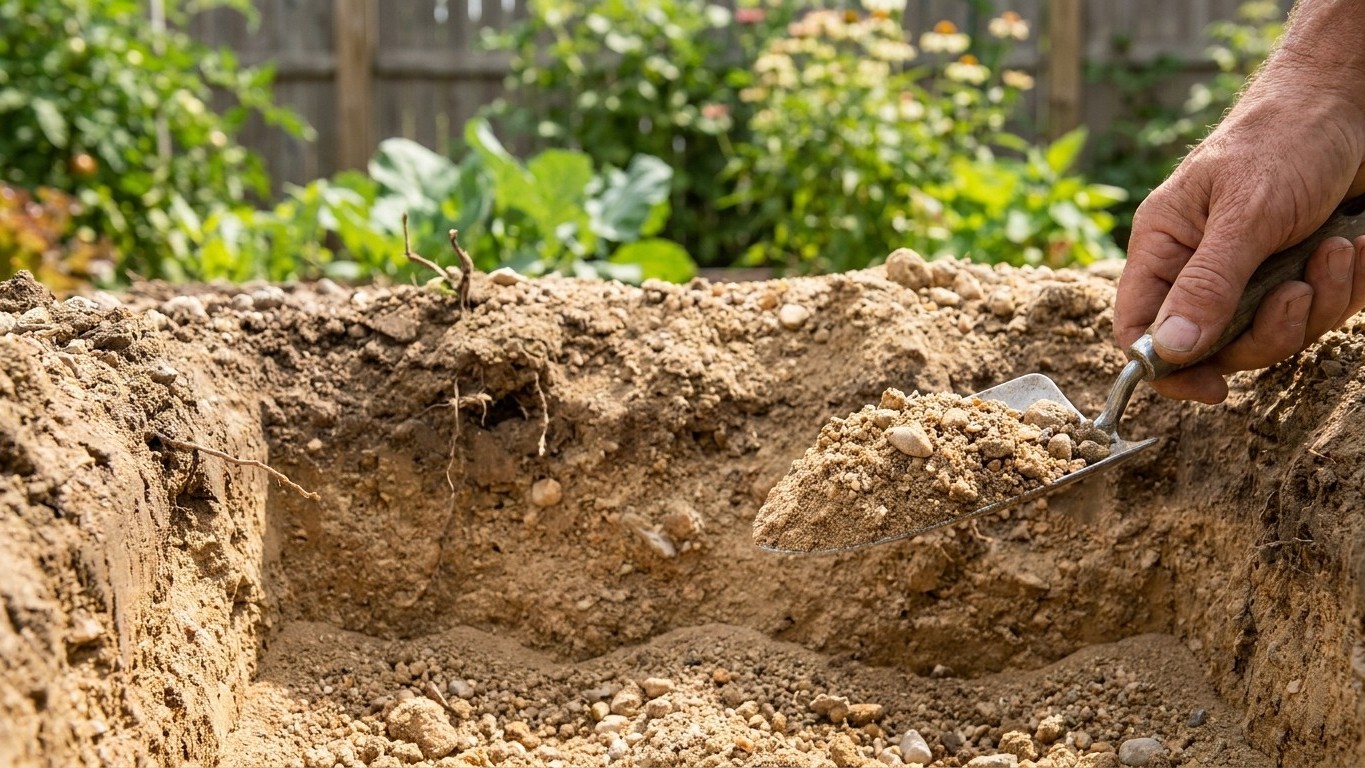

Dig a few inches down almost anywhere in Massachusetts and you’re likely in Paxton territory: a slightly acid, sandy, well-drained soil that drains fast, warms quickly in spring, and needs regular feeding to hold nutrients. Here’s what the numbers actually say, and how to check whether your own yard matches them.
What is under your garden

Massachusetts’ official state soil is the Paxton series, named by state law in 1990 and tracked by the USDA’s State Soils program. Paxton is an Inceptisol, which is soil-science shorthand for “young.” It hasn’t been in place long enough to develop the strongly layered horizons you’d see in older, more weathered soils further south. That youth matters in practice: Paxton soils tend to be loose, workable, and full of rock fragments left behind by glaciers, rather than deeply structured clay banks.
The USDA’s Soil Survey Geographic Database has measured the surface horizon across 265 mapped components of this series, and the representative numbers are specific enough to work with directly.
| Reading | Value |
|---|---|
| Surface pH | about 5.5 (slightly acid) |
| Sand | 61 percent |
| Silt | 32 percent |
| Clay | 7 percent |
| Organic matter | about 5.5 percent |
| Drainage class | well drained |
Those figures describe a soil that’s mostly sand and silt with almost no clay to speak of, mildly acidic, and reasonably rich in organic matter for a sandy soil. But this is the soil that represents Massachusetts as a whole, not the soil under your tomatoes. A state this size holds hundreds of mapped soil series. River-bottom ground behaves nothing like a hillside outcrop, and any lot a builder has scraped, graded, or filled with construction subsoil has left the native profile behind entirely. Treat the Paxton numbers as a starting expectation, not a substitute for looking at your own dirt.
Reading your own soil in five minutes
Two quick checks tell you more than a glance ever will. First, the ribbon test: wet a small handful of soil until it’s moist but not muddy, then squeeze it between thumb and forefinger, pushing it out into a ribbon. Sandy soil won’t hold a ribbon at all; it just crumbles. Loam forms a short, fragile ribbon before breaking. Heavy clay stretches into a long, greasy ribbon that holds its shape.
Second, the jar test: fill a clear jar about a third full of soil, top it off with water, shake it hard, and let it sit overnight. Sand settles to the bottom within minutes, silt layers on top of that over an hour or two, and clay stays suspended longest, often leaving the water cloudy until the next day. The thickness of each layer gives you a rough texture read you can compare against the Paxton numbers above.
Testing before you amend
Guessing at soil amendments is one of the most common ways gardeners waste money. Lime, sulfur, and fertilizer all cost cash, and applying the wrong one, or the right one in the wrong amount, can set a bed back a full season. A soil test tells you three things your eyes never will: the actual pH, the levels of phosphorus and potassium already in the ground, and, often, the percentage of organic matter. None of that is visible from the surface.
Given that Paxton soil runs about pH 5.5, it’s reasonable to expect a Massachusetts yard to test on the acid side. But expecting isn’t knowing. Soils shift with decades of lawn fertilizer, wood ash disposal, old foundation lime, or nothing more than the particular glacial till a house happens to sit on. The only way to know your number is to test it.
A representative sample takes a few minutes and follows the same routine everywhere:
- Pick one planting area at a time; don’t mix soil from the vegetable bed with soil from under a mature oak.
- Push a clean trowel or soil probe 6 to 8 inches deep, roughly where most root activity happens, and pull a core.
- Repeat that in 8 to 10 spots scattered across the bed, avoiding low spots, edges, and anywhere fertilizer was recently piled.
- Mix all the cores together in a clean plastic bucket, breaking up clumps and removing stones, roots, and mulch.
- Pull about a pint of the mixed soil, let it air-dry if it’s wet, and bag it for the lab with the bed’s location and current use noted.
When results come back, the pH number tells you which direction to push; the phosphorus and potassium levels tell you whether you actually need fertilizer or you’re just feeding a surplus that’s already there.
Amending it
Paxton’s numbers point to two clear jobs: nudge a mildly acid, low-clay soil toward neutral for most vegetables and ornamentals, and keep organic matter high enough that a fast-draining, sandy-silty soil doesn’t dry out between waterings.
Lime, for acid ground
At a surface pH around 5.5, most Massachusetts ground sits below the 6.0 to 6.8 range that vegetables, lawns, and most perennials prefer. Lime is the correct lever here, not sulfur; adding sulfur to soil that’s already acidic just makes a bad situation worse. Acid soil locks up phosphorus so plants can’t use it even when it’s present, and it stunts brassicas like broccoli and cabbage, which are especially sensitive to low pH and clubroot disease that thrives in acid ground. Lime works slowly, over a season or two, as it reacts with soil moisture and works down through the root zone. It is not a same-week fix, and reapplying too heavily before the first application has finished working is a common, costly mistake.
Never lime alkaline ground
This doesn’t describe typical Paxton soil, but it matters for anyone gardening on ground that runs above roughly pH 7.3, often near old concrete, foundations, or masonry debris. Lime must never go on soil already that alkaline. The fix there is elemental sulfur and steady additions of organic matter, both of which work gradually to pull pH down. At high pH, iron becomes chemically locked out of reach of plant roots, which is exactly what’s behind the classic symptom of yellow leaves with dark green veins, known as iron chlorosis.
Organic matter, for the sand
With sand at 61 percent and clay at only 7 percent, Paxton soil drains fast and holds onto nutrients poorly. Organic matter, compost, aged manure, shredded leaves, is the fix, and it’s a fast one: a single season of working in 2 to 3 inches of compost noticeably improves water and nutrient retention. Because sandy ground won’t hold moisture long, shift to shorter, more frequent watering rather than deep occasional soaking.
If you’re on heavy clay instead
Not every Massachusetts yard matches Paxton’s low-clay profile. Where clay dominates, organic matter is again the answer, worked in over multiple seasons to open up structure. Never add sand to clay; the combination behaves more like concrete than loam. And never work clay soil while it’s wet, since that compacts it into clods that take a year or more to break down.
Drainage and compaction
Paxton’s official drainage class is well drained, meaning water moves through it readily and standing puddles after rain should be rare on undisturbed ground. That’s a genuine advantage: it means less risk of root rot and fewer weeks lost to soggy spring beds. But “well drained” describes the natural, undisturbed profile, and years of foot traffic, lawnmowers, and parked equipment compact soil regardless of its native drainage class.
A simple percolation test tells you where your actual bed stands. Dig a hole about 12 inches deep and 12 inches across, fill it with water, and let it drain completely once to saturate the surrounding soil. Refill it a second time and time how fast the water level drops. A drop of 1 to 3 inches per hour is typical of well-drained ground; faster than that and water is moving through too quickly to be much use to plant roots; slower than an inch an hour signals compaction or a hidden clay layer, regardless of what the regional soil series suggests.
Compaction from decades of lawn traffic or construction equipment is common enough that double digging, once the standard advice for loosening a bed, has fallen out of favor among extension agronomists; it disturbs soil biology and often doesn’t hold. On badly compacted ground, a raised bed filled with quality topsoil and compost is frequently the more honest answer than three years of patient amendment.
- Do: add compost annually and mulch to protect surface structure from rain compaction.
- Avoid: walking or parking equipment on garden beds, especially when soil is wet.
- Plant elsewhere: anything needing consistent moisture, like blueberries or many perennial flowers, if your percolation test shows fast drainage and you can’t irrigate regularly.
Local help
The UMass Extension runs the state’s soil testing lab and reads results alongside gardeners rather than just mailing back a printout. County offices can walk you through what your specific numbers mean for the crops or lawn you’re planning, which matters more than any statewide average once you’ve got your own test in hand.
Common questions
Is all Massachusetts soil the same as the Paxton series?
No. Paxton is the officially designated state soil and a common series across the state, but Massachusetts contains hundreds of mapped soil types, including sandy Cape Cod soils, river-bottom silt, and heavily disturbed urban fill that share little with Paxton’s profile.
Does a pH of 5.5 mean I need to lime my garden?
It means acid soil is common in the region, but only a soil test on your own bed confirms your actual number. Some plants, like blueberries and rhododendrons, actually prefer soil in that acid range and need no correction at all.
How often should I retest my soil?
Every 2 to 3 years for an established garden bed, or yearly for a bed you’re actively amending, since pH and nutrient levels shift as lime, compost, and fertilizer work through the soil.
Why does my soil hold water even though it’s supposed to be well drained?
Well drained describes the undisturbed natural profile. Foot traffic, construction equipment, or a hidden layer of compacted subsoil beneath a thin topsoil layer can override that natural drainage entirely, which is exactly what a percolation test will reveal.