
Flowers built for both ends of Missouri’s climate do best here: a real winter freeze and a long run of summer heat. The USDA Plant Hardiness Zone Map’s 2023 update puts the state between zones 5b and 7b, and Kansas City averages 32.7 days a year at 90F or hotter according to NOAA’s 1991-2020 climate normals, so a plant has to shrug off both ends of that range. Before buying anything borderline hardy, look up your own zip code on the USDA map rather than trusting the statewide range, since the north and the south of the state are genuinely different gardens.
What thrives in Missouri

Thirty-three days a year above 90F, measured right at the Kansas City reference station, is the number that actually decides which flowers make it through a Missouri summer. That heat, stacked on top of humidity thick enough to bring on powdery mildew and black spot by July, does more damage to a border than any winter cold ever does. A plant bred for a cooler, drier climate can sail through January here and still collapse by August.
Heat and humidity matter as much as cold
Summer is the other filter. With close to 33 days a year above 90F at the Kansas City reference station, foliage diseases like powdery mildew and black spot show up fast on anything bred for a cooler, drier climate. Heat and humidity tolerance together, not just cold hardiness, is what separates a flower that survives Missouri from one that merely survives the winter and then fails in July. Compare this to Nebraska just to the north, where colder winters set the limit more than summer humidity does, as covered in our guide to flowers that actually thrive in Nebraska, or to Arkansas to the south, where longer, more humid summers push the balance the other way, in our Arkansas flower guide.
The families that carry these traits
Two plant families do most of the heavy lifting in Missouri borders. The daisy family, Asteraceae, gives coneflowers, black-eyed Susans, asters, and yarrow, all of which tolerate heat, poor soil, and drought once established. The mint family, Lamiaceae, gives salvias, catmint, and bee balm, most of which handle humidity better than showier alternatives from cooler, drier climates. Sedums and other succulent-leaved perennials round this out, storing water in their leaves through the driest stretch of summer. None of these need coddling once they’re through their first season.
Native plants worth the space
A native plant that’s had thousands of years to adapt to this region’s freeze-thaw cycles and humid summers arrives pre-tested. Once established, usually after one full growing season, it needs less supplemental water, less fertilizer, and less pest management than an imported ornamental bred for a different climate. That’s not a marketing claim, it’s a function of root systems built for local rainfall patterns and soil that hasn’t been amended into something artificial.
What natives bring to a border
Plants native to the wider tallgrass prairie and eastern woodland region of the central United States also carry the pollinators that evolved alongside them. A monoculture lawn or a bed of imported hybrids offers almost nothing to native bees, butterflies, and the moths that feed songbirds their caterpillars, while a bed built around regional natives becomes actual habitat. Milkweed species in particular matter here since monarch butterflies need them specifically to lay eggs, not just any nectar source.
A short list of natives from the wider region that do well in the average Missouri border:
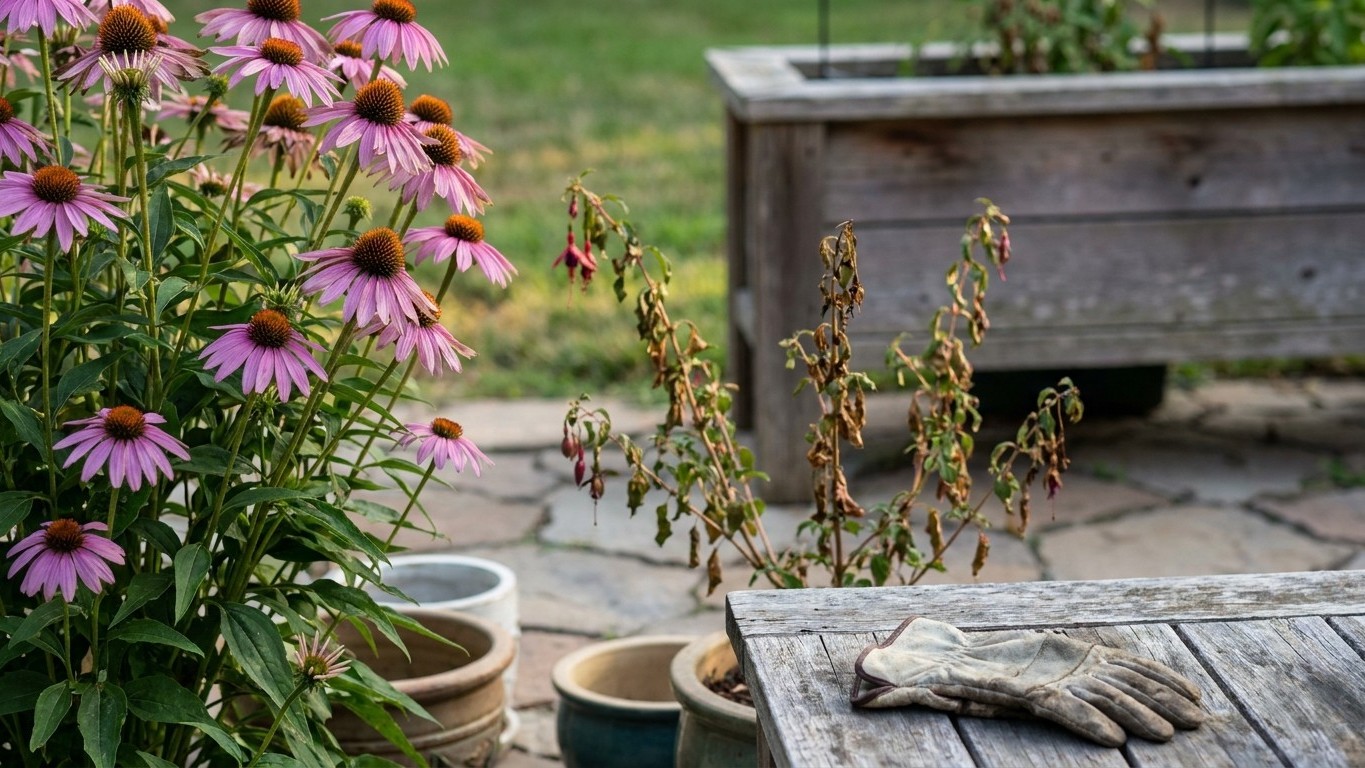
- Purple coneflower (Echinacea purpurea): pink-purple daisy flower with a spiky orange-brown cone center
- Black-eyed Susan (Rudbeckia hirta): golden-yellow petals around a dark brown center disc
- Butterfly milkweed (Asclepias tuberosa): clusters of small bright orange flowers
- Blazing star (Liatris spicata): tall purple-pink flower spikes that bloom from the top down
- Wild bergamot (Monarda fistulosa): shaggy lavender-pink flower heads on square mint-family stems
These aren’t rare or difficult to source. Most independent nurseries in the region carry all five, and they cross-pollinate well with each other, which is part of why a native bed tends to fill in and thicken over a few seasons without much replanting.
Perennials that come back

At USDA zones 5b through 7b, a perennial’s reliability depends entirely on where in that range your garden sits. Peonies, hostas, daylilies, coneflowers, and most ornamental grasses return without fail across the whole state. Further down the hardiness scale, things get more particular.
Reading a plant tag against your own zone
Plant tags list a hardiness range, and the number that matters is the coldest zone listed, not the warmest. If a tag says “hardy zones 7-10” and your garden sits in zone 6a on the northern edge of the state’s range, that plant is likely to die back over winter most years, since NOAA’s 1991-2020 normals put the average coldest-month minimum at Kansas City at 19.5F, colder than a true zone 7 plant is bred to tolerate reliably. Lantana and tropical hibiscus fall into this category across most of Missouri. Gardeners here grow them as annuals, replacing them every spring, even though they behave as woody perennials in zone 8 and warmer, further south than the state’s range goes.
Timing planting and division
NOAA’s 1991-2020 climate normals put the last spring freeze at the Kansas City area between April 6 and April 20, and the first fall freeze between October 18 and October 29, though the downtown station runs about five days earlier in spring and southern Missouri stays frost-free noticeably longer. That window is what you’re working with when you divide perennials or move them in spring, and it’s worth writing on a calendar rather than guessing, since planting a tender division too early into that range risks losing it to a late frost.
Putting a border together
A border that looks good from June through October, rather than for two intense weeks in May, is built in layers and staggered by bloom time, not planted all at once from a single flat of whatever’s blooming at the garden center that weekend.
Height and layout
Put the tallest plants, ornamental grasses, tall coneflowers, and Joe Pye weed, at the back of a bed viewed from one side, or in the center of an island bed viewed from all sides. Mid-height plants like salvia and black-eyed Susan fill the middle layer. Low, spreading plants like sedum and catmint edge the front and spill over hardscape. Leave real space between young plants at installation, even though it looks sparse the first season, since most perennials in this climate double or triple their spread within two years and a border planted tight now becomes a tangle by year three.
Sequencing bloom and repeating color
Missouri’s growing season runs from that April frost window through the one in October, several months longer than the showiest individual flower stays in bloom, so a border needs at least three overlapping waves: something for late spring, something that carries the peak heat of July and August when the 90-degree days pile up, and something that holds color into fall. Repeat the same two or three colors at intervals along the bed rather than scattering one of everything, which is what makes a border read as designed instead of accidental from a distance.
- Spring: peonies, catmint, early daylilies
- Summer: coneflower, black-eyed Susan, bee balm, garden phlox
- Fall: asters, sedum, ornamental grasses going to seed
Local help
The University of Missouri Extension runs the state’s Master Gardener program, with volunteers trained through the university who answer plant identification and site-specific questions county by county, often for free at local plant clinics and county fairs. Their extension service also publishes regional plant lists that account for the north-south split in this state’s hardiness zones better than any general guide can. For more on gardening tasks specific to this state, our Missouri guides cover soil, vegetables, and lawn care alongside flowers.
Common questions
What zone is Missouri for planting?
Missouri spans USDA zones 5b to 7b according to the USDA Plant Hardiness Zone Map’s 2023 update, with the colder zones in the north of the state and the warmer zones in the south. Check your specific county rather than assuming, since a plant hardy in Springfield can fail in the far northern counties.
Can I grow lavender in Missouri?
Lavender struggles more with humidity than cold here. It tolerates the winter minimums fine in most of the state but tends to rot at the roots during humid summers unless it’s planted in raised, fast-draining soil with good air circulation around the base.
Why did my perennial come back smaller or not at all?
Check the hardiness rating on the original tag against your specific zone, since a plant rated for a zone warmer than yours may survive one mild winter and die the next. Poor drainage over winter also kills more borderline perennials in Missouri’s clay soils than cold alone does.
When should I divide overgrown perennials?
Early spring, before new growth gets tall, or in early fall well ahead of the first freeze, gives divisions time to root before either winter cold or summer heat stresses them. Avoid dividing right in the middle of that spring frost window, since a tender, newly cut division is more vulnerable to a late freeze than an established clump.
Related guides
- Flowers That Actually Thrive in Iowa, and the Ones That Struggle
- Flowers That Actually Thrive in Illinois, and the Ones That Struggle
- Flowers That Actually Thrive in Nebraska, and the Ones That Struggle